
Spunbond and meltblown are both made directly from molten thermoplastic polymer, but they turn it into very different fibers. Spunbond lays down continuous filaments, typically 15–35 µm across, and bonds them into a strong, abrasion-resistant sheet. Meltblown attenuates the polymer with hot, high-velocity air into microfibers of roughly 0.5–5 µm, forming a dense but weak web built for filtration, fluid barrier, and oil pickup. SMS (spunbond-meltblown-spunbond) stacks the two so one fabric carries both jobs.
This guide compares spunbond vs meltblown side by side, shows where each one works in finished products such as masks, drapes, wipers, and filter media, and explains how buyers specify them. If you are new to the material itself, start with what nonwoven fabric is.
What Is the Difference Between Spunbond and Meltblown?
Both processes belong to the spunmelt family: nonwovens formed directly from thermoplastic polymer. EDANA describes the group as covering spunlaid and meltblown webs, which are often combined on the same line. The difference lies in how the fibers are made fine and how the web holds together.
| Property | Spunbond | Meltblown |
|---|---|---|
| Fiber form | Continuous filaments | Microfibers |
| Typical fiber diameter | 15–35 µm | 0.5–5 µm |
| How the fibers are formed | Filaments are extruded, quenched, and drawn | Polymer is attenuated by hot air while still partly molten |
| Bonding | Usually heated calender rolls, leaving a visible bond pattern | Fibers self-bond as they land on the collector |
| Web structure | Open | Dense, with fine pores and a large surface area |
| Strength and abrasion | High | Low at filter weights |
| What it does best | Structure, coverage, liquid filter media | Filtration layer, fluid barrier, oil and solvent pickup |
| Used alone? | Often | Usually supported, except wiper-weight sheets |
| Graminton examples | LF025, LF035, and LF050 filter paper; treatment-room covers | Melt-blown middle layer of GhealthCare masks; L7207 and L8138 wipers |
Fiber diameters are typical industry ranges, not Graminton product specifications.
In short, meltblown vs spunbond is a trade between fineness and strength: the finer the fiber, the better the web filters and holds oil, and the weaker the sheet. For a wider overview that also covers spunlace, see our comparison of spunlace, spunbond and meltblown.
How Is Spunbond Nonwoven Made, and Where Does It Work Best?
Spunbond is made in four steps:
- Molten polymer is extruded through a spinneret into many continuous filaments.
- The filaments are quenched with air and drawn, which orients the polymer and builds strength.
- The drawn filaments are laid on a moving belt as a web.
- The web is bonded, usually with heated calender rolls that leave the dot or diamond bond pattern visible on most spunbond sheets.
EDANA’s terminology calls thermally bonded spunlaid webs “spunbonded”, which is where the everyday name comes from.
Because the filaments are continuous, spunbond has good tensile and tear strength and holds its shape while staying breathable. On its own, it does limited fine filtration, which is the job meltblown takes on.
Two Graminton product lines show where spunbond works best. The LICK LF025 oil filter paper, with LF035 and LF050, is polyester spunbond used to filter solid particles, such as metal shavings, from liquids or gases in metal and non-metal working processes. The three grades differ in thickness, wet strength, and filtration efficiency, withstand temperatures up to about 80 °C, and are listed with excellent strength when wet, which is the continuous-filament advantage at work.
Treatment-room covers are the second example. The NK7301 crosscut bed sheet roll (80 × 180 cm, 50 sheets per roll), the NK7304 pillow towel roll, the NK7305 foot pad roll, and the NK8301 face rest cover are all polyester spunbond, used as a sanitary barrier on beds, pillows, foot rests, and face rests.
What Is Meltblown Fabric, and Why Is It Used for Filtering and Wiping?
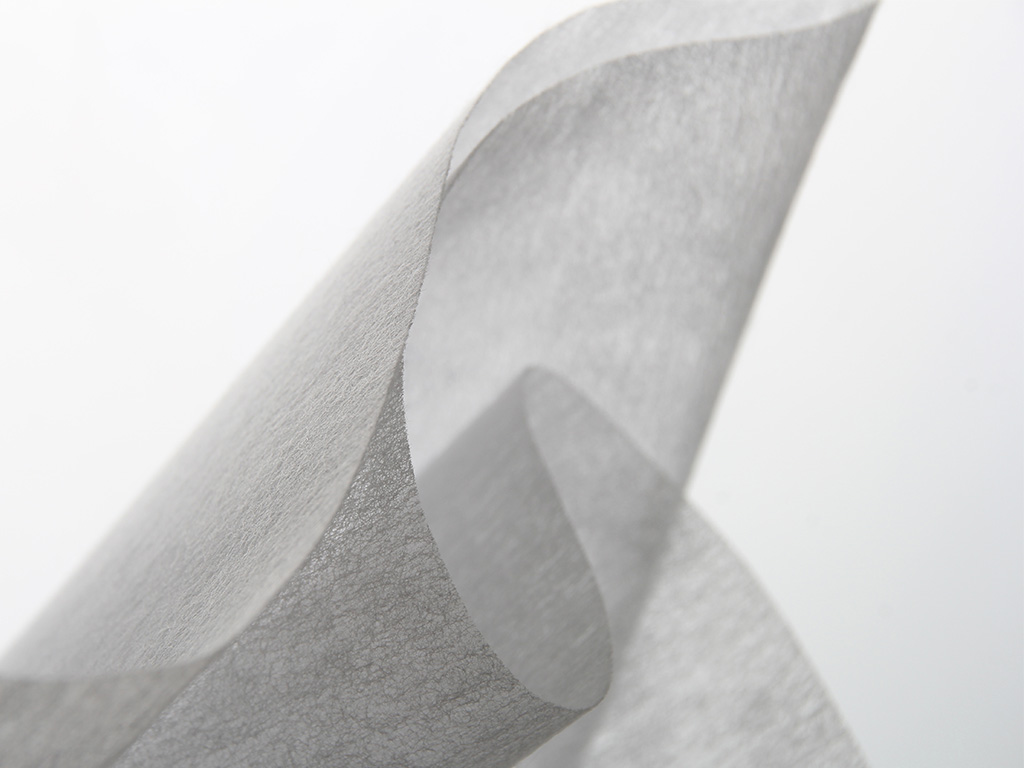
Meltblown fabric is a nonwoven made by extruding molten polymer through a row of fine die holes into converging jets of hot, high-velocity air. The air stretches the polymer into microfibers, which land on a collector as a dense web that bonds to itself.
That fineness explains both main uses. For filtration, fine fibers leave small pores and a large fiber surface, so particles that meet the fibers are caught while air still passes through. For wiping, the narrow spaces between microfibers draw in oil films and ink by capillary action. The weakness is strength: at filter weights, a meltblown web tears and abrades easily, so it is usually carried by spunbond or another layer. Heavier, wiper-weight meltblown sheets can be used on their own.
GhealthCare medical masks show the filtration role. In the Adults Classic, Coral Embossed, Kids, Cooling, and 3D masks, a melt-blown nonwoven is the middle layer, and the product pages attribute the bacterial filtration to it. All five are verified to CNS 14774, Taiwan’s national standard for medical face masks, with a bacterial filtration efficiency (BFE) of at least 95%. The mask as a whole is covered in what medical masks are made of.
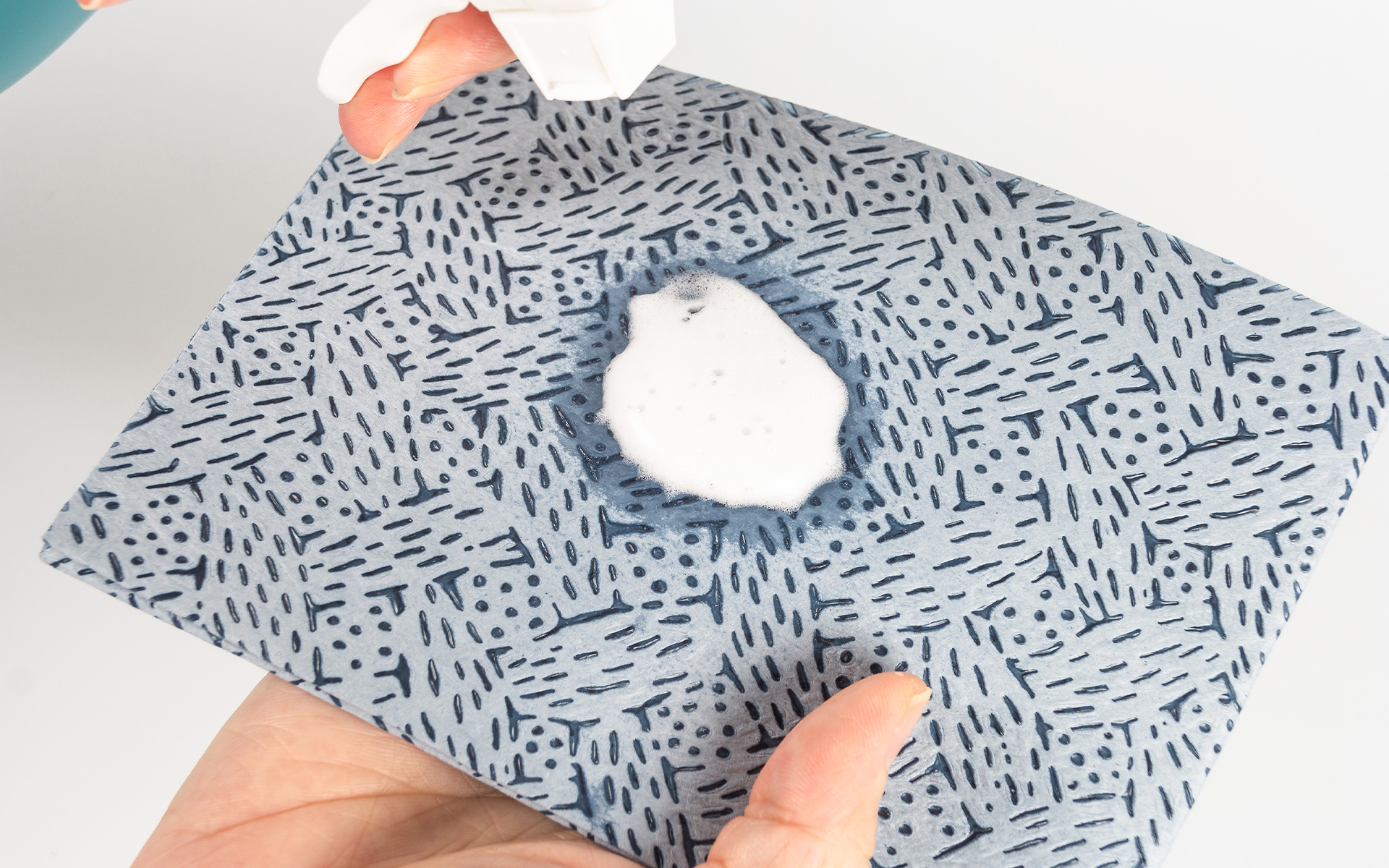
The LICK L7207 power cleaning cloths (32 × 25 cm, 640 sheets per perforated roll, 2 rolls per carton) and the L8138 quarterfold version (30 × 23 cm, 30 sheets per pack, 24 packs per carton) show the wiping role. Both are polyester meltblown, low lint, and acid- and base-resistant, so they can be used with solvents and alcohol. They are used on machines and parts, in engine assembly and repair, in LCD panel assembly, and for printing and glass cleaning, where they pick up printing ink and machine oil.
Why Does SMS Put Meltblown Between Two Spunbond Layers?
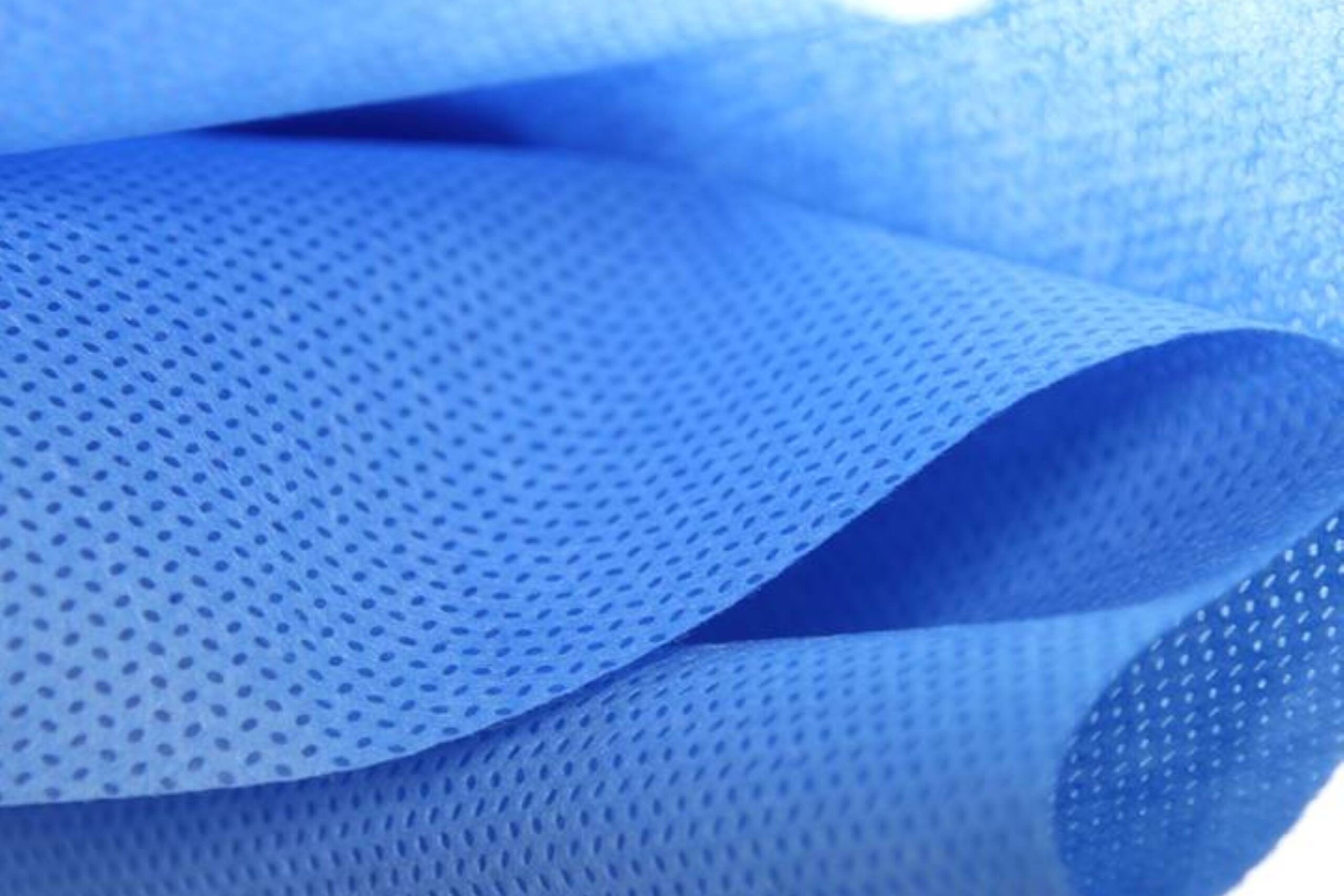
SMS stands for spunbond-meltblown-spunbond, and each layer has a job. The two outer spunbond layers supply strength, abrasion resistance, and easy handling. The meltblown core supplies the fluid and particle barrier while keeping the fabric breathable. The layers are usually formed one after another on the same line and bonded together with heated calender rolls, although separately made webs can also be laminated.
Variants add meltblown layers: SMMS has two, and SMMMS has three. More meltblown raises the barrier level, and the weight and breathability of the fabric change with it, so the construction is chosen for the use rather than simply maximized.
The GhealthCare SMS Drape is listed in SMS, SMMS, and SMMMS constructions, in blue or white, at widths from 100 to 320 cm, and both the construction and the width can be made to your specification. Its product page describes a durable barrier fabric that withstands high-temperature sterilization processes, used to control and contain fluid, as fenestrated material, or as a sterilization wrap. It is supplied non-sterile, so sterilization and end use follow each facility’s own protocols, and it has SGS test results for formaldehyde, heavy metals, E. coli, and migrating fluorescent agents. For how drape types are used in procedures, see how SMS, aperture and towel drapes differ.
Which Construction Does Your Finished Product Need?
The right construction follows from what the finished product has to do.
| Finished product | Usual construction | Why it fits | Graminton example |
|---|---|---|---|
| Medical face masks | Meltblown filter layer between other nonwoven layers | Fine fibers filter, while the outer and inner layers protect the filter and sit against the face | GhealthCare masks with a melt-blown middle layer, CNS 14774, BFE ≥95% |
| Surgical drapes and sterilization wraps | SMS, SMMS, or SMMMS | Spunbond outer layers for strength, a meltblown core for barrier | SMS Drape, 100–320 cm wide |
| Oil and solvent wiping | Wiper-weight meltblown | Microfibers hold oil and ink and tolerate solvents | L7207 and L8138, polyester meltblown |
| Coolant and cutting-fluid filtration | Spunbond filter media | Continuous filaments keep their strength when wet and catch metal shavings | LF025, LF035, and LF050, polyester spunbond |
| Treatment-room covers | Light spunbond | Breathable and tough at a low cost per sheet | NK7301, NK7304, NK7305, NK8301 |
| Soft skin-contact wipes | Usually spunlace or airlaid rather than these two | A softer hand and higher absorbency | — |
Graminton’s work is the integrated application of nonwovens: matching spunbond, meltblown, SMS, and other constructions to each finished product, and documenting them product by product. The medical side is collected under GhealthCare medical masks and drapes, and the wiping side in our guide to choosing industrial cleaning wipes.
How Do Buyers Specify Spunbond, Meltblown, and SMS Fabrics?
A spec sheet for these fabrics usually covers the same lines, whichever finished product they go into.
| Spec line | How it is stated | Test reference | Why it matters |
|---|---|---|---|
| Polymer | PP, polyester, or another polymer | Polymer declaration on the spec | Heat tolerance, solvent resistance, cost |
| Construction | S, M, SMS, SMMS, or SMMMS, with layer order | Spec sheet | Strength vs barrier vs breathability |
| Basis weight | g/m² with tolerance | ISO 9073-1 or ASTM D3776 | Cost, body, barrier |
| Tensile strength | MD and CD, dry, and wet where it matters | ISO 9073-3 | Handling, tearing, filter media in liquid |
| Fluid barrier | Hydrostatic head | ISO 9073-16 | Drapes, wraps, and gowns |
| Breathability | Air permeability | ISO 9073-15 | Comfort and filter flow |
| Filtration | Measured on the finished product to its product standard | For example, BFE for medical masks | Our masks: CNS 14774, BFE ≥95% |
| Restricted substances | Formaldehyde, heavy metals, migrating fluorescent agents, microbial tests | Third-party lab reports | Skin- and product-contact documentation |
Numbers only compare when they come from the same test method, so a basis weight or tensile figure is best read together with its method. Our guide to basis weight (GSM) explains the most common spec line in detail.
Documents that typically support these lines include the spec sheet and third-party test reports. On Graminton’s side, the product pages for the SMS Drape and the L7207 and L8138 wipers list SGS tests for formaldehyde, heavy metals, E. coli, and migrating fluorescent agents, and the report for a specific SKU is available on request. The mask product pages list CNS 14774 verification with a BFE of at least 95%.
FAQ
Is meltblown fabric waterproof?
Not in the way a plastic film is. A hydrophobic polymer with very fine pores holds back liquid at low pressure while still letting air through, and how much it resists depends on basis weight and layering. Hydrostatic head, tested to ISO 9073-16, is the usual measure. A single spunbond layer holds back less, which is why SMS-type fabrics are used where a product has to breathe and still block fluid.
Can meltblown fabric be used on its own?
At filter weights it rarely is, because the web is weak and abrades easily, so it is carried by spunbond or another layer. Heavier, wiper-weight meltblown can be used alone: the L7207 and L8138 cloths are polyester meltblown sheets that work with solvents and alcohol.
What is the difference between SMS and SMMS?
SMMS adds a second meltblown layer, and SMMMS adds a third. The SMS Drape product page puts it simply: the more meltblown layers, the higher the protection level. The trade-off is weight and breathability, which is why the drape is listed in SMS, SMMS, and SMMMS constructions.
Are spunbond and meltblown always made of polypropylene?
No. Polypropylene is the most common polymer, but polyester can be made by both processes. The L7207 and L8138 wipers are polyester meltblown, and the LF filter papers and the NK treatment-room covers are polyester spunbond. The polymer affects heat tolerance, solvent resistance, and cost, which is why it belongs on the spec sheet; the LF filter papers, for example, withstand temperatures up to about 80 °C.
What is spunmelt nonwoven?
Spunmelt is the umbrella term for nonwovens formed directly from thermoplastic polymer, covering spunlaid and meltblown webs, which are often combined on one line. SMS is the most common spunmelt composite, and a thermally bonded spunlaid web is what the industry calls spunbond.
Comparing spunbond, meltblown, or SMS for a mask, drape, wiper, or filter line? Tell us the finished product, the construction or basis weight you have in mind, and your monthly volume, and we’ll reply with matching Graminton products, samples, and the test documentation listed for each SKU.