
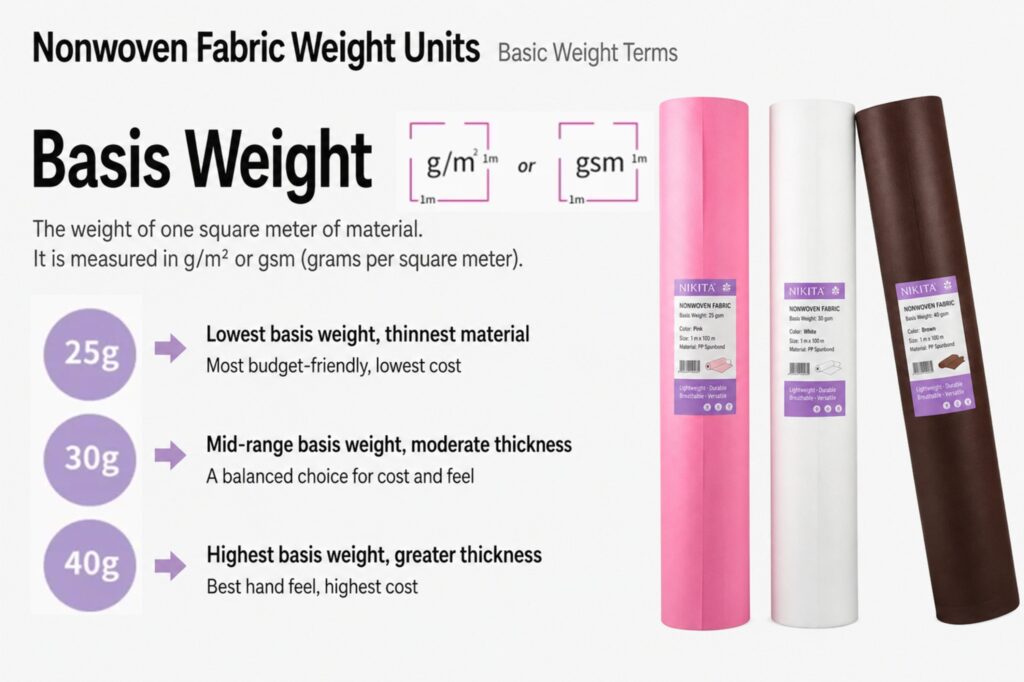
Basis weight is the mass of a fabric per unit area, and for nonwovens it is almost always quoted in grams per square meter — written as g/m² or simply GSM (also called grammage). It is the single most quoted number in any nonwoven specification because it drives three things at once: material cost, strength, and feel. Buyers usually compress the whole question into “what nonwoven fabric gsm do I need?” — and that is exactly what this guide answers. A 40 gsm fabric contains twice the fiber of a 20 gsm fabric of the same type — and roughly twice the raw material cost. This guide explains how basis weight is measured, what ranges are typical for common products, and how to choose a weight instead of guessing. If you are new to the material itself, start with our overview of what nonwoven fabric is.
Why Does Basis Weight Matter So Much?
Nonwovens are bought and sold by weight, so GSM is where performance meets price:
- Cost: fiber is the dominant cost of a nonwoven roll. Higher gsm = more fiber = higher price per square meter, almost linearly.
- Strength and durability: more fiber per area generally means higher tensile and tear strength within the same fabric type.
- Opacity and coverage: heavier fabrics look more solid and feel more substantial — relevant for drapes, gowns, and table covers.
- Absorbency: for absorbent fabrics such as spunlace, more mass usually holds more liquid.
- Softness and drape: the trade-off — heavier fabrics get stiffer, less breathable, and less conformable.
Because one number moves all of these at once, basis weight is the first spec a buyer and a factory negotiate. It is also the first place quality corners get cut: a roll delivered at 17 gsm instead of the quoted 20 gsm is 15% less material.
How Is Basis Weight Measured?
A widely used reference method is ASTM D3776 (Standard Test Methods for Mass Per Unit Area of Fabric); ISO 9073-1 is the nonwoven-specific counterpart. In practice:
1. Cut specimens of known area from different positions across the roll, in the size and number your chosen method specifies.
2. Weigh them on an analytical balance.
3. Divide mass by area and report in g/m² (or oz/yd² in US specs).
Two practical notes for buyers. First, always sample across the web width — nonwoven lines can run heavier at the center than the edges, so a single-point measurement can mislead. Second, agree on a tolerance in the purchase spec — basis weight varies across a roll and between lots — and have your incoming QC check against it. Converting US specs is simple: 1 oz/yd² ≈ 33.9 gsm, so a “1.2 osy” spunbond is about 41 gsm.
What Are Typical GSM Ranges by Application?
Industry practice clusters into recognizable bands. Use this table as a starting point, then fine-tune with samples:
| Application | Typical range | Why that weight |
|---|---|---|
| Medical mask layers | 20–30 gsm per layer | Breathability first; filtration comes mainly from the melt-blown layer’s fine fibers and electrostatic charge, not weight alone |
| Isolation gowns, bed sheets, drapes | 25–60 gsm | Coverage and fluid holdout scale with weight and risk level |
| Sheet mask substrates | 28–70 gsm | Light = invisible, second-skin fit; heavy = holds more essence |
| Wet wipes, cleaning wipes (spunlace) | 35–70 gsm | Absorbency and scrub durability |
| Shopping bags, furniture substrates (spunbond) | 70–120 gsm | Load-bearing strength |
Real products make the logic concrete. A three-layer medical face mask keeps each layer light so the stack stays breathable. A disposable bed sheet for spa and therapy beds is offered in 25, 30, and 40 gsm — same fabric, three price-durability tiers, chosen by how demanding the treatment is. And in sheet masks, Graminton’s range runs from a 28 gsm lyocell sheet mask engineered for a barely-there fit up to a 70 gsm lifting sheet mask built to carry more essence and hold tension on the skin.
How Do You Choose the Right Basis Weight?
Work through four questions, in order:
1. What must the fabric survive? Single-pass wiping, an hour on a massage table, or a loaded bag? Set the minimum weight that won’t fail in use — then resist the urge to over-spec far beyond it.
2. What must it feel like? Skin-contact products reward lightness and drape; structural products reward body. If softness matters more than strength, consider changing fabric type before adding weight.
3. What does the process contribute? Weight is only half the story — fiber type and bonding process set what a given gsm can do. A 40 gsm spunbond and a 40 gsm spunlace are completely different materials: one is a strong structural sheet, the other a soft absorbent cloth. Weight comparisons only make sense within the same fabric type.
4. What does the budget close at? Because cost tracks gsm nearly linearly, trimming 5 gsm off a high-volume disposable is a real saving — if performance still passes. This is where sampling two adjacent weights (say 25 vs 30 gsm) and testing in your actual use case pays off.
For demanding environments the calculus shifts from weight to function: cleanroom wipers, for example, are specified primarily by linting and solvent resistance rather than gsm alone — see our cleanroom wiper selection guide for that logic. When the standard bands don’t fit your product, a materials team can engineer the weight-process combination to the target: that is the day-to-day work of Graminton’s nonwoven material research center.
FAQ
Is a higher GSM nonwoven always better?
No. Above the weight your application actually needs, extra gsm buys stiffness, lower breathability, and higher cost — not quality. “Better” is the lightest fabric that reliably passes your use test.
Is basis weight the same as thickness?
No. Basis weight is mass per area; thickness (caliper) is height under a defined pressure. Two 40 gsm fabrics can differ widely in thickness depending on how densely they are bonded — a calendered fabric is thin and dense, a bulky airlaid is thick and lofty. Specify both if your application is sensitive to either.
How do I convert oz/yd² to gsm?
Multiply by 33.9. So 1.0 osy ≈ 34 gsm, 1.5 osy ≈ 51 gsm, 3.0 osy ≈ 102 gsm. Divide gsm by 33.9 to go the other way.
Why do two fabrics with the same GSM feel so different?
Because fiber diameter, fiber material, and bonding process determine hand-feel at any given weight. Fine fibers and water-jet bonding (spunlace) feel soft; coarse filaments and thermal calendering (spunbond) feel papery. Match the process to the job first, then tune the weight.
What GSM are nonwoven bags usually made of?
Reusable nonwoven shopping and promotional bags are commonly made from polypropylene spunbond in the 70, 80, or 90 gsm range: 70 gsm for light promotional totes, 80 gsm as the general-purpose standard, and 90 gsm or more for grocery bags that carry heavier loads or get laminated with a printed film. Bag makers choose the weight by load, print quality, and how many uses the bag should survive. Bags are outside the scope of this guide, which focuses on basis weight for wipes, hygiene, and medical products, where the relevant bands are much lighter (20–70 gsm). For the difference between the spunbond used in bags and the spunlace used in wipes, see our comparison of nonwoven fabric types.
Not sure which basis weight your product needs? Send us your application and target cost — our nonwoven R&D team will recommend a weight-process combination and prepare samples.