
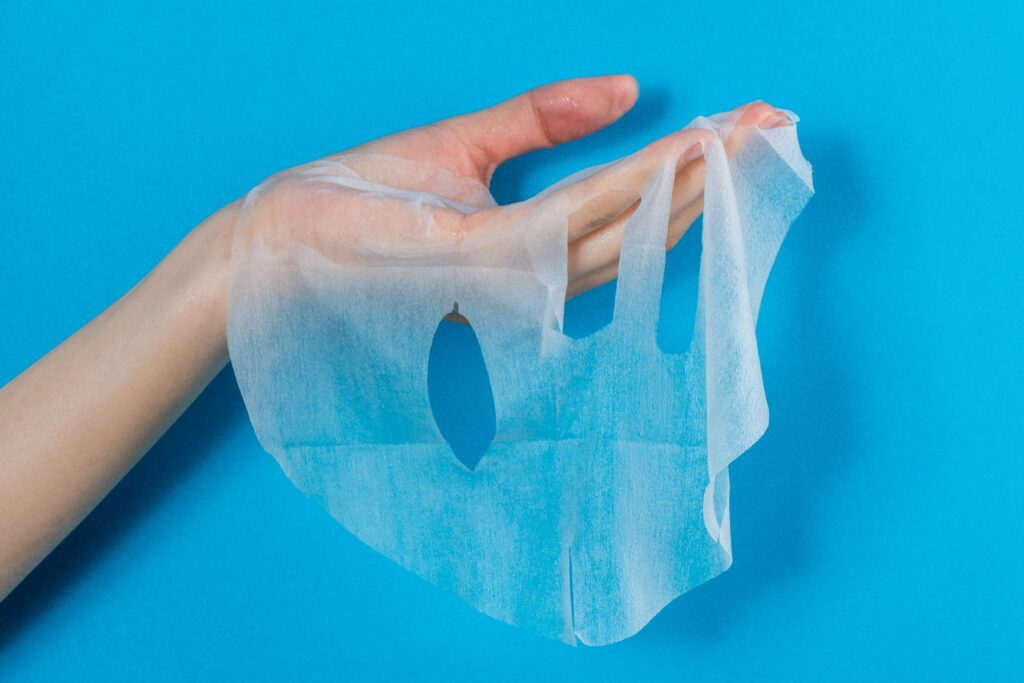
The material of a sheet mask — the substrate, or “mask sheet” — is the delivery system for everything else in the product. It decides how much essence the mask carries, how closely it fits facial contours, how it feels for fifteen minutes, and a surprising share of the unit cost. Brands typically brief the formula in detail and leave the fabric to chance; in practice, substrate choice is a positioning decision. This guide compares the major sheet mask materials — cotton, rayon, lyocell, bamboo charcoal, nanofiber, and the non-woven outliers bio-cellulose and hydrogel — from the perspective of someone deciding what their product should be made of.
What Are Sheet Masks Actually Made Of?
Most sheet masks are cut from spunlace nonwoven fabric — fibers entangled by high-pressure water jets rather than woven or knitted (the process family is explained in our nonwoven fabric types guide). What changes between masks is the fiber going into that fabric:
- Natural fibers — cotton; soft, absorbent, and the anchor of "natural" positioning.
- Regenerated cellulose — rayon (viscose), lyocell, and cupro; plant-derived fibers re-spun for performance, from everyday softness to near-invisible fit.
- Functional blends — bamboo charcoal and other additive fibers that bring visual and marketing differentiation.
- Engineered formats — nanofiber webs with ultra-fine strands for second-skin adhesion.
Two categories sold alongside these are not nonwoven fabrics at all — bio-cellulose (a fermented cellulose gel-sheet) and hydrogel (a molded gel) — and they behave differently enough to deserve their own comparison rows.
How Do the Materials Compare?
| Material | Feel & fit | Strengths | Watch-outs | Positioning fit |
|---|---|---|---|---|
| 100% cotton | Soft, cushioned, opaque | Natural story, high absorbency, gentle on reactive skin | Looser drape than regenerated fibers | Clean-beauty, sensitive-skin, mass-to-mid lines |
| Rayon (viscose) | Classic smooth mask feel | Reliable essence load, versatile, cost-efficient | Little differentiation story | Everyday and value-tier lines |
| Cotton + wood pulp | Plush, moisture-banking | Pulp locks essence, cotton touches skin | Thicker profile reads “treatment”, not “invisible” | Rich-treatment and firming formats |
| Lyocell (often known by the trade name Tencel™) | Light, translucent, close-fitting | Biodegradable wood-based fiber, high wet strength at low weight — e.g. the 28 gsm lyocell fibers sheet mask | Translucency exposes application errors | Eco-positioning, premium “invisible mask” |
| Bamboo charcoal | Grey-black, matte | Instant visual differentiation, purifying narrative | Color limits some brand aesthetics | Oil-control, men’s, detox-themed lines |
| Nanofiber | Second-skin cling | Ultra-fine 2 μm fibers for maximum adhesion — see the nanofiber sheet mask | Sits at the top of the substrate cost range | Flagship and derma-adjacent positioning |
| Cupro | Silky, high-drape | Fine regenerated fiber with elegant fit | Fewer supply sources than rayon/lyocell | Premium K-beauty-style lines |
| Bio-cellulose | Cool gel-sheet, skin-tight | Exceptional adhesion; slow essence evaporation | A fermented sheet, not a convertible fabric — different supply chain and cost class | Prestige single-mask heroes |
| Hydrogel | Cool, dissolving-gel feel | High active-carrying gel matrix; spa associations | Fragile, tears easily; not a fabric — a formed gel sheet | Premium spa-experience positioning |
The first seven are fabric substrates that run through nonwoven converting; the last two are format cousins competing for the same shelf. A brand can — and large ones do — tier a range across them: rayon or cotton for the core line, lyocell or nanofiber for the premium tier.
How Does Material Choice Change the Finished Product?
Three mechanics connect the fabric decision to what consumers experience:
1. Fit follows fiber fineness. Finer fibers drape closer to facial contours; that is why lyocell reads “invisible” and nanofiber reads “second skin”, while thick cotton reads “treatment mask”. Fit also gates essence transfer — a lifted edge is essence not reaching skin.
2. Essence capacity follows weight. Substrates run roughly 28–70 gsm, and heavier cloth carries more formula — the same basis-weight logic covered in our GSM guide. A watery essence pairs with light, tight cloth; a rich serum needs weight to hold it.
3. Cost follows both. Substrate is a meaningful slice of unit cost, and it scales with fiber grade and weight. The fabric that supports a US$1 mask and the one that supports a US$5 mask are different engineering answers — matching tier to material is the core selection rule.
Because Graminton makes the nonwoven fabric and converts the finished mask in the same sheet mask production program — with retail proof in its own Gbuuty line — fabric and formula can be engineered as a pair rather than bought separately and hoped compatible.
What About Compressed Face Masks?
A compressed face mask is a dry substrate pressed into a coin or tablet: the user (or spa) soaks it in toner or serum, and it expands into a wearable mask. For brands, it is less a rival to finished masks than a different business: the substrate is the entire product, there is no essence to formulate or preserve, units are featherweight to ship, and the format sells through travel, spa, and beauty-tool channels. The fabric selection logic above still applies — absorbency and expansion behavior decide whether the soaked sheet performs — which makes compressed formats a low-complexity entry point into the mask category for accessory and lifestyle brands. The same dry-cloth logic drives disposable face towels — often the next SKU these channels add.
The same substrate thinking also extends to partial masks — eye patches, neck and décolleté sheets, and zone-targeted panels, covered under our facial & partial masks solutions and explained in depth in our partial face masks guide — where smaller die-cuts change the economics but not the material logic.
FAQ
Is a hydrogel mask better than a fabric sheet mask?
Neither is “better” — they are different products. Hydrogel offers a cool, gel-cushion experience and strong active-carrying capacity but is fragile and costs more per unit; fabric masks are robust, versatile, and support every price tier. The question is which experience your positioning promises.
Lyocell or cotton — which should my brand choose?
Choose by story and tier, not by a universal ranking. Cotton anchors natural/sensitive positioning with a familiar plush feel; lyocell brings biodegradability plus a lighter, closer, more “invisible” wear. Mid-market lines often run cotton; eco- and premium lines increasingly default to lyocell.
Which sheet mask materials are biodegradable?
Cotton and the regenerated cellulose family — rayon, lyocell, cupro — are cellulose-based and biodegradable in principle, with lyocell carrying the strongest certified-sourcing story (wood pulp from managed forests, closed-loop solvent process). If sustainability is a claim, it rests on certificates at the fiber level rather than on the category label.
Does the fabric affect how well the essence works?
The fabric governs delivery: how much essence reaches skin and for how long the sheet keeps it there. A close-fitting, slow-drying substrate keeps actives in contact longer; a gaping or fast-drying one wastes formula. That is a material-and-fit mechanism, not an efficacy claim about any ingredient. (For the ingredient side of the pairing, see our guide to PDRN, a trending active in premium mask essences.)
How do I turn a material choice into an actual product?
Substrate selection is step one of a sheet mask OEM project — sampling, essence pairing, and MOQ planning follow. Our sheet mask production team runs that process end to end; start with a brief through the sheet mask production page or the contact form below.
Choosing a mask material? Tell us your positioning, price tier, and target markets — we’ll send substrate options with wear samples to compare.