

Disposable face towels (also sold as facial cleansing cloths, dry wipes, or towelettes) are single-use nonwoven cloths for washing, drying, and makeup removal — supplied dry, so you can use them as a soft dry towel or add water and use them like a washcloth. Unlike pre-moistened wet wipes, they contain fiber only: no preservatives, fragrance, or alcohol. The three choices that actually matter when buying are texture (plain, reticulated, or embossed), fiber material, and format — this guide walks through each, using real product specs.
What Exactly Is a Disposable Face Towel — and How Is It Different from a Wet Wipe?
A disposable face towel is a dry spunlace nonwoven cloth: fibers tangled together with high-pressure water jets, which keeps the fabric soft, absorbent, and free of chemical binders. (Curious how that works? See our comparison of nonwoven fabric types.)
The differences from a wet wipe are practical:
- Formula-free: nothing on the cloth but fiber — you control what touches your skin by choosing your own cleanser or just water.
- Dual use: dry for blotting and drying; wet for cleansing and makeup removal.
- Hygiene logic: one fresh cloth per wash replaces the bathroom towel that stays damp between uses.
Wet wipes still have a place — pre-dosed formulas like an amino-acid cleansing wipe are convenient for travel and makeup removal — but for daily face washing, the dry format is the more versatile default.
Which Texture Should You Choose?
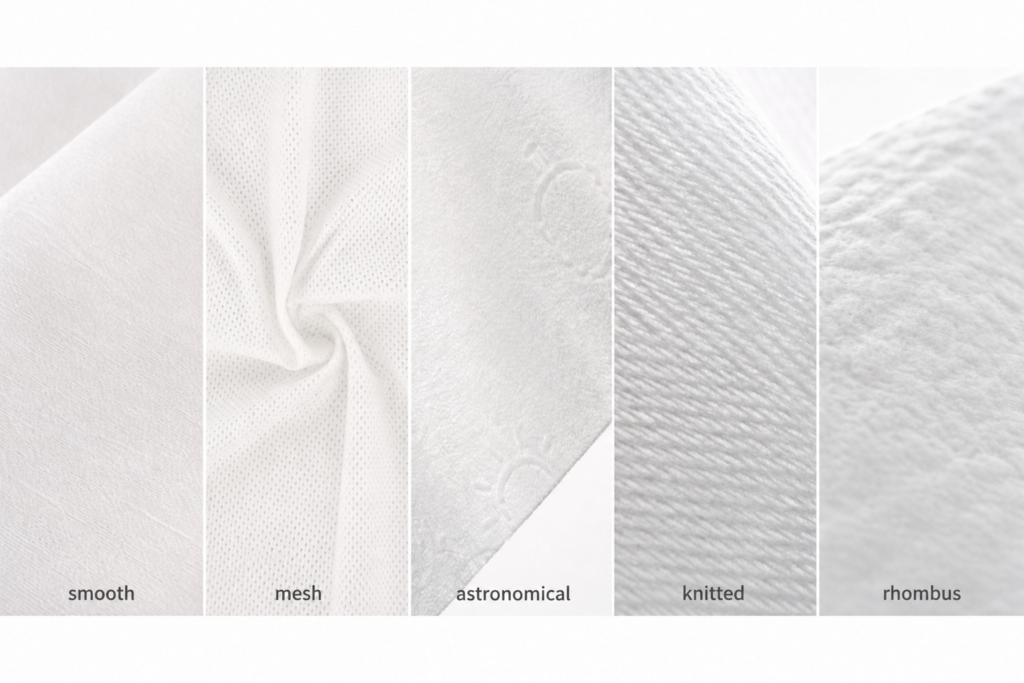
Texture is the biggest performance difference between face towels, and it is built into the nonwoven during manufacturing:
| Texture | Surface feel | Best for | Example | Absorbency | Lint | Pieces per pack |
|---|---|---|---|---|---|---|
| Plain (smooth) | Flat, even | Drying, sensitive skin, applying toner | Plain face towel, 20 × 20 cm | High — viscose/rayon + polyester blend | Low — smooth spunlace, no binder | 180 pcs/pack (40 packs/carton) |
| Reticulated (pearl/mesh) | Raised dot grid | Deep cleansing — the texture adds gentle friction that lifts makeup and oil | Reticulated face towel, 20 × 20 cm | High — viscose/rayon + polyester blend | Low — spunlace, no binder | 200 pcs/pack (40 packs/carton) |
| Embossed patterns (knitted, rhombus, astronomical) | Decorative 3D emboss | Retail-friendly look and feel with light exfoliating action | Knitted-texture facial cloths, 17.5 × 20 cm | High — plant fiber + polyester; rhombus line is the thickest, towel-like hand | Low — spunlace, no binder | 50–70 pcs/pack (knitted 70, astronomical 70, rhombus 50) |
The industry shorthand you will meet on marketplaces — “pearl texture” — is the raised-dot reticulated finish. A practical two-cloth routine many users settle on: reticulated or embossed side for cleansing, plain cloth for drying and skincare steps.
Which Fiber Material Matters for Your Skin?
Check the fiber blend before the marketing copy:
1. Viscose/rayon blends — soft, highly absorbent wood-derived fiber; the mainstream choice for face-contact cloths.
2. Plant fiber + polyester — natural-fiber feel with polyester adding wet strength, so an embossed cloth survives a full makeup-removal session without shredding; sturdy enough for secondary use as a household wipe afterward.
3. Wood pulp blends — bulkier and very absorbent; common in thicker towels built for drying.
4. Cotton — premium softness; often blended rather than pure for strength and cost balance.
Two quality checks that separate skincare-grade cloths from generic wipes: restricted-substance testing (Graminton’s face towels and facial cloths carry SGS formaldehyde test reports) and lint behavior — a face towel should not leave fibers on damp skin.
What Size and Format Fit Your Routine?
- 20 × 20 cm squares — the daily-wash standard; high-count packs (180–200 pieces) keep per-use cost low.
- Long towels (30 × 60–65 cm) — face-and-neck coverage, hair-drying assistance, and salon treatments; thicker builds like the thick long face towel double as a compact body towel for travel and gyms.
- Compressed or folded retail packs — smaller counts (50–70 pieces) with embossed patterns aimed at retail shelves.
Estimating usage is simple: pieces per day × household members. A two-person household using one cloth each daily runs through roughly 60 pieces a month — so a 180–200-piece pack lasts about three months.
How Should Salons and Retail Buyers Purchase?
For professional buyers the calculus is per-client cost and consistency:
1. Match texture to service — plain for skincare application steps, textured for cleansing stations.
2. Buy by carton, price by piece — e.g., 20 × 20 cm towels at 180 pieces/pack × 40 packs/carton; divide carton price by total pieces for the real unit cost.
3. Check test reports — restricted-substance documentation on skin-contact disposables is what your clients can trust; Graminton’s face towels carry SGS formaldehyde test reports.
4. Consolidate with other disposables — face towels ship alongside bed sheets and spa towels; our salon & spa disposables guide covers the full list. Beauty retailers pairing face towels with cotton pads and cotton rounds can use that sourcing guide for the second category. Consumer-retail buyers can also source embossed-pattern lines under the Gbuuty brand, while salon formats run under NIKITA.
FAQ
Are disposable face towels better than wet wipes for daily cleansing?
For daily use, generally yes — dry cloths are fiber-only (no preservative system needed), and you pair them with your own cleanser. Wet wipes win on convenience when there is no water: travel, gyms, or quick makeup removal. (The same dry-versus-wet logic applies in baby care — see our baby dry wipes guide.)
Can disposable face towels be reused?
They are designed for one use. A cloth can be used dry and then wetted within the same wash, but it should not be laundered and used on the face again: spunlace nonwovens lose loft and strength in the wash, and a used cloth left to dry on a counter has the same hygiene problem as a damp washcloth. Sturdy plant-fiber/polyester cloths are often given a second life as a household or kitchen wipe after the skincare step, which is a sensible way to offset single-use cost — just not a second facial use.
What is “pearl texture”?
The raised-dot (reticulated) texture you feel on cleansing-grade cloths. The dots add friction that helps lift makeup, sunscreen, and oil — think of it as a very gentle textured washcloth, renewed every use.
Are these suitable for sensitive skin?
Choose plain texture, viscose/rayon or cotton-rich fiber, and verified restricted-substance testing (formaldehyde, fluorescent agents). Avoid heavily embossed textures if your skin reacts to friction, and patch-test any pre-moistened formula first.
Are disposable face towels more hygienic than washcloths?
In general, yes — and the advantage comes from the single-use cycle, not from the fiber itself. A cotton washcloth stays damp between uses, and damp textiles are a well-documented environment for bacterial growth unless they are laundered frequently at high temperature. A disposable face towel is opened dry and discarded after one wash, so nothing is carried over to the next use — or, in a salon, to the next client. For professional settings that is the practical case for specifying single-use: it removes laundering as a variable in the infection-control routine.
What are disposable face towels made of, and are they eco-friendly?
Graminton’s face towels are spunlace nonwovens: viscose/rayon (a wood-derived cellulose fiber) blended with polyester for wet strength in the 20 × 20 cm towels, wood-pulp fiber with polyester in the thick long towel, and plant fiber with polyester in the embossed cloths. The cellulose portion is plant-based; the polyester portion is synthetic. The cloths are not flushable; dispose of them in general waste.
Disposable face towels vs paper towels — which should you stock?
Paper towels are wood-pulp tissue, usually held together with wet-strength resins; they shed lint, turn abrasive when wet, and break apart under rubbing. Disposable face towels are spunlace nonwovens — fibers entangled by water jets rather than glued — so they stay soft, hold together when soaked, and are tested for skin-contact substances (formaldehyde, fluorescent agents) that paper towels are not usually screened for. The cost gap is real, but for anything that touches the face the nonwoven is the correct specification; paper towels belong at the sink for hands and surfaces.
Stocking face towels for a salon, store, or brand? Tell us your channel and monthly volume — we’ll send texture samples with carton pricing, or scope a private-label run.