
Spunlace nonwoven (also called hydroentangled nonwoven) is a fabric made by entangling fibers with fine, high-pressure water jets instead of heat, adhesive, or weaving. With no chemical binder in the web, spunlace stays soft, drapes like cloth, and absorbs readily when it contains cellulose fibers such as viscose or cotton, which is why face towels, cosmetic pads, wipes, and sheet masks are commonly built on it. This guide covers how it is made, which fibers and patterns change it, and how buyers specify it; for the wider material family, see what nonwoven fabric is.
How Does Hydroentanglement Hold Spunlace Together?
Hydroentanglement bonds a web by moving fibers, not by melting or gluing them. As EDANA, the nonwovens industry association, describes it, the process is commonly applied to carded or wet-laid webs and uses fine, high-pressure water jets to make the fibers interlace. The jets drive fibers through the web and around one another, and friction between the tangled fibers gives the sheet its strength. In ISO 9092 terms, that is a physical bonding route.
The trade name goes back to early hydroentangled fabrics, which picked up a lace-like look from the patterned conveyors they were made on. Today “spunlace,” “spunlaced,” and “hydroentangled” describe the same process on a specification sheet. What the process leaves behind explains where the fabric gets used:
- Cloth-like hand and drape: no melted bond points or binder film stiffen the sheet.
- Binder-free structure: the fibers hold by entanglement alone, which matters for face- and skin-contact products.
- Absorbency set by the fiber: cellulose-rich blends take up water quickly; polyester-rich blends absorb less but keep more of their strength when wet.
- Low lint: tightly entangled fibers shed less than loosely bonded webs, although no spunlace is lint-free by default.
The trade-offs are strength and cost. At the same basis weight, spunlace is weaker than spunbond and usually costs more. For that comparison across spunlace, spunbond, and meltblown, see our nonwoven fabric types comparison.
How Is Spunlace Nonwoven Made?
A spunlace line runs from fiber bales to wound rolls in five stages, and each stage sets a property that later shows up in the finished product:
| Stage | What happens | What it sets |
|---|---|---|
| 1. Opening and blending | Fiber bales are opened and mixed to the specified blend | Blend ratio, which drives softness, absorbency, wet strength, and cost |
| 2. Web forming | A card combs staple fibers into a thin, even web; wood pulp, if used, goes on as a separate layer | Basis weight, uniformity, and strength balance by direction |
| 3. Hydroentangling | Rows of fine water jets, typically at rising pressure from the first injector to the last, strike the web on a perforated belt or drum, on one or both faces | Bond strength, softness, and surface pattern |
| 4. Dewatering and drying | Suction removes most of the water, and a through-air dryer finishes the job | Moisture, bulk, and hand-feel |
| 5. Finishing and winding | Optional finishes such as a hydrophilic treatment, printing, or embossing, then slitting and winding | Surface function and roll width |
Web direction deserves a closer look, because it decides how a finished sheet tears. EDANA notes that carded webs can be parallel-laid, with most fibers in the machine direction (MD), or randomized. A parallel-laid fabric is stronger along the roll than across it (the cross direction, CD); cross-lapping lays the carded web back and forth across the line to lift CD strength. Equipment maker ANDRITZ positions direct, parallel-laid lines for wipes, hygiene, medical, and face-mask fabrics, and cross-lapped lines for filtration and automotive uses.
Which Fibers Go into Spunlace, and How Do They Change It?
The process sets the structure, but the fiber sets most of what the user feels. Most spunlace for wipes and towels is a blend: a 2024 report from The Nonwovens Institute at NC State notes that baby wipes are commonly made of viscose rayon and polyester.
| Fiber | What it brings | Watch-outs | Typical spunlace uses |
|---|---|---|---|
| Viscose (rayon) | Regenerated cellulose: soft, drapes well, absorbs quickly | Weaker when wet than lyocell, so it is usually blended with polyester | Face towels, wet wipes, cosmetic pads |
| Polyester (PET) | Wet strength, abrasion resistance, dimensional stability | Absorbs little on its own; synthetic content matters for end-of-life claims | Blended into most wipes and towels |
| Lyocell | Solvent-spun cellulose with higher wet strength than viscose and low linting | Light, close-fitting weights turn translucent, which shows misalignment on a mask | Sheet masks, baby wipes, cosmetic pads |
| Cotton | Natural fiber with a soft hand and a fiber claim shoppers recognize | Often blended for strength and cost balance | Baby dry wipes, cosmetic pads |
| Wood pulp (composite) | A pulp layer hydroentangled onto a carrier web adds absorbency | Relies on the carrier web for structure and wet strength | Wet wipes, kitchen and industrial wipes |
Blend ratios are stated by weight (for example, 70/30 viscose/polyester), and changing the ratio shifts absorbency, wet strength, and cost at the same basis weight. That is why two fabrics sold simply as “spunlace” can behave very differently, and why the fiber line belongs at the top of any specification. The product examples later in this guide show how Graminton lists fiber content on each product page.
What Surface Patterns Does Spunlace Come In?
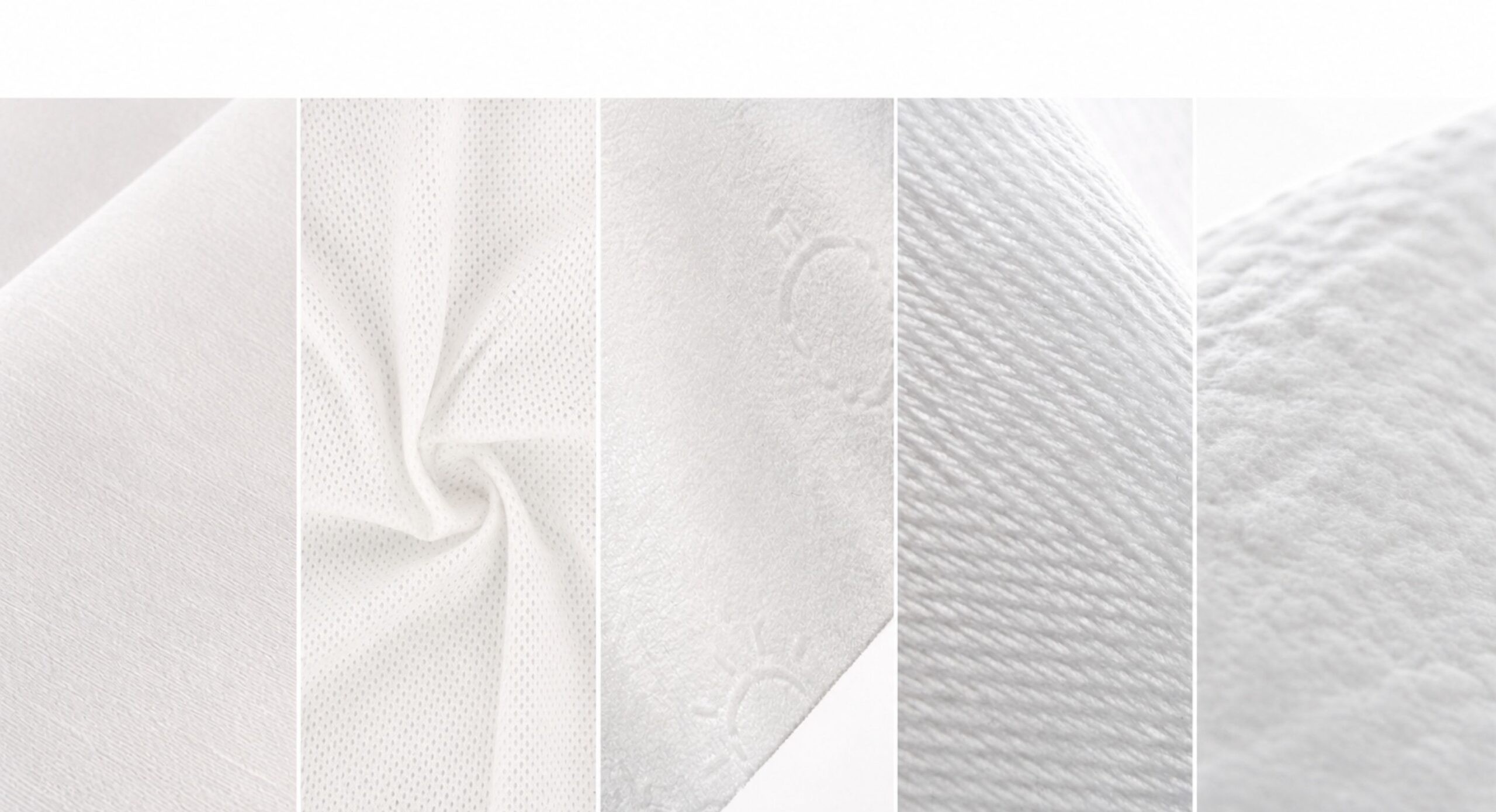
Texture forms while the web is still wet. The fibers take the shape of the surface they are entangled on: a smooth support gives a plain fabric, while a patterned drum sleeve or belt produces raised dots, 3D motifs, logos, or open apertures. Embossing calenders can also add a pattern after entangling. These are the four families buyers meet most often:
- Plain: a smooth, closed surface for drying, applying toner, and even liquid release, as on the NK9101 plain face towel and the BU8105 makeup pad, whose product page describes a spunlace plain structure.
- Pearl-dot (reticulated): a raised dot grid that adds gentle friction for cleansing, common on facial cloths and cleansing wipes.
- Embossed: raised motifs for retail appeal and a light exfoliating texture, such as the astronomical and rhombus patterns on the BU8106 and BU8107 facial cloths.
- Apertured (mesh): regular open holes that release liquid quickly and add scrubbing texture, common in wet wipes and cleaning cloths.
Pattern changes more than looks. At the same weight, a textured or apertured sheet can absorb, release liquid, and shed lint differently from a plain one, so the pattern belongs on the specification next to basis weight. For choosing textures by use in face care, see our guide to disposable face towel textures.
Where Does Spunlace Show Up in Finished Products?
Wipes are where spunlace is most visible: the 2024 report from The Nonwovens Institute puts spunlace at 49% of the wipes substrate market. The same fabric logic carries into towels, pads, and masks:
| Finished product | What spunlace does | What buyers check |
|---|---|---|
| Face towels and facial cloths | Works dry or wet and holds together when soaked | Pattern, sheet size, count per pack |
| Salon and spa towels | Absorbs water and color at the basin, then is discarded | Size, absorbency, roll or pack format |
| Cosmetic pads | Thin layers absorb and release toner; stretch helps the fit | Thickness, elongation, lint on skin |
| Baby dry wipes | A soft sheet used dry or with water | Fiber declaration, softness, low lint |
| Wet wipes | Carries lotion without tearing in use | Wet tensile strength, lotion compatibility, disposal labeling |
| Sheet masks | A light fabric holds essence and follows facial contours | Weight, fit, translucency (see our sheet mask materials guide) |
| Cleaning cloths | Absorbs and releases liquid over repeated wiping | Abrasion resistance, lint, solvent compatibility |
Graminton’s finished products that use spunlace include:
- NIKITA professional line: the NK9101 plain face towel (20 × 20 cm), the NK7401 disposable hair salon towel (51 × 20 cm, 100 towels per roll), and the NK8207 disposable spa towel (30 × 75 cm); material for all three: Viscose/Rayon, Polyester.
- Gbuuty line: the BU8105 ultra-thin makeup pad (50 × 60 mm; material: Rayon, Polyester) and the BU8106 and BU8107 embossed facial cloths (17.5 × 20 cm; material: Plant Fiber, Polyester Fiber).
- G Bear baby care line: the MB9201/MB8206 plain baby dry wipes (20 × 20 cm) and the MB8201 ultra-soft baby dry wipes (30 × 30 cm); material: Plant Fiber, Polyester Fiber.
- G Dolphin care line: the HU9201 dry disposable washcloth (24 × 30 cm); material: Plant Fiber, Polyester Fiber.
Each product page lists the fiber, size, pack format, and SGS test items for that SKU, so the fabric choices above can be checked against a real specification before sampling.
How Do Buyers Specify Spunlace for a Finished Product?
A finished-product specification names the fabric first and the tests that confirm it second. Brand owners and distributors typically build their purchasing specification from these lines:
| Spec line | How it is stated | Test reference | Why it matters |
|---|---|---|---|
| Fiber blend | Fibers and percentages by weight | Fiber declaration on the specification | Feel, absorbency, wet strength, and the fiber claim on the pack |
| Basis weight and thickness | g/m² with a tolerance; thickness in mm | ISO 9073-1 or ASTM D3776; ISO 9073-2 | Cost, body, and liquid capacity |
| Web structure and pattern | Parallel-laid or cross-lapped; plain, pearl-dot, embossed, or apertured, matched to an approved sample | Approved physical sample | Tear behavior, texture, and liquid release |
| Tensile strength and elongation | Force per strip width, MD and CD, dry and wet | ISO 9073-3 | Whether the sheet survives pulling from the pack and wet wiping |
| Absorbency | Absorptive capacity (%) and absorbency time (s) | ISO 9073-6 | Towel and pad performance, lotion loading |
| Lint | Particle release in the dry state | ISO 9073-10 | Face contact and precision wiping |
| Restricted substances | Formaldehyde, heavy metals, migrating fluorescent agents, microbial tests | Third-party laboratory reports | Skin-contact documentation for your market |
| Finished format | Sheet size, count, fold, pack, and carton | Product specification | Price per piece and shelf fit |
Basis weight is the line buyers negotiate most often, because it moves cost, body, and liquid capacity at once; our basis weight (GSM) guide covers how it is measured and the ranges typical for each application. Tensile figures compare fairly only when both sides test the same way, since ISO 9073-3 allows either a 25 mm or a 50 mm strip; absorbency figures likewise need the method named next to the number.
Documents that typically support a spunlace specification include test results against the methods above, restricted-substance reports, and the finished product’s specification sheet. On Graminton’s side, the finished products that use spunlace named in this guide carry SGS reports for formaldehyde, heavy metals, E. coli, and migrating fluorescent agents, and BU8105 also lists a skin irritation test. The report for a specific product is available on request.
When the comparison widens from fabric to supplier, our guide to sourcing finished nonwoven products from Taiwan covers evaluation across medical, industrial, beauty, and baby-care categories.
FAQ
Is spunlace the same as cotton?
No. Spunlace is a bonding process, and cotton is one fiber it can use. Many spunlace fabrics contain no cotton at all; viscose with polyester is the common wipes blend. Product names can also describe feel rather than fiber: Graminton’s BU8109 Premium Cotton-Soft Tissues, for example, are made of rayon and polyester. The fiber line on the specification or the pack, not the product name, defines the material.
Is spunlace lint-free?
Not automatically. Entanglement holds fibers without a binder, so spunlace generally sheds less than loosely bonded webs, but linting still depends on the fiber, how hard the web was entangled, and how the edges are cut. For face-contact products, the practical check is whether a damp cloth leaves fibers on skin. For technical wiping, dry lint can be measured with ISO 9073-10, which counts the particles a sample releases while it is flexed.
What GSM is spunlace fabric?
Spunlace is made across a wide weight range, and the right weight depends on the product. The Nonwovens Institute cites 40–60 g/m² as a common range for wipe substrates. Heavier fabrics add absorbency and body; lighter ones drape closer to the skin and cost less. Compare weights only within the same fiber blend and pattern, because a viscose-rich sheet and a polyester-rich sheet of the same weight perform differently.
Is spunlace biodegradable?
It depends on the fiber, and the claim belongs to the finished product, not the process. Viscose, lyocell, cotton, and wood pulp are plant-based cellulose; polyester and polypropylene are synthetic. In the United States, the FTC Green Guides (16 CFR 260.8) require competent and reliable scientific evidence that the entire item will completely break down within a reasonably short time after customary disposal, and within one year for items entering the solid waste stream. A blend’s claim cannot rest on its cellulose share alone.
Is spunlace flushable?
Not by default. Most spunlace is built to stay intact when wet, and blends containing polyester do not break apart in water. Flushable wipes are a separate construction, assessed against guidance such as the INDA/EDANA flushability guidelines (GD4), whose labeling code calls for a “Do Not Flush” symbol on non-flushable wipes. The Graminton towels, pads, wipes, and facial cloths named in this guide carry a do-not-flush precaution on their product pages.
Is spunlace fabric safe for skin?
Spunlace contains no binder or adhesive, which is one reason it is used for face- and skin-contact products. Whether a specific fabric suits skin still depends on its fibers, any finishes, and how the finished product is tested. Documents that typically support skin-contact use include restricted-substance tests for formaldehyde, heavy metals, and migrating fluorescent agents, plus a skin irritation test for some cosmetic formats. For Graminton’s finished products that use spunlace, the SGS test items are listed on each product page.
Sourcing face towels, cosmetic pads, or salon towels built on spunlace? Tell us the product, target fiber blend, pattern, and monthly volume, and we’ll reply with matching Graminton products, samples, and the SGS reports for the SKUs you shortlist. For a new material idea, start with our nonwoven material research center.