
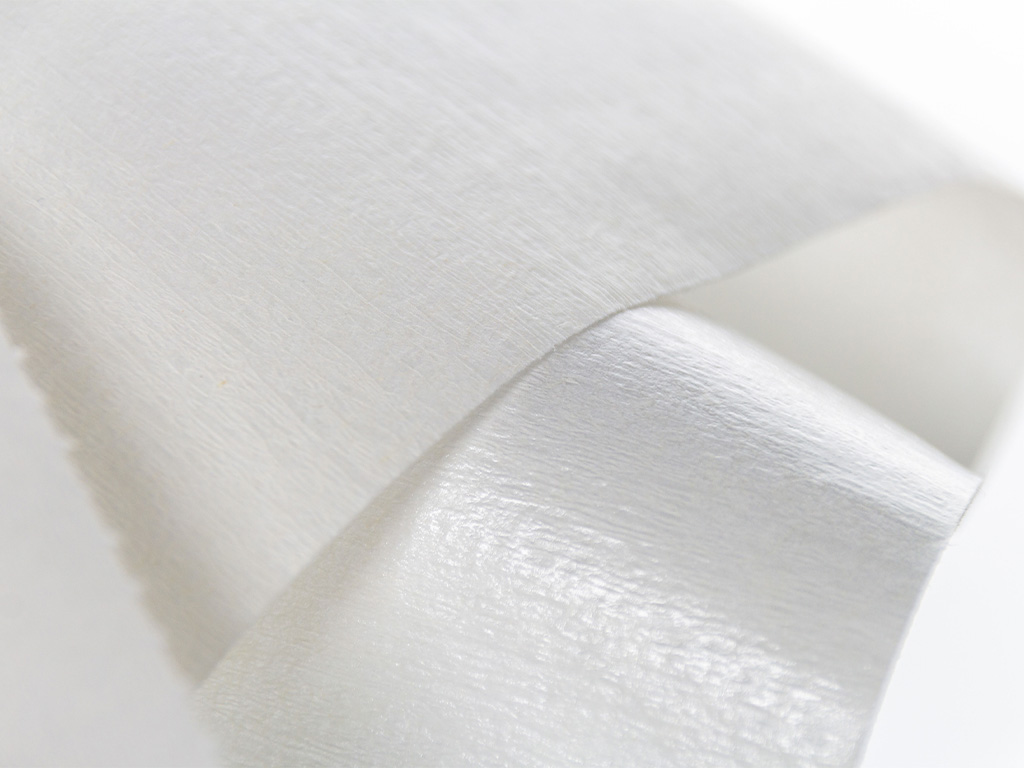
Exam table paper (also called table paper, couch roll, or doctor roll) is the disposable paper barrier pulled over an examination table and normally changed after every patient. The crepe vs smooth exam table paper choice is about the surface: crepe has a soft, crinkled texture that is quieter, less slippery, and more absorbent, while smooth, machine-glazed paper gives a crisp, flat finish and usually more feet per roll. Poly-backed paper is a separate choice: a polyethylene film underneath keeps fluids from soaking through to the table.
Written for distributors and clinic purchasing teams, this guide compares the three types, maps US inch sizes against metric formats, matches paper to specialties, and shows how to compare cost per exam. For the rest of the exam-room basket, see our exam-room supplies for clinics.
Crepe vs Smooth Exam Table Paper: What's the Difference, and Where Does Poly-Backed Fit?
Exam table paper varies along two separate axes. The finish, crepe or smooth, decides how the surface feels, how much it rustles, and how it handles moisture from skin. The backing, plain paper or a laminated polyethylene (PE) film, decides whether liquids reach the table. Crepe and embossed papers can be poly-backed too, so specify finish and backing as two separate lines.
| Type | Construction | Strengths | Trade-offs | Typical use |
|---|---|---|---|---|
| Crepe | Creped into a fine, soft texture | Quiet, less likely to slip, picks up perspiration and light moisture | US rolls are commonly 125 ft, so fewer exams per roll | Pediatrics, longer exams, chiropractic and physical therapy |
| Smooth (machine-glazed, MG) | Flat, glazed surface | Crisp look; can be printed; 225-ft rolls are common | Noisier, more slippery, and less absorbent than crepe | High-turnover general exams |
| Poly-backed (PE-laminated) | Absorbent paper top laminated to a PE film | The top absorbs; the film blocks soak-through to the table | The extra layer adds material cost | Gel or body fluids, OB/GYN, minor procedures |
Neither plain finish is a fluid barrier: plain paper soaks through once it is saturated, which is where a poly backing earns its place. Crepe and smooth are comfort and cost decisions; backing is a protection decision.
The GhealthCare table papers on our site are not creped; all of them are the laminated type: a wood-pulp fiber top bonded to a PE film bottom, described on the product pages as an “absorbent top and waterproof bottom,” with lamination that helps the two layers resist separating. That places our PE-laminated medical table paper rolls in the poly-backed column: the top absorbs liquids while the film blocks seepage.
What Are the Standard Exam Table Paper Sizes, and How Do Metric Formats Compare?
US exam table paper comes in inch widths, mostly on continuous rolls, and most tables and add-on dispensers are built for 18- or 21-inch rolls with a cutter. In the UK and much of Europe, the same product is sold as couch roll in metric widths, usually perforated into sheets. Check which convention a customer’s tables follow first: the roll has to fit the holder.
| US exam table paper | Metric couch roll (UK and Europe) | |
|---|---|---|
| Common widths | 14 to 14.5 in (about 36 to 37 cm) for narrow and pediatric tables; 18 in (45.7 cm); 21 in (53.3 cm); 24 in (61 cm) and wider for bariatric tables | 39, 50, 55, and 60 cm |
| Common lengths | 125 ft (38.1 m), typical for crepe; 225 ft (68.6 m), typical for smooth | Roughly 40 to 50 m; tissue/PE versions are common |
| Dispensing | Mostly continuous; staff pull the length they need and tear it at the cutter | Usually perforated into sheets of about 38 to 50 cm |
Graminton’s GhealthCare range follows metric conventions (sizes ±1 cm; counts are nominal):
| SKU | Format | Size | Count per roll or pack | Per carton |
|---|---|---|---|---|
| HC7301 | Sheets on a roll | 38 × 30 cm per sheet | 120 sheets | 25 rolls |
| HC7302 | Sheets on a roll | 45 × 40 cm per sheet | 200 sheets | 9 rolls |
| HC7306 | Sheets on a roll | 35 × 30 cm per sheet | 25 m per roll | 30 rolls |
| HC7305 | Sheets on a roll | 55 × 50 cm per sheet | 100 m per roll | 6 rolls |
| HC7303 | Continuous roll | 55 cm wide | 100 m per roll | 6 rolls |
| HC7304 THK | Roll | 55 cm per piece | 120 pieces | 25 rolls |
| HC8305 S / L | Flat pack | 35 × 50 cm / 55 × 50 cm | 200 sheets per pack | 7 packs / 5 packs |
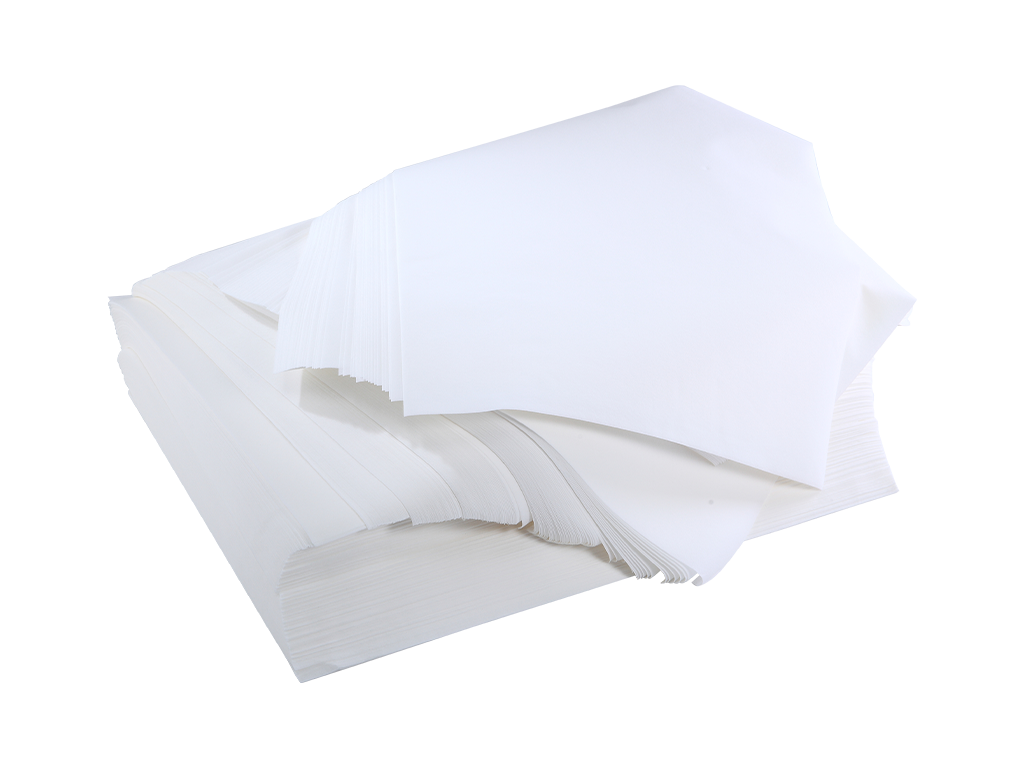
Per the HC7301-06 product page, the S and M sizes are perforated to tear by hand, and the L size is unperforated so staff can tear the length they need. The HC7304 THK product page describes it as suited to areas with a lot of liquids, and HC8305 comes as stacked flat sheets that are easy to pick up one at a time.
These metric formats are not made to the US 18- or 21-inch roll standard, so check the table’s roll holder and cutter before substituting them for an existing US-format paper. Where a table has no holder, or where only the zone that gets wet is covered, sheets and flat packs fit the way staff already work.
Which Exam Table Paper Fits Each Specialty?
The right paper depends on what happens on the table: how long the patient stays, how much they move, and whether gel or body fluids are involved. The table summarizes common choices, and distributors can use it to plan an assortment by customer type.
| Setting | What the table sees | Common choice | Format notes |
|---|---|---|---|
| General practice | Short, dry exams at high turnover | Smooth for cost per exam; crepe for comfort | Full-length rolls |
| Pediatrics | Movement, noise-sensitive patients, diaper leaks | Crepe; poly-backed where leaks are likely | Narrow 14 to 14.5 in rolls; printed designs are common in the US |
| OB/GYN and ultrasound | Gel, body fluids, sensitive exams | Poly-backed or laminated paper | Zone sheets under the hips or where gel collects |
| Dermatology and aesthetics | Peels, cooling gels, longer procedures | Laminated paper or waterproof sheets on the wet zone | Paired with bed sheets and face-rest covers |
| Physical therapy (physiotherapy) and chiropractic | Movement, lotions, face-down positions | Crepe for grip; headrest paper for the face rest | Nonwoven sheets on massage beds |
| Dental | Chair-side work; splatter on trays | Bibs and surface barriers, changed between patients | Flat sheets on trays and counters |
Where GhealthCare items fit: the HC7301-06 and HC7304 product pages name gynecological and ultrasound examinations, and HC8305 lists dental clinics, labs, and gynecological exams. For aesthetic rooms, our aesthetic clinic supplies checklist places table paper next to bed sheets and drapes; for massage and physical therapy beds, see our guide to disposable bed sheets and pillow covers. Dental rooms pair paper sheets with patient bibs such as HC8401 dental bibs.
Does Exam Table Paper Replace Cleaning Between Patients?
No. Exam table paper is a comfort and barrier layer; it does not disinfect the table, and infection-control guidance treats barriers as a supplement to surface cleaning, not a substitute. US guidance frames where barriers fit:
- CDC environmental infection control (2003). Recommendation E.I.4.3 (Category II) calls for barrier protective coverings, as appropriate, on noncritical equipment surfaces touched frequently with gloved hands, likely to become contaminated with blood or body substances, or difficult to clean. CDC lists impervious-backed paper among suitable materials; coverings come off while staff are still gloved, and clean material goes on before the next patient.
- OSHA bloodborne pathogens standard. Where staff may be exposed to blood or other potentially infectious materials, 29 CFR 1910.1030(d)(4)(ii)(B) names "imperviously-backed absorbent paper" as a protective covering, to be replaced as soon as feasible when overtly contaminated, or at the end of the shift if it may have become contaminated.
- CDC dental guidance. Barriers on clinical contact surfaces are changed between patients, and surfaces without a barrier are cleaned and disinfected after each patient.
Recent studies narrow down where paper helps. In a small 2024 Annals of Family Medicine study (Chiarlitti et al.), 75% of simulated patients’ hand touches landed on the uncovered edges of the table. The authors still see a role for paper in sensitive exams (rectal, genital, and pelvic) and for newborns and the elderly, and suggest covering a reduced segment of the table when paper is used.
Four regional BC Cancer centers in British Columbia stopped routine table paper use while continuing to disinfect tables between patients, kept paper available on request, and used absorbent pads and washable cotton cloths for cases involving body fluids (BC Medical Journal, 2024).
For buyers, the practical reading is to plan paper around the procedures where it does a job (fluid exposure, sensitive exams, vulnerable patients, patient expectations) and to keep surface disinfection in the SOP either way. In fluid-heavy work, a film-backed paper also does more than plain paper. For the wider picture across clinic disposables, see our clinic disposables buying guide.
How Much Does Exam Table Paper Cost per Patient?
Cost per patient matters more than price per roll. For continuous rolls, divide the roll price by the exams it covers (roll length divided by the length pulled per exam); for sheet formats, divide the carton price by sheets per carton and multiply by sheets used per exam.
- Compare per exam, not per roll. US crepe rolls are commonly 125 ft and smooth rolls 225 ft, so a cheaper crepe roll can still cost more per exam.
- Measure the real pull length. Tally rolls against visits for a week to get a working exams-per-roll figure; the Annals study above sketches a clinic using about three rolls a week for 150 table exams.
- Cover the zone when the whole table is not needed. Sheets placed where fluids collect use less paper than a full-length pull.
- Count the costs outside the paper: changeover time, waste handling, storage space per carton, and stockouts.
GhealthCare carton arithmetic, using the nominal counts on each product page:
- HC7301: 120 sheets × 25 rolls = 3,000 sheets per carton
- HC7302: 200 sheets × 9 rolls = 1,800 sheets per carton
- HC7304: 120 pieces × 25 rolls = 3,000 pieces per carton
- HC8305: 1,400 sheets per carton for S (7 packs of 200) or 1,000 sheets for L (5 packs of 200)
- HC7303 and HC7305: 6 rolls × 100 m = 600 m per carton; HC7306: 30 rolls × 25 m = 750 m per carton
A clinic using one HC7302 sheet per exam gets 1,800 exams from a carton, so the paper cost per exam is the carton price divided by 1,800.
What Should Distributors and Clinic Chains Check Before Ordering?
- Fit to the table. Width, roll diameter, core, and the table’s holder decide whether a roll works; metric sheets and flat packs suit chairs, trays, and tables without a holder.
- Finish and backing by account type. General practice may run on smooth paper; pediatric, OB/GYN, and aesthetic accounts usually need crepe or poly-backed options. List finish and backing as separate order lines.
- A hands-on trial. Tear a sheet at the perforation, move on it, and pour water or gel on the absorbent side, then check the table underneath. A trial with the staff who change the paper settles noise, slip, and soak-through faster than a datasheet.
- Documentation. Documents that typically support table paper in a clinical account include a material specification (fiber and film), restricted-substance tests such as formaldehyde and heavy metals, microbial tests such as E. coli, and a migrating fluorescent agent test. On Graminton’s side, the GhealthCare medical supplies line table papers (HC7301-06, HC7304, and HC8305) carry SGS results for formaldehyde, heavy metals, E. coli, and migrating fluorescent agents; the report for a specific product is available on request. The range is supplied non-sterile, and each product page shows its Taiwan medical device license (Class I, medical absorbent fiber); registration and labeling in your own market are a separate check.
- Carton and storage. Rolls or packs per carton set storage space and reorder rhythm; keep cartons sealed and dry until use.
- Consolidation. Table paper usually ships with the rest of the exam-room basket: HC8301 disposable bed sheets, HC8312 pillow tissue for the exam pillow, bibs, and drapes. Our guide to choosing a medical consumables supplier covers range consolidation in more depth.
FAQ
Which is better, crepe or smooth exam table paper?
Neither is better across the board. Crepe is quieter, softer, and less slippery, which suits pediatrics, longer exams, and chiropractic or physical therapy tables. Smooth paper looks crisp and usually covers more exams per roll, which suits high-turnover general practice. With gel or body fluids, the backing matters more than the finish.
Is crepe exam paper more absorbent than smooth exam paper?
Generally, yes. Creping adds texture and surface area, so crepe takes up perspiration and light moisture better than a glazed smooth sheet. Neither is a fluid barrier, though; for fluids, an absorbent top laminated to a polyethylene film keeps liquid off the table.
What size is standard exam table paper?
In the US, 18- and 21-inch widths are the most common, with 14- to 14.5-inch rolls for narrow and pediatric tables and 24 inches or wider for bariatric tables. Crepe rolls are commonly 125 ft and smooth rolls 225 ft. Metric couch roll is typically 50 to 60 cm wide.
How often should exam table paper be changed?
Clinics normally change it after every patient. Where blood or other potentially infectious materials are involved, OSHA’s bloodborne pathogens standard also requires protective coverings to be replaced as soon as feasible when overtly contaminated. Changing the paper does not replace cleaning the table between patients.
Is couch roll the same as exam table paper?
Yes, in function. Couch roll is the usual UK and European name for the same disposable barrier, sold in metric widths such as 50 or 60 cm and usually perforated into sheets. Doctor roll and medical table paper are other names for it.
Is exam table paper sterile?
No. Exam table paper is a single-use hygiene barrier, and GhealthCare table paper is supplied non-sterile. A procedure that needs a sterile field calls for a separately specified sterile product, handled under the facility’s own protocols.
Stocking exam table paper for clinics, a hospital group, or a distribution business? Tell us your table widths, specialties, and monthly volume, and we’ll reply with samples, the SGS reports for the SKUs you shortlist, and carton pricing for Made in Taiwan GhealthCare table paper.