
Private label skincare is a product made by a manufacturer and sold under your brand. With a private label skincare manufacturer in Taiwan, a project usually starts from a stock formula: a proven base the factory already produces. You can launch it as is, adjust it (fragrance, texture, selected actives, packaging), or replace it with a formula developed for you. This guide maps those routes to the OEM and ODM terms Taiwanese factories use, shows what each customization sets off, and explains which regulatory duties stay with your brand.
It is written for brand owners, distributors, and professional channels such as aesthetic clinics and salons that are building a line of their own. Graminton Enterprise Ltd. works with all three; the formulation, sampling, filling, packaging, and batch QC behind a project are outlined on our cosmetics OEM services page.
What Does Private Label Mean in Skincare, and How Does It Map to OEM and ODM?
Buyers and factories describe the same work in different words. In the United States the everyday terms are private label and contract manufacturing; Taiwanese manufacturers usually say OEM and ODM. The terms overlap, and contract manufacturing is often used as an umbrella for all of them, so the useful question is what you bring to the project and what the factory supplies:
| What you bring | Common US term | Term at a Taiwan factory | Who typically owns the formula | Relative speed |
|---|---|---|---|---|
| Your brand and artwork; the product itself is unchanged | White label, or stock private label | Private label (ready product) | Manufacturer | Fastest |
| A brief to adjust a stock base: fragrance, texture, selected actives | Private label with customization, or semi-custom | ODM on a mature formula | Manufacturer (the base) | Fast, often faster than OEM |
| A brief for a formula that does not exist yet | Custom formulation | ODM with custom development | Negotiable before development | Slowest, longer than OEM |
| A production-ready formula of your own | Contract manufacturing to your formula | OEM | You | Short |
ODM covers two routes. Adapting a mature formula is usually the fastest way to launch, often faster than OEM, because the base is already validated. Developing a new formula takes longer than OEM, because every custom formula goes through rounds of sampling and confirmation. A US brief that says “private label” can mean any of the first three rows, so it pays to name the row early. Graminton takes projects in all four rows, including a stock product launched unchanged under your brand. Our OEM vs ODM comparison covers the full decision.
What Can You Customize on a Stock Formula, and What Does Each Change Set Off?
Private label is often summed up as “your logo on our product,” but most projects change more than the label. Every change has a knock-on effect on testing, minimums, or labeling, which is why the scope is worth fixing before sampling starts. The table below shows the usual elements, how often each can be adjusted on a stock base, and what each change sets off.
| Element | Usually adjustable? | What the change sets off |
|---|---|---|
| Brand name, label, and carton artwork | Yes; this is the core of private label | The label has to carry what your market requires (see the regulatory section below) |
| Packaging (bottle, jar, tube, pump, sachet) | Yes, from stock or custom components | A formula-packaging compatibility check; custom components bring their own supplier minimums |
| Fragrance, or fragrance-free | Often | A new stability check; fragrance allergens may need to be named on the label |
| Texture and skin feel | Often, within the limits of the base | Changes to viscosity or the emulsion can need fresh stability data |
| Selected actives (type or level) | Sometimes | New stability data, plus supporting data for any claim tied to the active; large changes shift the work toward custom development |
| Claims wording | Your decision, within what the data supports | Claims decide whether a product is regulated as a cosmetic or a drug in some markets |
| Base system (emulsion type, preservation) | No | Changing it creates a new formula, which is custom development |
Packaging is usually where the minimums come from. Stock bottles, jars, and tubes keep a first order small, while custom-molded or custom-printed components add supplier minimums of their own and a longer lead time. Settling the container early also keeps compatibility testing to a single round, because the formula is checked in the pack it will actually ship in.
Sheet masks add a second component to customize: the fabric. Graminton’s Gmask sheet-mask fabric range covers nearly 20 fabrics and more than 100 face shapes, including the Lyocell Fibers Sheet Mask (100% lyocell fibers, 28 g/m²), and the automated sheet mask line brings fabric and essence together. Brand markings can also be printed on the mask fabric itself, which helps a private label mask stand out and supports anti-counterfeiting.
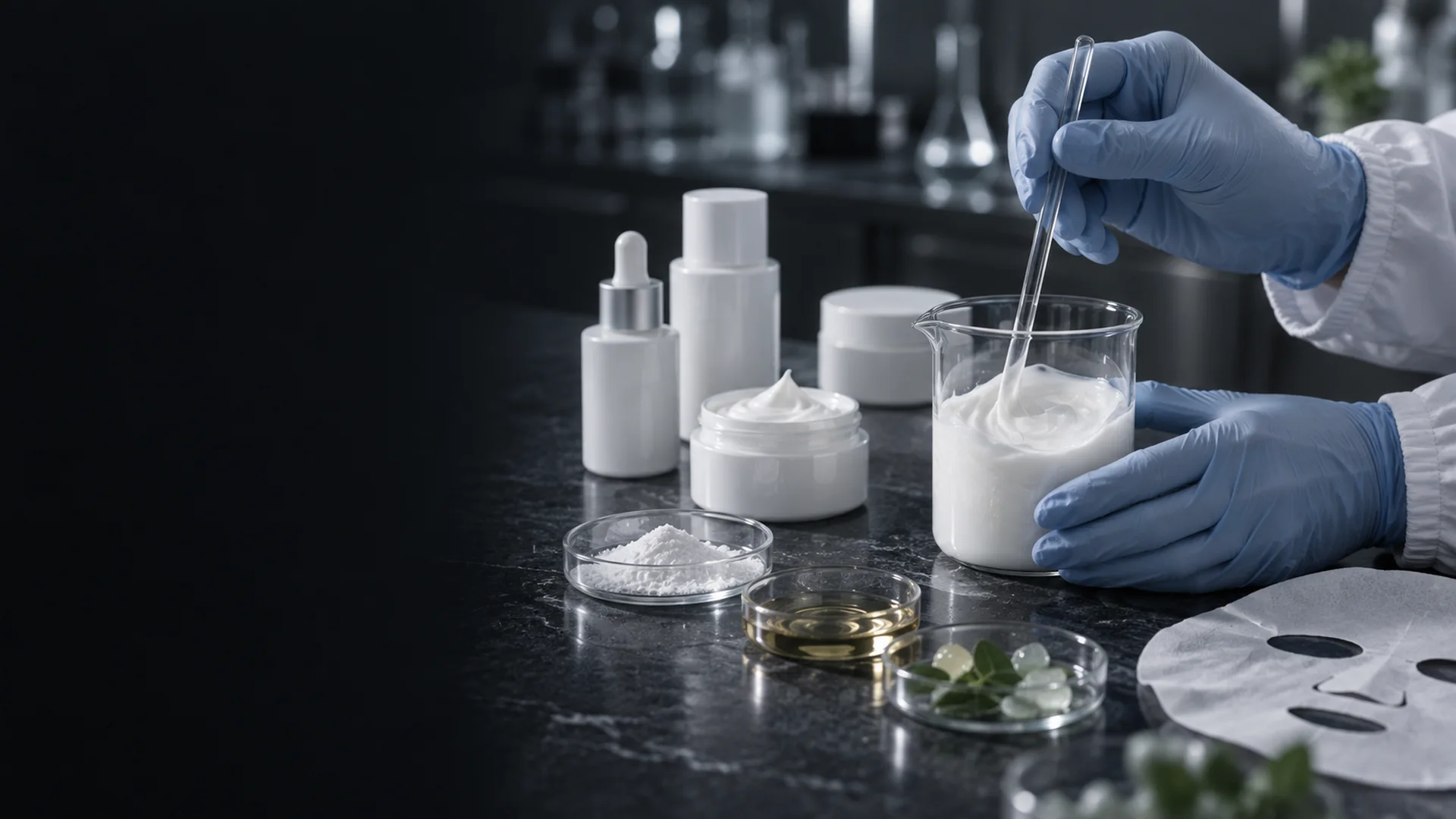
Stock Formula or Custom Formula: What Should You Check Before You Commit?
The main difference between a stock formula and a custom formula is how much evidence exists on day one. A stock base has been made before, tested, and in many cases sold; a custom formula builds its evidence during development. How far the existing evidence reaches decides how much work remains for your market and your claims. Documents that typically support a stock skincare formula include:
- Stability data, ideally in packaging similar to the pack you plan to use
- Preservative efficacy (challenge) test results for water-based products
- A full ingredient list with INCI names, which feeds both your label and your product listing
- Microbiological specifications for finished batches
- Packaging compatibility results whenever the container or its material changes
Texture and skin feel are easier to judge side by side than in writing. Graminton uses 24 formulation textures, shown on our cosmetics OEM solutions page, to align skin-feel expectations for liquids and creams early in a project, so “lighter” or “richer” becomes a specific sample rather than an adjective.
Two commercial points matter as much as the data. A stock base usually stays in the manufacturer’s library and may be sold to other brands, so any exclusivity by market, channel, or period is a term to agree in writing. And claims have to fit the evidence: a formula tested for stability is not automatically supported for the claim you want on the front of the pack.
Ingredient rules also differ between the US, the EU, and Asian markets, both in which ingredients are allowed and at what level. A base that suits one market may need changes for another, so confirming that each ingredient and its level suit your target markets is part of your own review, ideally before the sample you approve becomes the production reference.
How Does a Private Label Project Run, From Samples to Shipment?
The six stages below follow the sequence Graminton uses for cosmetics OEM projects. In a private label project, most of the decisions sit with your brand, and the pace is usually set by packaging and approvals rather than by production. The last column shows where schedules tend to slip, so you can plan around it.
| Stage | What happens | What your brand decides | What usually sets the pace |
|---|---|---|---|
| 1. Project brief | Product types, target markets, sales channel, volumes, reference products | Which markets you will sell in, which fixes the regulatory path and claim limits | How complete the brief is |
| 2. Product proposal | Stock bases or a development route proposed against the brief | Stock, adjusted stock, or custom | Sample shipping and your feedback loop |
| 3. Formulation and samples | Adjustments to fragrance, texture, or actives; packaging selection | The approved sample, which becomes the production reference | Number of adjustment rounds and compatibility checks |
| 4. Approval and quotation | Quotation for formula, packaging, and quantities; artwork review | Final artwork and label content for your market | Packaging lead times and artwork approvals |
| 5. Manufacturing | Production of the approved product, sometimes after a pilot batch | Acceptance criteria for finished goods | Line scheduling, and stability data for any late change |
| 6. Inspection and shipment | Finished-goods inspection; shipment on the agreed terms | Your importer and the destination paperwork | Freight booking and customs clearance at your end |
Two habits keep the schedule short:
- Freeze formula and packaging together. A late container change reopens compatibility testing, and a late fragrance change reopens stability checks.
- Approve artwork after the label content is checked. Ingredient order, the distributor statement, and the country of origin are easier to fix on a proof than on printed cartons.
On the production side, Graminton’s cosmetics manufacturing runs under quality systems based on ISO 22716 principles, the cosmetics good manufacturing practice guideline that covers production, control, storage, and shipment. EU and UK brands will find the cross-border specifics, including the Responsible Person’s role and the supporting documents, in our guide to sourcing skincare OEM from Taiwan.
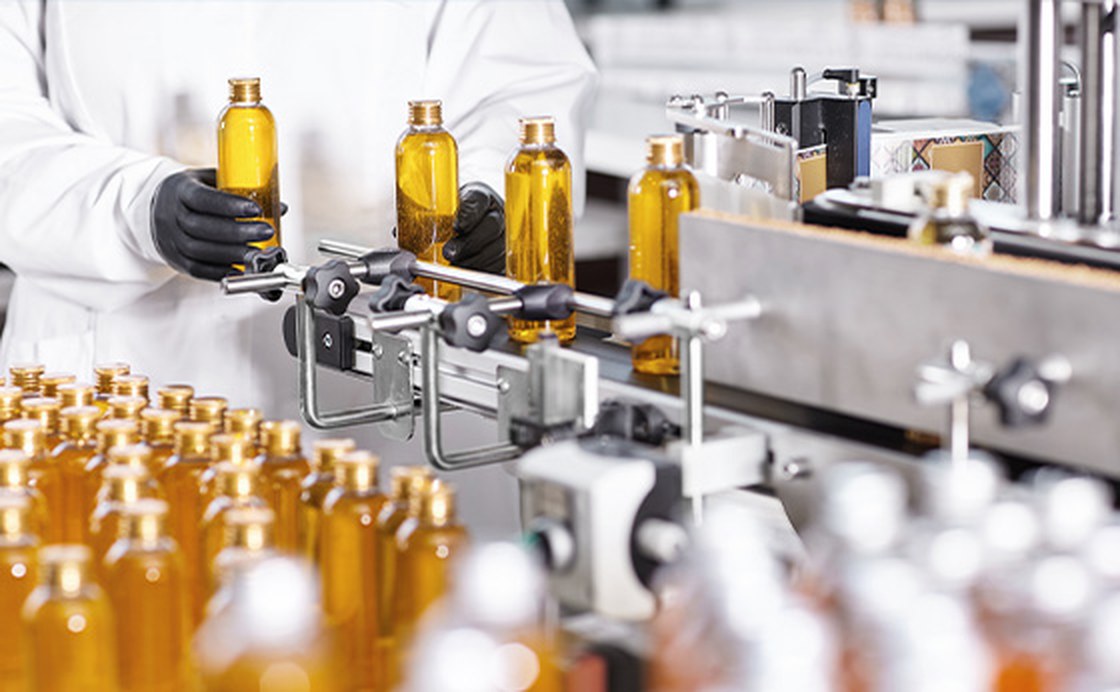
Which Regulatory Duties Stay With Your Brand?
In both the US and the EU, the company that puts its name on a private label product carries most of the legal responsibility for it, even when a factory abroad makes it. The summary below is background for US launches under the Modernization of Cosmetics Regulation Act of 2022 (MoCRA); how each duty applies to your products is part of your own compliance review.
MoCRA assigns most duties to the responsible person: the manufacturer, packer, or distributor whose name appears on the label (FD&C Act §604). In a private label deal, that is usually your brand, because the label names your company, typically with “Distributed by” wording. The duties below follow from that role, while facility registration sits with the facility’s owner or operator.
| MoCRA duty (US) | Held by | FD&C Act section |
|---|---|---|
| Product listing: each marketed product and its ingredients, within 120 days of first marketing, updated annually | Responsible person | §607(c) |
| Safety substantiation: ensure, and keep records showing, that each product’s safety is adequately substantiated | Responsible person | §608 |
| Serious adverse event reports to FDA within 15 business days; related records kept for six years | Responsible person | §605 |
| Label contact: a domestic address, domestic phone number, or electronic contact such as a website, for adverse event reports | Responsible person | §609(a) |
| Facility registration, renewed every two years; a foreign facility’s registration names a US agent | Owner or operator of the manufacturing facility | §607(a) |
Some small businesses are exempt from registration and listing, although the exemption does not extend to certain product types, such as products that contact the eye’s mucous membrane. MoCRA also directs FDA to issue good manufacturing practice and fragrance-allergen labeling rules; neither was final at the time of writing.
Label content also comes from long-standing FDA and customs rules:
- Who you are: the name and place of business of the manufacturer, packer, or distributor, with wording such as "Distributed by" when the named company is not the manufacturer (21 CFR 701.12).
- What is inside: ingredients declared in descending order of predominance (21 CFR 701.3).
- Where it was made: imported products are marked with the English name of the country of origin (19 U.S.C. 1304), so a Taiwan-made product carries "Made in Taiwan."
Claims can also move a product out of the cosmetic category. FDA classifies products by intended use, so sunscreens, acne treatments, and moisturizers marketed with an SPF are regulated as over-the-counter drugs, or as both drugs and cosmetics, with requirements that go beyond MoCRA. Our sunscreen OEM guide shows how SPF projects differ by market.
Selling in the EU moves the same logic to a Responsible Person established in the EU (Regulation (EC) No 1223/2009, Article 4), who ensures the safety assessment (Article 10), keeps the Product Information File (Article 11), and notifies the product through the CPNP portal (Article 13). In either market, much of the evidence behind a safety file originates at the manufacturer, so the documentation a project needs for its target markets belongs in the first brief.
FAQ
What is the difference between private label and white label skincare?
The two terms are often used interchangeably. Where suppliers separate them, white label means an unmodified product the manufacturer offers to many brands, while private label means a product made for your brand, sometimes adjusted and sometimes exclusive. At a Taiwan factory, the unmodified product is the ready-product route, and adjustments put the project on the mature-formula ODM route.
Who owns the formula in private label skincare?
For stock and adjusted stock formulas, the base formula usually stays with the manufacturer, while your brand owns its trademark, artwork, and label. Ownership of a custom-developed formula is negotiable and is settled before development starts. Our skincare ODM guide compares ownership and exclusivity for mature and custom formulas.
Do private label skincare products need FDA approval?
No. In the United States, cosmetics and their ingredients, other than color additives, do not need FDA approval before sale. Under MoCRA, however, the responsible person lists each product, keeps safety substantiation records, and reports serious adverse events, and facilities that make cosmetics for the US market are registered by their owner or operator. Products with drug claims, such as sunscreens or acne treatments, also have to meet over-the-counter drug requirements.
What is the minimum order for private label skincare?
It depends on three things: the formula route, the packaging, and the number of SKUs. Stock formulas in stock packaging keep minimums lowest; custom-printed or custom-molded components usually set the real minimum, and each fragrance or size is counted as its own SKU. Our cosmetic OEM costs and MOQ guide breaks down each component.
How long does it take to launch a private label skincare line?
An unchanged stock formula in stock packaging is the fastest route. Each adjustment round, custom packaging component, and artwork revision adds time, and a custom-developed formula takes longer than OEM because it goes through rounds of sampling and confirmation. In the US, product listing is due within 120 days of first marketing, so it follows the launch rather than gating it.
Can a private label formula be exclusive to my brand?
Sometimes. A stock base is usually shared across the manufacturer’s clients, although exclusivity for a market, channel, or period can be negotiated in some cases. When exclusivity is central to your positioning, an adjusted formula with its own fragrance and texture, or a custom development, is the more dependable route, with the terms agreed in writing before work starts.
Planning a skincare or sheet mask line under your own brand? Tell us your product types, target markets, planned quantities, and a reference product if you have one. We’ll suggest stock bases you can launch as is or adjust, or a development route, confirm what can be customized for your project, and arrange samples.