

A medical consumables supplier provides the single-use items a clinic, hospital, or care facility goes through every day — exam table paper, drapes, bibs, underpads, face masks — in recurring wholesale volumes. Choosing one is less about any single product and more about the operation behind it: whether items are properly registered, whether batches can be traced, how much of your list one supplier can cover, and whether deliveries arrive on time in packaging your staff can actually use. This guide walks procurement teams and distributors through those five checks, from the perspective of a Taiwan-based manufacturer.
What Are Medical Consumables?
Medical consumables — also called medical disposables or disposable medical supplies — are single-use products consumed in the course of routine care and then discarded. The category spans exam room coverings (table paper, drapes), patient protection (bibs, underpads), personal protective items (masks, gloves), and wound-care basics such as gauze. In institutional purchasing, the same category is often labeled hospital consumables.
What defines the category commercially is the reorder cycle. Unlike equipment bought once every few years, consumables are ordered monthly or quarterly, in carton quantities, against a standing budget line. That is why supplier choice matters more here than in almost any other purchasing category: you are not evaluating one delivery, you are evaluating a relationship that repeats.
A large share of modern medical consumables are made from nonwoven fabric, which is why nonwoven manufacturers sit at the source of this supply chain. If you are still deciding what to stock rather than who to buy it from, start with our overview of essential nonwoven supplies for clinics, then come back to the evaluation framework below.
Medical Consumables vs Medical Devices: What's the Difference?
The two terms are often mixed together in search and in catalogs, but they describe different purchasing problems:
| Medical consumables | Durable medical equipment | |
|---|---|---|
| Use pattern | Single-use, discarded after one patient or procedure | Durable, reused across patients for years |
| Examples | Table paper, drapes, dental bibs, underpads, masks, gloves, gauze | Monitors, autoclaves, examination chairs, diagnostic instruments |
| Purchasing cycle | Recurring wholesale reorders (monthly/quarterly) | Capital purchase with service contracts |
| Regulatory intensity | Varies by item; many are unregulated or registered as low-risk medical devices | Device classification plus installation, maintenance, and servicing rules |
| What you evaluate | Consistency, traceability, supply stability, packaging | Specifications, service network, total cost of ownership |
One nuance worth knowing: the line is regulatory, not physical. Some consumables — medical face masks are the clearest example — are themselves classified as low-risk medical devices in many markets, which is exactly why the registration questions in the next sections apply even to “simple” disposable items.
Supplier vs Distributor vs Manufacturer: Who Are You Actually Buying From?
“Supplier” is an umbrella word, and knowing which type sits behind the quote changes how you evaluate it. The roles are defined most clearly in EU medical device regulation: a manufacturer is the entity that makes a device — or has it designed and made — and markets it under its own name or trademark; a distributor is any other party in the supply chain, apart from the importer, that makes the device available on the market; a supplier can be either. In the table below, “manufacturer” means one that runs its own production lines.
| Role | What they control | Typical strengths | What to verify |
|---|---|---|---|
| Manufacturer | Production line, materials, quality system, registrations | Batch consistency, factory documentation, source traceability | Whether their quality system and registrations cover what you buy |
| Distributor | Logistics, warehousing, catalog breadth | One order across many brands, local stock, fast delivery | Who actually made each item, and whether that source is stable |
| Trader / broker | The transaction only | Price on spot deals | Everything — origin, documentation, repeatability |
Large national healthcare distributors solve breadth and logistics. Buying manufacturer-direct solves a different problem: every carton traces to a production line you can ask questions about, documentation comes from the source, and the same line makes your next batch. For distributors themselves, manufacturer-direct sourcing is the supply side of their own business — the evaluation framework below applies equally when you are qualifying a factory to resell from.
How Should You Evaluate a Medical Consumables Supplier?
For disposables, the useful evaluation is not a generic vendor scorecard — it is five checks specific to how consumables are made, regulated, and consumed.
1. Regulatory registration
The first check is whether the items you are buying are registered where they are made, and what documentation exists. In Taiwan, items classified as medical devices are listed with the TFDA (Taiwan Food and Drug Administration, Taiwan’s medical device regulator); other manufacturing countries have equivalent listings. Which product standards apply is the other half — for medical face masks, for example, the reference standards are CNS 14774 (Taiwan’s medical mask standard), ASTM F2100, and EN 14683, covered in detail in our guide to Taiwan-made medical disposable face masks.
Two cautions. First, registration in the country of manufacture does not substitute for registration in your own market — device classification and listing requirements differ by destination, so confirm what your market requires before importing. Second, how the factory’s quality system is certified matters more than which certificates exist. Graminton’s medical device manufacturing runs under an ISO 13485-certified quality management system — the full framework is on our quality standards page.
2. Lot and batch traceability
Medical channels get audited, and when a question arises about a product, the answer starts with a batch number. Three things define a supplier’s traceability: how batches are coded on cartons and inner packaging, what production and inspection records are kept per lot, and how a complaint or nonconformity would be traced back and handled. A supplier who can walk you through that path in concrete steps is describing a working system. For distributors, traceability is also what protects your own downstream accounts when a customer audit reaches back through you.
3. Product range consolidation
Every additional supplier on your list adds ordering overhead, another delivery schedule, and another potential point of failure. A supplier whose range covers more of your consumption list reduces all three. The practical question: of the disposables your facility reorders every month, how many can one supplier cover from its own production? The next section shows how that looks against an actual manufacturer’s range.
4. Supply stability and lead times
A consumable that misses its delivery window is not a discount problem — it is an exam room that cannot be turned over. Ask where production actually happens (own line versus traded goods), whether safety stock is held for recurring items, and how lead times are communicated when demand shifts. The honest answer to “what is your lead time?” is a per-item, per-quantity answer at quotation — a real number per item tells you more than a blanket promise of instant delivery. Recurring-order buyers such as hospitals and healthcare institutions should also ask how the supplier handles demand surges, because that is when supply chains are tested hardest.
5. Packaging formats that match how your staff works
The same product in the wrong format creates waste every single day. Exam table paper comes in rolls or pre-cut sheets; drapes come folded per-piece; bibs come in dispenser-friendly stacks — and the right choice depends on how your treatment rooms and wards actually dispense items. Check pieces per pack, packs per carton, and whether the inner packaging suits the storage point where staff grab it. Carton counts also drive freight economics for wholesale buyers, so ask for the carton specification at quotation. Specialty settings have their own dispensing patterns — aesthetic clinics, for instance, are covered in our aesthetic clinic supplies checklist.
Which Medical Consumables Can You Source from One Supplier?
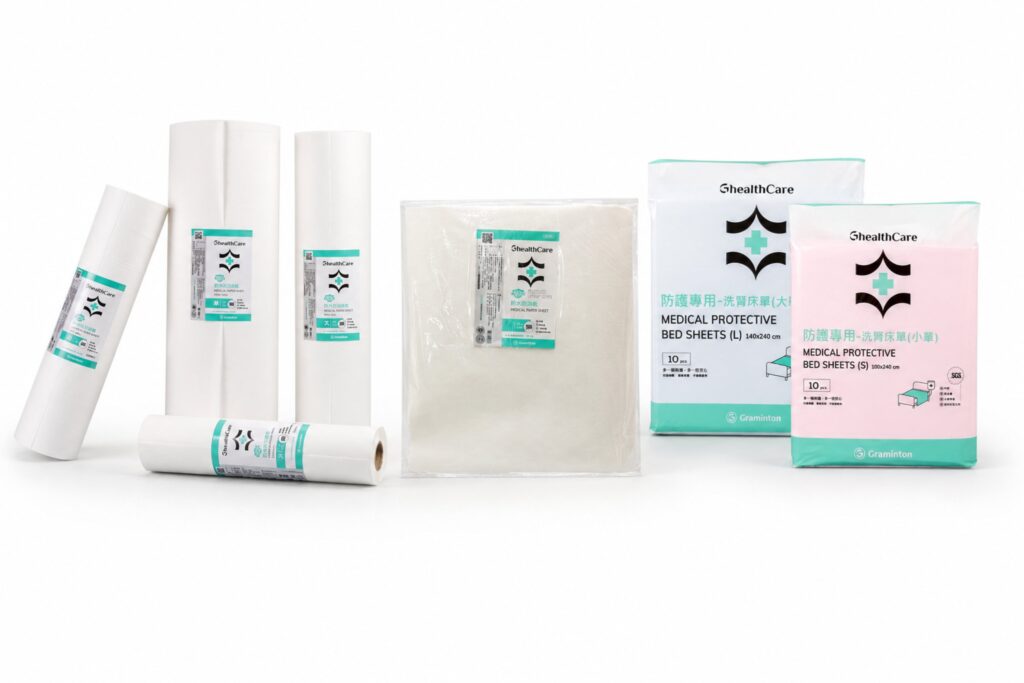
Here is what range consolidation looks like in practice, using Graminton’s own GhealthCare line — nonwoven medical consumables made in Taiwan and sold as finished goods in wholesale carton quantities:
| Category | Products | Notes |
|---|---|---|
| Exam table coverings | Medical table paper (rolls, pre-cut sheets, and thickened versions) | Roll vs sheet formats for different dispensing habits |
| Drapes | SMS drapes, aperture drapes, towel drapes | Formats compared in our surgical drapes guide |
| Patient bibs | Dental bibs, U-shaped bibs | Absorbent top layer with fluid-barrier backing |
| Underpads | Disposable underpads | Buying criteria in our underpads guide |
| Face masks | Adult medical face masks (classic and embossed colors) and kids’ sizes | Finished-goods wholesale; for private-label mask production see our medical face mask OEM guide |
| Facility cleaning | Low-lint dry wipes | Used for instruments and hard surfaces in hospitals |
For a clinic, this list covers most of the daily nonwoven consumption from a single order; for a distributor, it is a coherent product family to carry under one sourcing relationship instead of five.
How Does Bulk Ordering Work?
The standard path for wholesale buyers: send your item list and estimated monthly consumption → receive samples and product documentation → confirm specifications and packaging formats → receive a quotation with carton counts and lead time per item → schedule the first order, then move to a reorder cadence. Products are made in Taiwan and packed in standardized cartons; international buyers and distributors can inquire through the contact form with their location and volumes for shipping arrangements. Our product procurement service covers how sourcing and consolidation work for multi-item orders.
Two practical notes. Order in carton multiples — that is how pricing and freight are structured, and partial cartons rarely make commercial sense at wholesale. And start with samples even for simple items: a bib or table paper that looks identical on a datasheet can feel different in daily use, and validating with your own staff before committing to volume is the cheapest quality control you will ever run.
FAQ
Are medical consumables the same as disposable medical supplies?
Yes — the terms are interchangeable in practice. “Medical consumables” is more common in institutional and international procurement, “disposable medical supplies” or “medical disposables” in the US market, and “hospital consumables” when speaking specifically of institutional volumes. They all describe single-use products consumed in routine care, as distinct from durable medical equipment.
What certifications are needed for dental disposables?
It depends on how each item is classified in your market. Many dental disposables — bibs, tray covers, headrest covers — are low-risk items, while items classified as medical devices in your market carry registration requirements that vary by country. Rather than one universal certificate, three things tell you more: how the item is classified in its country of manufacture, what quality system the factory operates under, and what test documentation is available for the specific product — for example, absorbency and barrier-layer specifications for dental bibs.
Is it better to buy from a manufacturer or a distributor?
It depends on what you are optimizing. Distributors offer breadth — one order across hundreds of brands — and local warehousing. Manufacturer-direct offers source traceability, factory documentation, and batch-to-batch consistency from the same production line, which matters most for items you reorder continuously. Many facilities use both: a distributor for long-tail items, direct relationships for high-volume recurring consumables.
How do minimum order quantities and samples work?
Medical consumables sell in carton quantities, with per-item minimums quoted at inquiry — there is no universal MOQ number, because it depends on the product and format. Samples come first in every serious wholesale relationship: request them with your specification questions, validate in your own facility, then confirm quantities.
What is the advantage of consolidating consumables with one supplier?
Fewer purchase orders, fewer delivery schedules, fewer audits of supplier documentation — and one relationship to strengthen instead of five to maintain. Consolidation also improves your position on freight, since fuller cartons and combined shipments cost less per unit. The precondition is range: consolidation only works when one supplier genuinely covers most of your list, which is why product range is one of the five evaluation checks above.
Sourcing medical consumables for a clinic, hospital, care facility, or distribution channel? Send us your item list and estimated monthly volumes — we’ll reply with samples, documentation, and carton-level pricing from our Taiwan production.