
Food service wiping cloths (also sold as foodservice towels or foodservice wipers) are the towels, disposable wipers, and pre-moistened wipes used to clean food-contact and non-food-contact surfaces in food plants, commercial kitchens, and bars. Choosing them comes down to three questions: where the cloth is used, how it is handled between uses — kept dry, held in sanitizer, or discarded — and what documentation supports its use around food. This guide covers the U.S. rules behind those questions, a zone-by-zone selection table, and how disposable nonwoven wipers compare with laundered towels. For the products behind it, see our food industry solutions.
What Are Food Service Wiping Cloths?
“Wiping cloth” is the term the FDA Food Code uses. In practice it covers three product families that behave very differently once they are in use:
| Type | What it is | Typical use | Between uses |
|---|---|---|---|
| Laundered cloth towels | Cotton bar towels, terry, or microfiber, owned or rented | Bar service, front-of-house polishing, general kitchen wiping | Held in sanitizer (wet) or kept dry for one task, then laundered |
| Disposable nonwoven wipers | Wood-pulp, wood-pulp/polyester, or meltblown sheets on rolls or in folded packs | Prep surfaces, equipment, production lines, spill control | Discarded after the task, or returned to sanitizer between uses, depending on the grade and your procedure |
| Pre-moistened sanitizing wipes | Wipes saturated with a registered sanitizer or disinfectant | Spot sanitizing of surfaces and equipment | Single use, following the product label |
The first two are substrates: they carry whatever detergent or sanitizer your procedure specifies. The third carries its own chemistry, so its label governs contact time and where it may be used. Keeping the two apart matters in daily practice — a dry wiper is not a sanitizing wipe just because it is disposable, and a sanitizing wipe is not a general-purpose cloth.
What Do Food Safety Rules Say About Wiping Cloths?
For restaurants and other retail food establishments, the rule most U.S. health departments apply is FDA Food Code §3-304.14, “Wiping Cloths, Use Limitation,” adopted through state and local food codes. In summary:
1. Dry cloths used for wiping food spills from tableware and carry-out containers during service are kept dry and used for no other purpose.
2. Wet cloths used on counters and other equipment surfaces are held between uses in a chemical sanitizer solution at the concentration the code specifies, and laundered daily.
3. Raw animal foods — cloths used on surfaces that contact raw animal foods are kept separate from cloths used for other purposes.
4. Clean holding — dry cloths and the sanitizer solutions that hold wet cloths stay free of food debris and visible soil, and sanitizer containers are stored off the floor.
5. Sanitizer wipes — single-use disposable sanitizer wipes are used according to their EPA-approved label.
Local health departments turn those rules into their own routines, such as when sanitizer solution is changed and how often cloths are laundered. The details differ by jurisdiction, so check the requirements where you operate.
Food manufacturing plants work under a different rule set: FDA’s current good manufacturing practice regulation, 21 CFR part 117. Its sanitary-operations section, §117.35, requires cleaning and sanitizing that protects against contamination and allergen cross-contact, and it names paper towels among the single-service articles that must be stored, handled, and disposed of so they do not contaminate food. Which cloth goes on which line, and how often it is changed, is then written into each facility’s food safety plan, typically built on HACCP principles.
Disposable or Laundered: Which Wiping Cloth Fits Your Operation?
Both approaches can meet the rules. They differ in where the risk and the workload sit:
| Factor | Laundered cloth towels | Disposable nonwoven wipers |
|---|---|---|
| Cross-contamination between tasks | One towel can travel through a shift; control depends on bucket discipline | A fresh sheet per task, station, or zone |
| Sanitizer strength | Cotton can bind quaternary ammonium (“quat”) sanitizers and lower the concentration in the bucket (see FAQ) | Check how a candidate wiper performs in your sanitizer during a trial |
| Fiber shedding | Increases as towels wear and fray | Low-lint grades available; each sheet starts new |
| Logistics | Laundry pickup, soiled-linen storage, inventory loss | Stock rotation and a waste stream instead of laundry |
| Cost visibility | Low apparent cost per use; laundering, loss, and replacement sit in other budgets | Cost per sheet is visible and scales with use |
| Records | Laundry and rotation logs | Product specification and test reports per SKU |
Many operations run both: laundered towels for front-of-house polishing and bar service, and disposable wipers on food-contact surfaces and at raw-protein stations, where a cloth should never move on to another task. If you are replacing rags on production lines, our guide to multi-purpose vs power cleaning cloths explains how the two cloth families split the work and walks through line cleaning step by step.
Which Wiper Goes Where? Zones in Food Plants and Commercial Kitchens
Food plants commonly map their floor into four hygiene zones, the scheme FDA uses in its draft guidance on controlling Listeria monocytogenes in ready-to-eat foods: Zone 1 is food-contact surfaces, Zone 2 is non-food-contact surfaces next to them, Zone 3 is more remote surfaces inside the processing area, and Zone 4 lies outside processing, such as loading docks and locker rooms. Assigning wipers by zone keeps a cloth from carrying soil from a low-hygiene area onto a food-contact surface.
| Zone / area | Examples | What the wiper must do | Graminton options |
|---|---|---|---|
| Zone 1 — food-contact surfaces | Conveyors, slicers, prep tables, cutting boards | Remove soil ahead of sanitizing; low lint; one task, then discard or return to sanitizer | L7212 multi-purpose wipes roll (raised-dot texture, low lint), L7209 general cleaning cloths |
| Zone 2 — adjacent non-food-contact | Equipment frames, guards, control panels | Hold up to repeated wet or dry wiping | L7206 multi-task cleaning cloths (100% wood pulp, high absorbency), L7209 |
| Zone 3 — processing-area surfaces | Walls, drains, floor spills | Absorb water and oil; heavy-duty sheets | L7206; oil-only pads for floor oil (see our oil absorbent pads and booms guide) |
| Zone 4 — maintenance and support | Machine shops, parts and engine cleaning | Tolerate solvents and alcohol on greasy parts | L7207 power cleaning cloths (meltblown, acid- and base-resistant) |
| Commercial kitchen | Prep counters, refrigerators, tableware | Absorbent, dispensed one sheet at a time | L9150 quarterfold cloths (boxed against dust), L7211 multi-purpose wipes, L7106 / L7107 for small and mid-size restaurants |
Many plants and kitchens also color-code cleaning tools by zone or food type — cloths, buckets, or dispenser stations. Color is one widely used way to keep cloths used around raw animal foods separate from the rest. Whichever method you choose, write it into the sanitation SOP so every shift follows the same map.
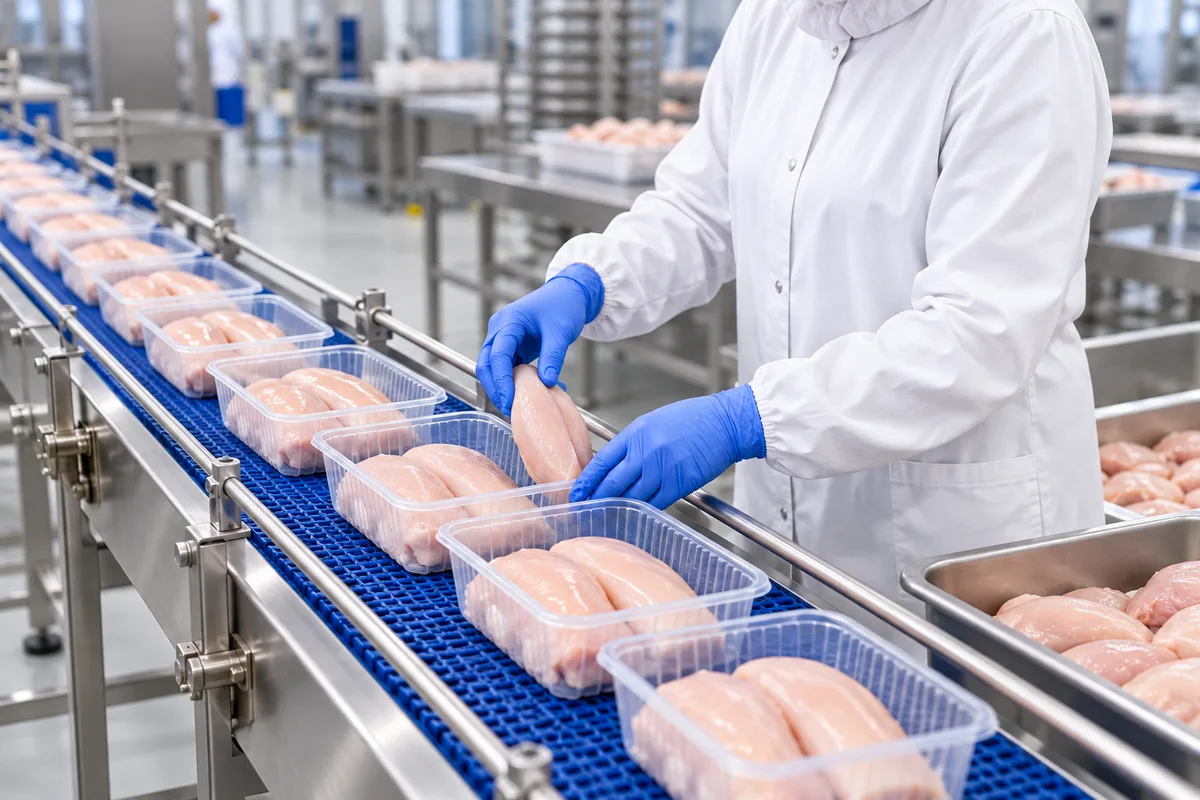
What Does "Food-Contact Tested" Mean for a Wiper?
“Food-safe” on a wiper’s packaging is not a single certification. What stands behind the claim is test documentation on the material itself. Documents that typically support a wiper’s use around food include:
- Food-contact and packaging-material testing of the substrate
- Restricted-substance tests, such as formaldehyde and heavy metals
- Migrating fluorescent agent tests for optical brighteners that could transfer from the sheet
- Microbial testing, such as E. coli
- A product specification — material, sheet size, and count — that matches what is delivered
On Graminton’s side, the LICK industrial line is made under an ISO 9001-certified quality system. Ten LICK SKUs — L7206, L7207, L7209, L7211, L7106, L7107, L7212, L9150, L7101, and L8138 — carry SGS test reports for food-contact and packaging materials, alongside SGS results for formaldehyde, heavy metals, E. coli, and migrating fluorescent agents. Test coverage varies by grade, and the SGS report for a specific product is available on request.
Food-contact rules differ by market — FDA regulations in the United States, Regulation (EC) No 1935/2004 in the European Union — so confirming what your market and your food safety plan require remains part of your own review. For how testing topics shift in other industries, see our industrial wiper supplier guide.
How Should You Stock and Dispense Wipers?
The format decides how much wiper each task uses, and how clean the unused stock stays until it is needed.
- Perforated rolls tear off one sheet at a time at high-volume stations: L7209 comes with 680 sheets (25.5 × 30 cm) or 900 sheets (30 × 35 cm) per roll, L7207 with 640 sheets (32 × 25 cm), and L7212 with 580 sheets (20 × 30 cm).
- Continuous rolls let staff tear the length a task needs — L7206 is a 23 cm × 176 m roll.
- Quarterfold packs dispense single sheets from a box that keeps dust off the stock: L9150 holds 160 sheets (30 × 30 cm) per pack, and L8138 packs 30 heavy-duty sheets (30 × 23 cm).
- Countertop rolls with a holder suit small kitchens — L7107 is the L7106 roll supplied with a roll holder.
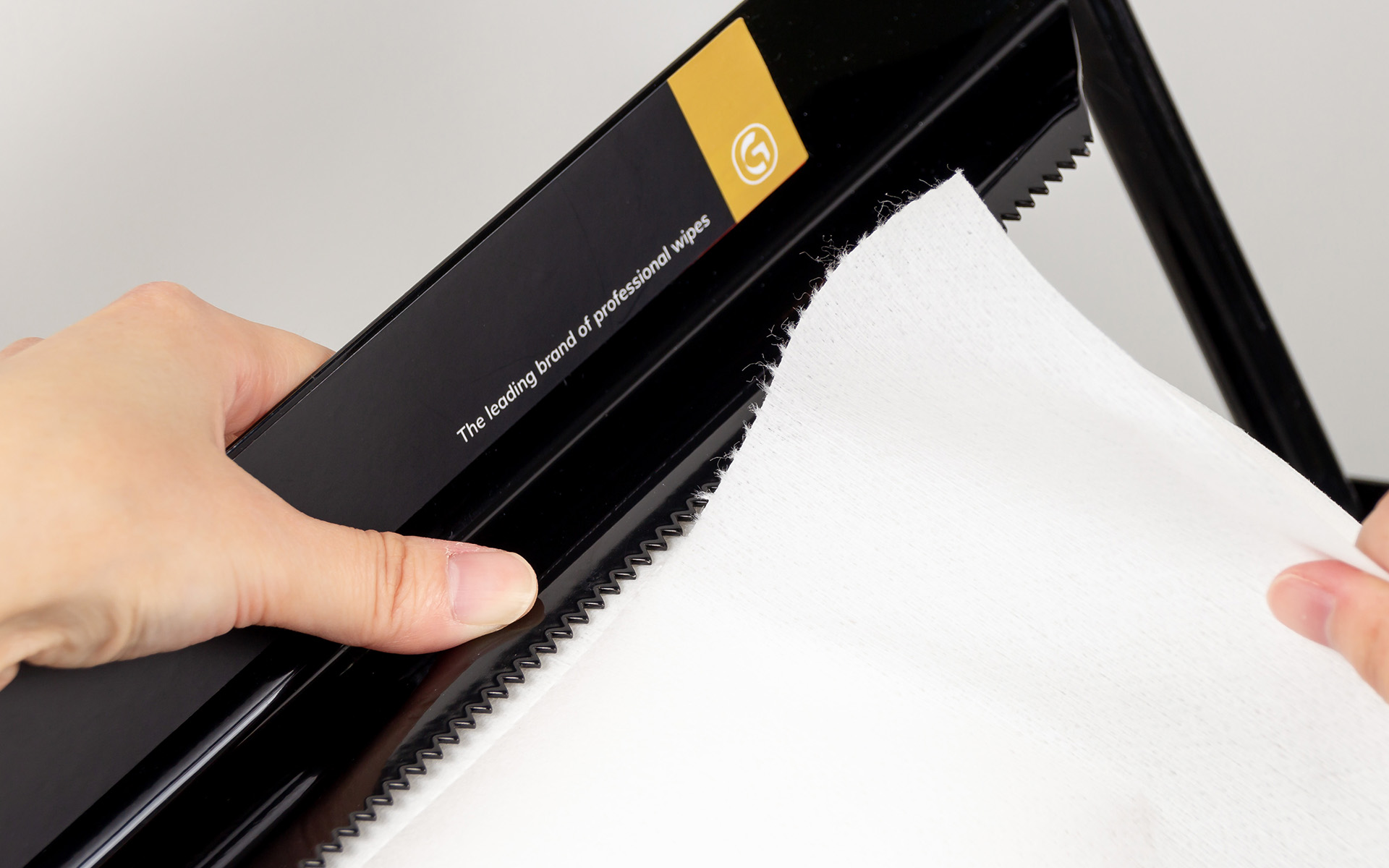
For line-side stations, the LE-0002 floor stand dispenser holds rolls up to 33 cm in diameter and width (up to 6 kg per roll), stands 92 cm tall with a tear-off bar, and weighs 2.7 kg, so it moves with the work. For roll loading and placement, see our guide to setting up a floor-stand wiping station. Keep wiper stock sealed in dry storage until use: U.S. manufacturing rules expect single-service articles to be stored and handled so they cannot contaminate food.
FAQ
Can paper towels be used on food-contact surfaces?
Yes, as single-use items. U.S. manufacturing rules (21 CFR 117.35) treat paper towels as single-service articles that must be stored, handled, and disposed of so they do not contaminate food. Keep in mind that a towel removes soil and liquid; sanitizing still depends on the sanitizer you apply, its concentration, and its contact time.
What is the difference between sanitizing wipes and wiping cloths?
Sanitizing wipes are pre-moistened with a registered sanitizer, and the Food Code requires single-use sanitizer wipes to be used according to their EPA-approved label. Wiping cloths — laundered towels or dry disposable wipers — carry no chemistry of their own. They are used with the detergent and sanitizer your procedure specifies, and a wet cloth that is reused goes back into sanitizer between uses.
How often should wiping cloths be changed?
Follow the routine your local health department sets for changing sanitizer solution and laundering cloths. Disposable wipers are simpler to manage: discard each sheet after its task or as soon as it is soiled, and keep cloths used around raw animal foods for that work only.
Can nonwoven wiping cloths be reused?
Some grades are built for it. L7206 and L7212 work wet or dry, and L7206, L7209, and L7212 are made for reuse — L7212 is washable for repeated use. If your procedure reuses a cloth during a shift, run a trial to confirm it holds up in the sanitizer you use, and follow your local rules for how reused cloths are stored between uses.
Do cloth towels affect sanitizer strength?
They can. Cotton towels can bind quaternary ammonium (“quat”) sanitizers and lower the concentration in the bucket. Whatever cloth you use, sanitizer test strips at each bucket are the practical check that the solution still meets its label concentration.
Should wiping cloths be color-coded?
Many food plants and kitchens do, as part of their food safety plans. Coding cloths, buckets, or dispenser stations by zone or food type keeps cloths used around raw animal foods separate from the rest, and writing the scheme into the sanitation SOP keeps every shift on the same map. What is required varies by jurisdiction, so check the rules that apply to you.
Sourcing wiping cloths for a food plant, a restaurant group, or a distribution business? Tell us your zones, sheet sizes, and monthly volume — we’ll reply with samples, the SGS reports for the SKUs you shortlist, and carton pricing for our Made in Taiwan LICK cloths.