
Automotive wipers, in a parts plant or repair shop, are the disposable shop wipes used on parts, engines, machines and work surfaces, not windshield wiper blades. Each station gets its own wipe: L7207 rolls or L8138 quarterfolds for degreasing parts and engine assembly, the raised-dot L7212 roll for machining lines and machine upkeep, LGK5 for inspection and precision parts, and the L7280 paper roll for light oil and small parts in the repair bay.
This guide is for auto, motorcycle and bicycle parts plants, repair shops and fleet depots, and the MRO distributors who supply them. It covers a station-by-station table, degreasing with solvent, what precision areas use, how to set up a repair bay, and how to turn station use into cartons.
Which Automotive Wiper Fits Each Station in a Parts Plant or Repair Shop?
Each station deals with different dirt and different surfaces, so a plant can match wipes station by station rather than using one everywhere.
| Station | What gets wiped | Suggested wipe | Format |
|---|---|---|---|
| Parts cleaning and degreasing | Oil, grease and cutting-fluid film on parts, wiped with the plant’s solvent | L7207 or L8138 | Perforated roll of 640, or quarterfold pack of 30 |
| Machining, presses and machine upkeep | Coolant, oil and swarf residue on machines, fixtures and workpieces | L7212 or L7209 | 580 sheets per roll, raised-dot texture |
| Engine and component assembly | Grease and fingerprints on parts and fixtures | L8138 | Quarterfold, one sheet at a time |
| Inspection and precision components | Surfaces that should not be scratched before measuring or packing | LGK5 | 300 per pack |
| Pre-paint wipe-down | Oil and dust on panels and parts, with the shop’s prep solvent | L7207, or LGK5 on scratch-sensitive surfaces | Roll or pack |
| Repair bay and service lane | Light oil, dipsticks, small parts and work surfaces | L7280 paper roll, L8138 for heavier grease | Roll on a floor stand |
| Oil drips on the floor | Leaks under vehicles and machines | LD oil-only pads | Pads or roll |
Tack cloths used just before painting are a different product and are not covered here. Stations outside the automotive line, such as food or print shops, are covered in our guide to industrial wipers by industry.
Which Wipe Handles Grease and Solvents on Parts and Engines?
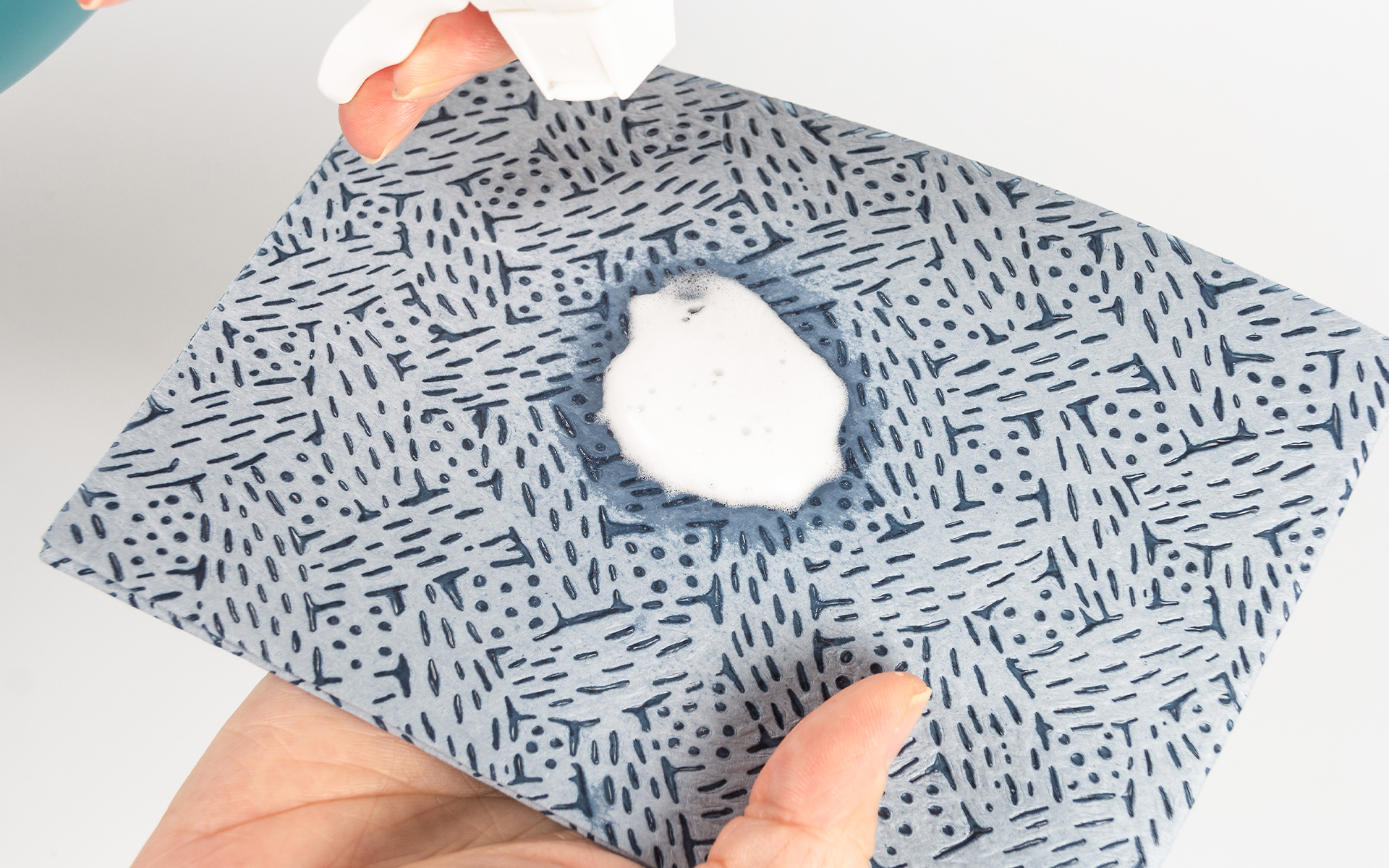
The L7207 and L8138 are the same material, a polyester meltblown nonwoven at 73 GSM and 0.8 mm thick. They differ in how they dispense.
| L7207 power cleaning cloths | L8138 quarterfold power cleaning cloths | |
|---|---|---|
| Sheet size | 32 × 25 cm | 30 × 23 cm |
| Pack and carton | 640 per perforated roll, 2 rolls per carton | 30 per pack, 24 packs per carton |
| How it dispenses | Tear along the perforation | Single sheets, folded in four |
| Best for | Fixed degreasing stations | Assembly stations and carts |
The product pages describe both as acid- and base-resistant and suited to solvents and alcohol, and list machines, parts, and engine assembly and repair among their uses. The L7207 page notes that it absorbs machine oil. A typical degreasing wipe runs like this:
- Let the part drain over the tray or parts washer before wiping, so the wipe picks up a film rather than standing oil.
- Wet a fresh L7207 sheet, or an L8138 from the pack, with the plant’s degreaser or solvent, applying it to the wipe rather than straight onto the part.
- Wipe the part from the cleanest area toward the dirtiest, folding the sheet to a clean face as it loads up.
- Finish with a dry sheet to lift the loosened oil and leftover solvent.
- Put used wipes in the closed container the site uses for oil- and solvent-soaked waste.
Parts washers, ultrasonic tanks and high-pressure cleaning are a separate process step. In auto parts cleaning, wipes handle the work before and after the washer, plus large parts, machines and work surfaces that never go in one.
What Should Machining, Assembly and Inspection Areas Use?
Each of these areas needs something different from its wipe.
Machining lines. The L7212 multi-purpose wipes roll is 20 × 30 cm, 580 sheets per roll, with a raised-dot texture. Its product page lists engine departments, machine upkeep, and wiping workpieces and processed parts, and describes it as absorbing water and oil, low lint, durable and compatible with solvents. The L7209, a wood pulp and polyester spunlace, is listed for precision machinery plants.
Assembly stations. The L8138 quarterfold comes out one sheet at a time with no tearing, so it is easy to count and keep at each station.
Inspection and precision components. LGK5 low-lint wipes are a plant fiber and polyester spunlace, 23 × 23 cm, 300 per pack. The product page lists car and bicycle component manufacturing areas and describes them as low lint, absorbent, soft and won’t leave scratches; low lint is among their SGS test items. Where a larger, tougher sheet that works with solvents is needed, the LGK7 (30 × 30 cm, wood pulp and polyester, dry or wet use) is an option.
Some automakers set technical cleanliness requirements for parts; meeting them is verified through the customer’s and the plant’s own testing.

What Do Repair Shops and Service Bays Need?
A repair bay runs on three items:
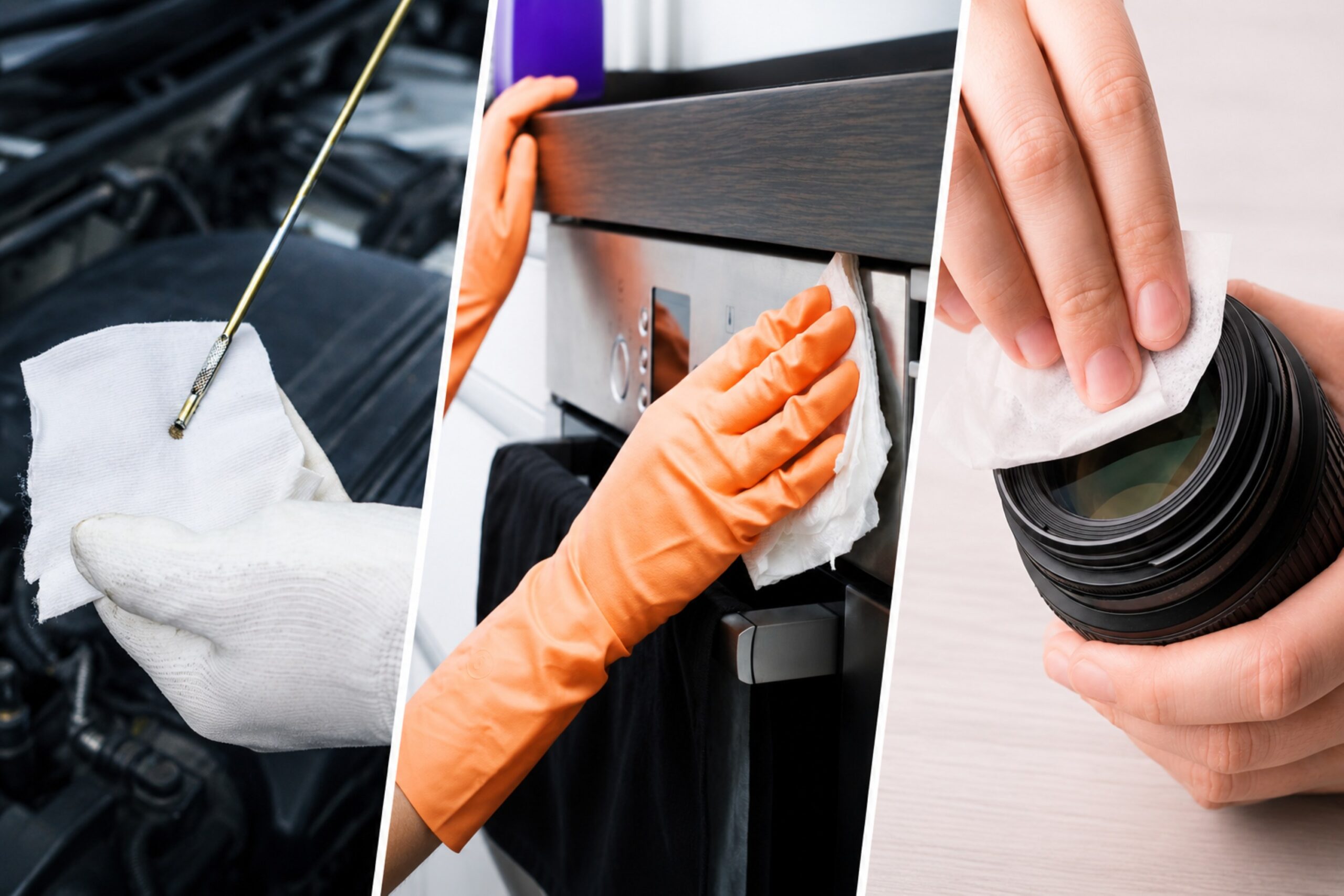
- A paper roll for light work. The L7280 paper wiper roll (25.5 cm × 794 m, 2 rolls per carton) is described as ideal for electronic parts and automobile repair factories, absorbent, low lint and unlikely to scratch surfaces.
- A heavier wipe for grease. The L8138 quarterfold handles heavier grease and solvent work.
- Oil-only pads for the floor. LD oil-only pads absorb more than 12 times their own weight in oil; actual take-up varies with oil viscosity and temperature.
Mount the paper roll on the LE-0002 floor stand, which holds a full roll up to 33 cm in diameter, 33 cm wide and 6 kg. For the setup steps, see setting up a floor-stand wiping station. For moving a shop off cloth mechanic rags, see replacing shop rags with industrial wipes, and for leaks under vehicles, cleaning up an oil spill at work.
How Many Automotive Wipers Does a Plant or Shop Use, and How Do You Order?
Work out monthly use from each station:
- Monthly sheets = sheets per station per shift (average over a few shifts) × number of stations × shifts per day × working days per month
- Cartons = monthly sheets ÷ sheets per carton, rounded up, plus safety stock
| Wipe | Per carton |
|---|---|
| L7207 | 1,280 sheets (640 per roll × 2) |
| L8138 | 720 sheets (30 per pack × 24) |
| L7212 | 1,160 sheets (580 per roll × 2) |
| L7209 | 1,360 sheets (680 per roll × 2); 30 × 35 cm format, 900 per roll, 1 roll |
| LGK5 | 3,000 sheets (300 per pack × 10) |
| LGK7 | 1,600 sheets (100 per pack × 16) |
| L7280 | 2 rolls of 794 m |
As an example with assumed numbers: six degreasing stations each using 25 L7207 sheets per shift, on two shifts a day and 22 days a month, use 6,600 sheets, or 6 cartons. For comparing wipes beyond the price per sheet, see the cost per use of industrial cleaning wipes.
LICK products are made under an ISO 9001-certified quality system, and the wipes listed here carry SGS results for formaldehyde, heavy metals, E. coli and migrating fluorescent agents. How solvent-soaked wipes are stored and disposed of depends on local rules and each chemical’s SDS, so check the requirements where you operate.
FAQ
Are automotive wipers the same as windshield wipers?
No. In parts plants and repair shops, automotive wipers or shop wipes are the disposable wipes used on parts, machines and surfaces; windshield wipers are a vehicle part. This guide covers only the first.
What is the difference between mechanic rags and shop towels?
Mechanic rags are usually washable cloth or recycled textile. Shop towels can mean washable cloth towels or disposable paper and nonwoven rolls. Disposable wipes replace both at the stations above.
Can these wipes be used with brake cleaner or degreaser?
The L7207 and L8138 product pages list them as acid- and base-resistant and suited to solvents and alcohol. Test any new wipe with the exact chemical first and check for fuzzing or tearing. Keep wipes away from flame, as the precautions note, and let engines and exhaust parts cool before wiping.
Are these wipes lint-free?
We describe them as low lint, and the LGK5 and LGK7 list low lint among their SGS test items. No wipe is entirely free of lint.
Can a distributor get these wipers under its own brand?
Private label applies to the LICK wipers and paper rolls (L7207, L8138, L7212, L7209 and L7280), with options such as size, fold, roll length and packaging; printed packaging sets the minimum order. The LGK5, LGK7, LD pads and LE-0002 stand are supplied as standard products. Distributors building a full range can see our janitorial supply list for wipers.
Supplying an automotive parts plant, a repair shop or a fleet depot, or distributing to them? Tell us your stations, the oils and solvents you use, and your monthly usage. We will match L7207, L8138, L7212, LGK5 or L7280 to each station and send samples, SGS reports and a quote.