
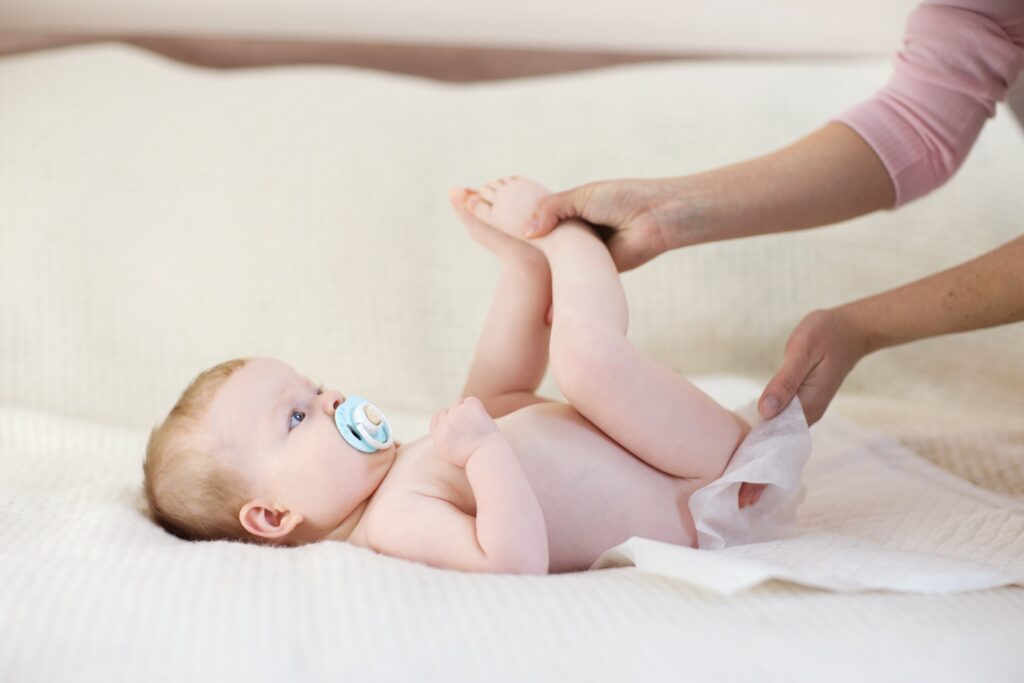
Baby dry wipes OEM means a factory manufactures dry, formula-free baby wipes — the fiber-only cloths parents wet with warm water — to your specification and under your brand. Unlike wet wipes OEM, there is no formula to develop and no preservative system to stabilize: the product is engineered entirely in the fabric, which makes material choice, infant-safety testing, and converting quality the whole game. This guide explains how a dry wipes OEM project works with Graminton, a Taiwan manufacturer that runs the same products under its own retail baby brand: the formats you can build on, the material ladder, the test documentation, how minimums are set, and the path from sampling to shipped cartons.
What Can a Baby Dry Wipes OEM Program Cover?
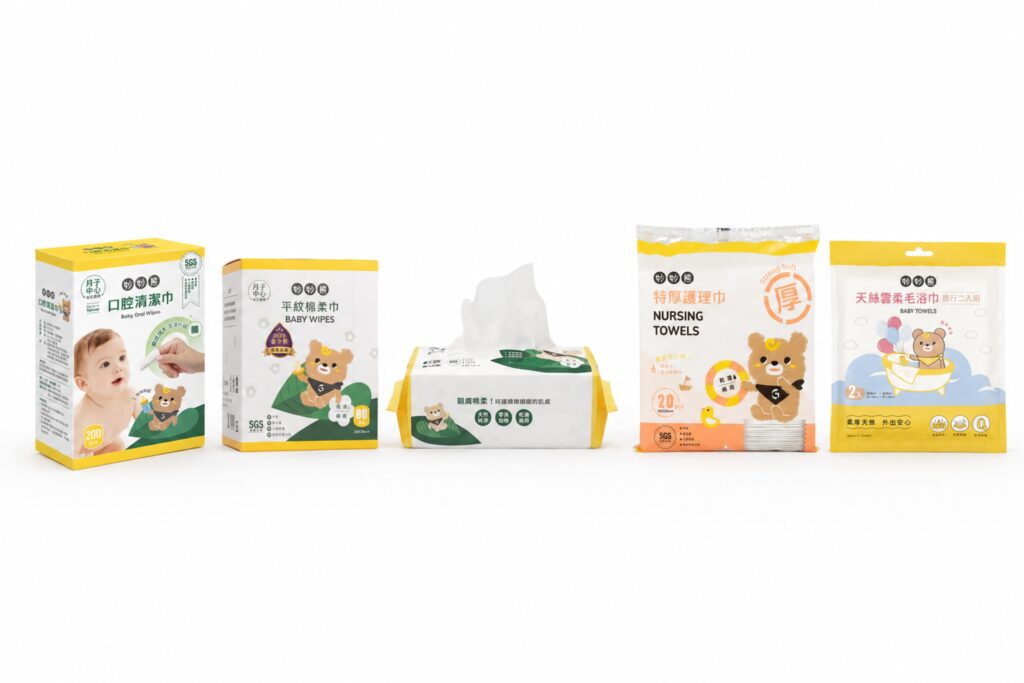
Most projects start from a proven platform rather than a blank sheet. Graminton’s OEM program for baby dry wipes is built on five production-validated formats — the same range sold at retail under the company’s G Bear brand:
| Platform | Material | Sheet size | Pack structure | Brand role |
|---|---|---|---|---|
| Baby dry wipes (standard) | Cotton nonwoven | 20 × 20 cm | 80 pcs/pack × 36 packs/carton; 15-count travel pack × 50/carton | Volume core — daily nursing and diaper changes |
| Baby Wipes | Plant fiber / Tencel fiber blend | 20 × 20 cm | 70 pcs/pack × 40 packs/carton | Premium “Tencel Fiber” claim for newborn positioning |
| Cotton Dry Wipes | 100% cotton | 20 × 20 cm | 70 pcs/pack × 40 packs/carton | One-ingredient 100% cotton claim for newborn and clean-label positioning |
| Ultra-soft dry wipes | Cotton nonwoven, low-lint | 30 × 30 cm | 20 pcs/pack × 60 packs/carton | Large-format sensitive-skin and bathing line |
| Ultra-thick dry wipes | Pulp nonwoven | 30 × 30 cm | 20 pcs/pack × 60 packs/carton | Fluffy, tear-resistant “extra thick” differentiation |
Private label on these formats — your artwork, your pack counts — is the fastest route to shelf, because the product engineering, converting, and safety testing already exist. Format adjustments such as sheet count and pack presentation are scoped per project in the quotation stage.
Two notes on scope. First, the wider Graminton catalog spans adjacent baby-care disposables — oral cleaning wipes, baby towels, gauze-style wipes, and disposable bibs — which buyers often fold into the same inquiry; availability for private label is confirmed item by item. Second, the same converting capability produces adult facial dry wipes: if your brand plan includes a face-wipes line for beauty or pharmacy channels, our guide to disposable face towels covers that category’s textures and formats.
Which Material Should Your Brand Build On?
Material is the positioning decision in a dry wipe, because there is nothing else in the product — no lotion, no fragrance, no preservative story to tell. The ladder runs in four steps:
- Cotton nonwoven — cotton fiber entangled into a soft, absorbent, durable cloth. The workhorse: soft enough for daily nursing and diaper-change use at a volume-friendly cost. This is the fabric of the standard and ultra-soft platforms.
- 100% cotton — the purest fiber declaration on the pack, highly breathable and gentle, aimed squarely at newborn-focused and “clean label” brand positioning. It supports the strongest shelf claim in the category: one ingredient.
- Plant fiber / Tencel blend — plant fiber for absorbency with Tencel (lyocell) for a smooth, cool hand-feel. It is the premium platform, positioned on softness for sensitive newborn skin rather than on a single-ingredient claim.
- Pulp nonwoven — a fluffy, thick, high-absorbency sheet that will not tear easily in use. It owns the “extra thick” slot, which in Graminton’s home market sustains its own search demand — a differentiation lane many Western brands have not filled yet.
One brand can ladder across these steps: a cotton-nonwoven entry line, a pure-cotton newborn line, and a thick pulp line — three price points from one supplier without new tooling. Honest fiber declaration matters commercially as well as legally: the fiber line is the claim parents read, so what the label says must match what the fabric is. For the retail strategy view of how these formats sit on a shelf, see our baby dry wipes sourcing guide.
What Testing Does a Baby Dry Wipe Need to Pass?
There is no single mandatory global certificate for a dry fiber wipe — which is exactly why buyers and marketplace compliance teams lean on third-party test reports. Two layers matter:
1. Product-level restricted-substance and hygiene testing. Every Graminton baby dry wipes platform above carries SGS test reports covering four items: formaldehyde, heavy metals, E. coli, and migrating fluorescent agent. These are the checks that answer a retail QA team’s actual questions — is there anything in the fiber that should not touch infant skin, and is the product hygienically clean off the line?
2. Market-level benchmarks. Internationally, textile products intended for babies are commonly benchmarked against OEKO-TEX Standard 100 Product Class I — the strictest class, applied to articles for children up to three years, with limits such as formaldehyde below 16 mg/kg. Treat it as the reference yardstick for what “safe for baby skin” means in textiles when you brief any supplier and set your own brand’s spec.
Beyond chemistry, physical QA matters just as much: a baby wipe must not shed lint on damp skin, packs must survive humid retail environments, and sheet size and count must hold to tolerance. All five Graminton platforms are made in Taiwan with per-batch production control, and physical samples are part of every project start — test them wet, the way a parent uses them.
A structural advantage worth understanding: because a dry wipe contains no liquid formula, it avoids the entire preservative-efficacy and formula-stability testing burden that wet wipes carry (more on the regulatory difference in the FAQ). Fewer failure modes, simpler documentation, faster iterations.
How Do MOQ and Packaging Work for Private Label Baby Wipes?
Minimums in this category follow production logic, and for dry wipes they are structurally friendlier than for wet:
- Packaging sets the floor. The wipes themselves run on existing converting lines; printed retail packaging is produced in plant-scale runs, so your printed film or cartons — not the cloth — are usually the binding component. Ask for the minimum broken down per component, and expect packaging runs to drive it.
- Carton multiples. Quantities are quoted in cartons (for example, 80 pcs/pack × 36 packs on the standard platform), so order sizes land on carton math rather than round marketing numbers.
- Changeover economics. Each variant — size, count, pack artwork — carries its own minimum because converting lines run one spec at a time. Consolidating variants into fewer, better-chosen SKUs lowers your entry threshold.
- Mixed programs help. Combining several platforms in one shipment — standard plus thick, retail packs plus travel counts — is generally easier than pushing a single small custom run.
Compared with wet wipes projects, there is no formula development phase and no filling line to book, which removes the cost items that push wet-wipe minimums up. The practical guidance: bring your target retail price and channel, and work backward with the factory to the pack format and order structure that fit — a transparent supplier will show the breakdown rather than quote one number.
How Does a Dry Wipes OEM Project Run from Sampling to Production?
A typical project with Graminton moves through five stages, coordinated through our product customization service:
1. Requirements briefing — target market and channel, material tier, sheet size and count, pack format, and estimated volumes. This determines which platform and line apply.
2. Sampling — you receive physical retail-grade samples of the relevant platforms; evaluate hand-feel, wet strength, and lint behavior against competitor products in your market.
3. Specification and quotation — confirmed spec, per-carton pricing, minimums per component, and lead-time estimate for your configuration.
4. Artwork and pre-production confirmation — your packaging artwork over the factory’s product and compliance text; pack dielines and labeling claims are locked against the test documentation so the pack never promises what the reports don’t support.
5. Production, QC, and shipment — converting, pack-off, final inspection, and export packing, with test documentation supplied for your import and marketplace listings.
Because the platforms are already retail-proven, private label projects skip the longest phase of most OEM timelines — product development. Confirm the lead time for your specific configuration at the quotation stage; it depends on packaging print runs and seasonal capacity.
Why Work with a Factory That Runs Its Own Retail Baby Brand?
The fastest audit of a baby wipes manufacturer is to look at what it sells under its own name. Graminton’s five dry-wipe platforms are not OEM-only specs on a rate card — they are live retail products under the G Bear brand, part of the company’s maternal and baby care program. For a brand builder, that means three things you can verify before you commit:
- The retail problems are already solved — shelf claims, pack integrity in humid stores, consumer-scale consistency — on the exact products you will private-label.
- You can buy the reference off the shelf. Evaluating the factory’s own retail product is cheaper and more honest than any brochure.
- The factory feels its own quality feedback. A manufacturer whose consumer reviews land on its own brand has skin in the game a contract-only converter does not.
Add the origin story — made in Taiwan, SGS-tested, dry-format specialist rather than a wet-wipes plant running dry cloths as a side line — and you have the supplier profile the private-label baby category currently lacks in English-language sourcing.
How to Choose a Baby Dry Wipes Manufacturer
Supplier lists for private label baby wipes are dominated by wet-wipes plants, so a dry-format buyer needs a shorter, sharper checklist. Five points separate a manufacturer you can build a brand on from one that only quotes well.
1. Material and test documentation
The documents that count are the fiber declaration and the third-party test report for each platform you intend to brand — not a generic factory certificate. For Graminton’s dry wipes platforms, SGS reports cover formaldehyde, heavy metals, E. coli, and migrating fluorescent agent. The report date should be current, and the tested item should be the SKU you are actually buying.
2. Production environment and quality control
A dry wipe is a skin-contact product for infants, so the points to cover are how converting and pack-off areas are kept clean, how incoming fabric is inspected, and how each batch is checked for sheet size, count, and lint. Graminton runs per-batch production control on the platforms above and can walk you through the inspection points at the quotation stage.
3. Packaging and customization scope
Confirm what is genuinely open to private label before you plan a range. At Graminton, the baby dry wipes platforms in the table above and the cotton pad range (see our cotton pads guide) are available for OEM and private label — your artwork, pack counts, and pack presentation, scoped per project. Adjacent catalog items are confirmed one by one.
4. Sampling process
A serious manufacturer sends physical, retail-grade samples of the platforms that fit your brief before any quotation is final. Evaluate them wet, compare them with the products already on your target shelf, and — where the factory sells its own retail brand — buy that version too. Sampling is the cheapest audit you will ever run on a supplier.
5. Supply stability
Ask where the products are made, how long each platform has been in continuous production, and how seasonal capacity is planned. Graminton’s dry wipes are made in Taiwan on formats that already run at retail under the G Bear brand, so fabric supply, converting lines, and pack specifications are established rather than set up for your order.
FAQ
What is the difference between dry wipes OEM and wet wipes OEM?
They are different projects in different regulatory worlds. A baby wet wipe is impregnated with a liquid formula intended to clean the skin, so in the EU it falls under the Cosmetics Regulation (EC) No 1223/2009 — meaning formula development, preservative-efficacy testing, a product information file, and cosmetics-grade production. A dry wipe contains no formula, so in the EU it is not treated as a cosmetic product: the compliance load centers on fiber safety testing instead. That is why dry-wipe projects have fewer cost components, simpler documentation, and structurally lower entry minimums.
What is “cotton tissue” — is it the same as baby dry wipes?
Cotton tissue is a retail name, common with Asian brands, for soft dry wipes sold for face and baby care — functionally the same product family as baby dry wipes. Caution: the name does not guarantee the fiber. Some products sold as cotton tissue are viscose or polyester-blend fabrics — soft and legitimate, but not cotton. Always read the fiber declaration, and make sure your own pack copy matches your fabric; “cotton” on the pack with blended fiber inside is a compliance and trust problem waiting to happen.
Can we evaluate the product before starting an OEM project?
Yes, two ways: request a sample kit of the platforms that fit your brief, and — the stronger test — obtain the G Bear retail versions and judge them as a consumer would. Testing the factory’s own shelf product tells you what your customers will experience, not what a spec sheet promises.
How much volume does a new brand need to get started?
Less than the wet-wipes numbers you may have seen quoted elsewhere, because there is no formula or filling economics involved. The practical floor is set by printed packaging runs, and it varies with pack format and artwork complexity — so the honest answer is a breakdown, not a single figure. The staged route works well: start with private label on one or two existing platforms with efficient pack formats, then expand the range as sell-through proves out.
What certifications should a baby wipes manufacturer have?
For a dry, formula-free wipe there is no single mandatory certificate, so documents matter more than logos. The core item is a third-party restricted-substance and hygiene report on the exact SKU — for Graminton’s platforms, SGS tests for formaldehyde, heavy metals, E. coli, and migrating fluorescent agent — plus a fiber declaration that matches the pack copy. Use OEKO-TEX Standard 100 Class I as the market yardstick when you set your own spec. Wet wipes need a longer list, because a skin-cleansing liquid formula brings cosmetics-regulation obligations in markets such as the EU that a dry wipe does not carry.
Building a baby dry wipes line under your own brand? Tell us your target market, material tier, and pack format — we’ll reply with platform specs, a minimums breakdown by component, and sample arrangements.