

Cotton pads — the small disposable pads (also sold as cotton rounds or makeup remover pads) used to take off makeup, apply toner, press on a wet compress, or remove nail polish — are one of the most dependable repeat-purchase items on a beauty shelf. Every skincare routine that uses a toner or a micellar water burns through them daily, and they never migrate out of the bathroom cabinet. For retailers and private-label brands, that makes cotton pads a low-risk, high-frequency category — provided you source on the one axis shoppers actually complain about. This guide covers the category logic, the formats that cover the shelf, the quality axis that separates a premium pad from a commodity one, and the private-label options.
Why Are Cotton Pads a Category Worth Stocking?
Three things make cotton pads a resilient facing for a range planner:
- Daily, non-negotiable consumption. A pad is spent the moment it touches remover or toner. A shopper following even a basic routine uses one to three a day — a repurchase cadence closer to a household staple than a beauty treat, with far less expiry pressure than a wet or pre-soaked product.
- One product, many jobs. The same pad removes makeup, applies toner, does a targeted wet compress, preps skin before serum, and takes off nail polish. That multi-use surface keeps the SKU relevant across skincare, color-cosmetics, and nail shoppers.
- A built-in upgrade story. The commodity end of this category sheds fibers — the number-one complaint shoppers voice about cotton rounds. That complaint is exactly what a better-engineered pad sells against, which is why the category supports a premium tier rather than racing to the bottom on price.
Cotton Pads vs Cotton Rounds vs Makeup Pads — What's the Difference?
Mostly branding, not substance. “Cotton rounds” are simply round pads; “cotton pads,” “makeup pads,” and “makeup remover pads” are the same disposable squares or ovals sold under a use-led name. Marketplaces list all of them interchangeably, so a range should target the phrase its shoppers search rather than pick a technically correct one.
One clarification matters more than the naming: a dry cotton pad is fiber only — the shopper adds their own toner or remover — while pre-soaked “toner pads” are a different, formula-bearing product with a shelf-life clock. This guide is about the dry format, which carries no preservative system and far less expiry pressure.
Which Cotton Pad Format Fits Which Use?
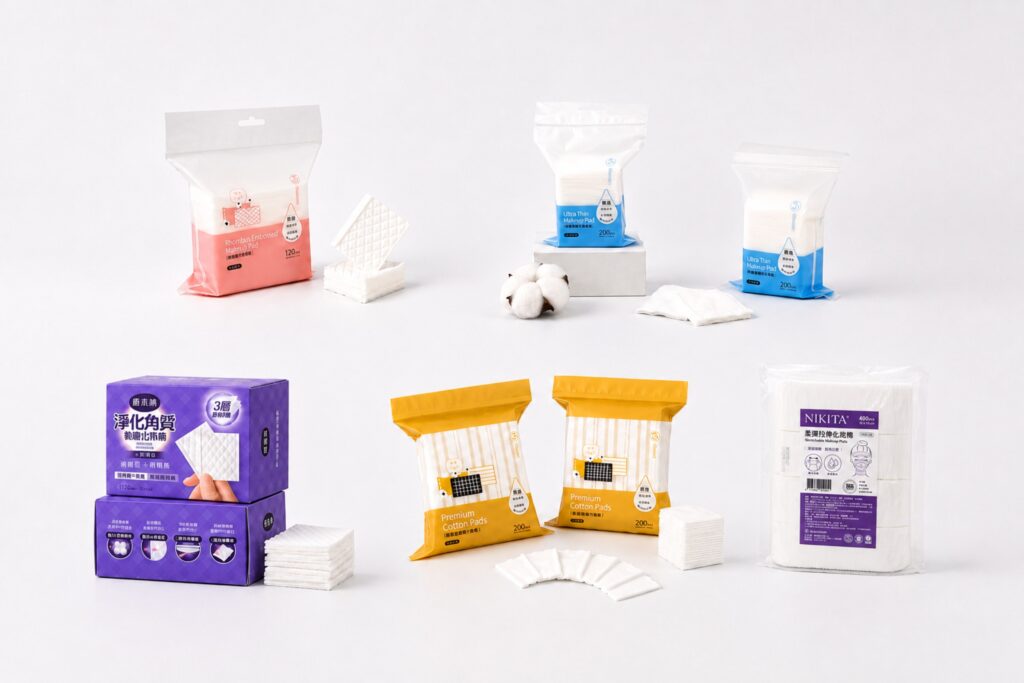
A short range covers the whole category without overlap. This is the architecture of Graminton’s own Gbuuty retail line, with the professional NIKITA format alongside:
| Format | Product | Spec | Best for |
|---|---|---|---|
| Premium low-lint | Premium cotton pad | Cotton, 3-layer, dual-sided (smooth + textured), 50 × 60 mm | The everyday hero — makeup removal and toner with minimal shedding |
| Textured cleansing | Embossed makeup pad | Cotton, rhombus emboss, 50 × 60 mm | Deeper cleansing and light exfoliation; also nail-polish removal |
| Ultra-thin compress | Ultra-thin makeup pad | Rayon/polyester, thin & stretchable, 50 × 60 mm | Wet compress and toner masking that fits close to the skin |
| Dual-effect prep | Skinprep cushion pads | Cotton, cushioned, 50 × 60 mm | Toner patting and skin prep before serum |
| Stretch wet-mask | Stretchable makeup pads | Rayon/lyocell, 10 × 10 cm, 400 pcs | Soak with toner, stretch, and lay on as a localized sheet compress |
| Cotton-soft tissue | Premium cotton-soft tissues | Rayon/polyester, 20 × 20 cm | The larger tissue format for face washing and makeup removal |
The stretch wet-mask format is the one that separates a specialist supplier from a generic one: a shopper soaks it, stretches it thin, and wears it as a toner-loaded local compress — a ritual with real demand in Asian skincare that a plain round can’t serve.
Why Does Lint Separate a Premium Pad from a Commodity One?
Shedding is the defining quality axis in this category. The most common shopper complaint about cheap cotton rounds is that fibers break off and cling to the face — worse still mid makeup-removal, when the pad is soaked. A pad earns its premium price by not doing that.
Two construction choices drive low linting: a multi-layer build with sealed edges so the pad holds together when saturated, and fiber engineering that gives the pad wet strength so it doesn’t pill or tear under pressure. Graminton’s premium cotton pad is a three-layer, dual-sided cotton construction — a smooth side for toner and a lightly textured side for cleansing — designed specifically to stay intact through a full makeup-removal pass. When you evaluate any supplier, saturate a sample with micellar water and a nail-polish remover, wipe under pressure, and check both the skin and the pad edge for fiber loss.
What Specs and Documentation Should Buyers Check?
The import checklist for cosmetic pads is short but exacting:
1. Fiber content — cotton for the cotton pads, and soft rayon/polyester or rayon/lyocell for the ultra-thin and stretch formats; state it on the label exactly as the goods are, especially where your market polices fiber claims. Fiber backgrounds are in our nonwoven fabric types guide.
2. Restricted-substance and skin-safety testing — Graminton’s cosmetic pads carry SGS reports for formaldehyde, heavy metals, E. coli, and migrating fluorescent agent, with skin-irritation testing on the premium lines. Skin-contact products without this documentation are a marketplace-compliance and recall risk.
3. Lint and wet strength — request samples and run the saturated wipe test above; this is the single most predictive quality check.
4. Size, count, and edge finish — 50 × 60 mm is the makeup-pad standard; count per pack and a clean sealed edge determine both cost-per-use and shed behavior.
5. Batch traceability — per-batch documentation is standard from an export-oriented manufacturer and is what retail QA teams ask for.
How Do Private Label, MOQ, and Carton Math Work?
Cotton pads suit brand-building because the product is simple and the shelf story — softness, low lint, clean testing — is easy to tell:
- Private label on proven specs — your brand on the formats above; the fastest route, with minimums driven mainly by printed-packaging runs rather than production.
- Format and shape customization — round vs square vs oval, pad thickness, pack count, and dispenser style tuned to your channel's price points.
- Price per piece, not per pack — divide carton price by total pieces (for example, 200 pcs/pack × 36 packs/carton) to get the real unit cost to compare across suppliers and against your retail architecture.
Graminton manufactures the range in Taiwan and sells it under its own Gbuuty and NIKITA brands, so the factory has already solved retail packaging, skin-safety documentation, and consistency at consumer scale — the same lines take OEM orders alongside the spa & salon disposables program. Professional and retail buyers stocking a fuller basket can cross-reference our salon & spa disposables guide, and estheticians choosing pads for treatment use can start with our salon cotton pads guide. Brands building a facial-cleansing range alongside pads can pair them with disposable face towels; that guide covers textures and materials.
FAQ
Are cotton pads and cotton rounds the same thing?
Effectively yes — “cotton rounds” are round pads and “cotton pads” or “makeup remover pads” are the same disposable squares or ovals under a different name. Buy by the term your shoppers search; the product is the same.
What are the pads made of?
The cotton pads are cotton, built in a soft multi-layer construction for low linting. The ultra-thin format uses rayon and polyester, and the stretchable format rayon and lyocell — fibers chosen for wet strength and close skin contact. Full fiber content is listed on every spec sheet.
Which pad is best for a toner compress?
The ultra-thin and the stretchable formats. Soak either with toner, and — with the stretch pad — pull it thin and lay it on as a localized sheet compress; it clings closer to the skin than a rigid round.
Do they hold up for nail-polish removal?
Yes, when the construction is right. A multi-layer, sealed-edge pad stays intact through acetone and heavy makeup removers; a thin single-layer commodity pad is where shredding and fiber transfer happen.
Disposable or reusable — which should a retailer stock?
Both have a shopper. Reusable pads answer the sustainability question; disposable pads win on hygiene and convenience, especially for makeup removal where you don’t want to reuse a soiled surface. Many ranges carry both and let the shopper choose.
Sourcing cotton pads for a store or your own beauty brand? Tell us your formats and volumes — we’ll send material samples, carton pricing, and private-label options.