
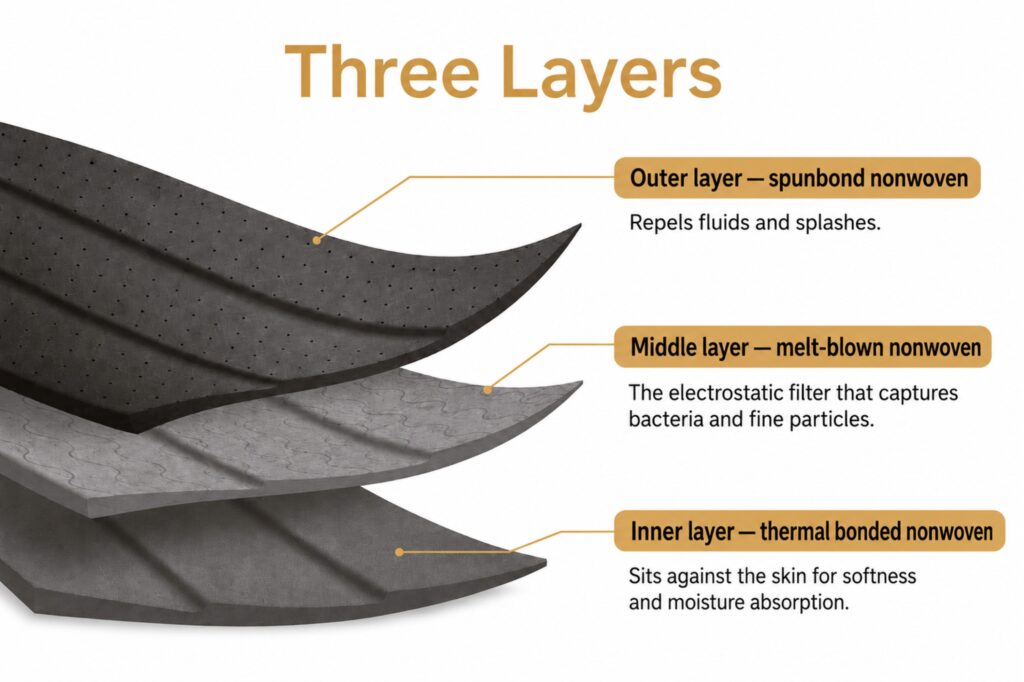
A typical medical face mask is made of three layers of nonwoven fabric, mostly polypropylene (PP), each doing a different job: a fluid-repellent spunbond outer layer that blocks droplets, a meltblown middle layer that does the actual filtration, and a soft inner layer — thermal-bonded in our masks — that sits against the skin and manages moisture. The mask’s protective power lives almost entirely in that thin meltblown core — which is why two masks that look identical can perform completely differently, and why standards testing, not appearance, is how buyers should judge them. Here’s what each layer does, how the materials are made, and how certification verifies the whole stack.
What Are the Three Layers — and What Does Each Do?
Using the actual construction of Graminton’s GhealthCare medical masks (spunbond nonwoven, melt-blown nonwoven, thermal-bonded nonwoven):
| Layer | Material | Job |
|---|---|---|
| Outer | Spunbond PP nonwoven, water-repellent treated | Blocks droplets and splashes from outside; carries the mask’s color and printing |
| Middle | Meltblown PP nonwoven, electrostatically charged | The filtration core — captures bacteria and fine particles |
| Inner | Thermal-bonded nonwoven, soft finish | Touches the face; absorbs breath moisture and keeps wear comfortable |
The division of labor is strict. Remove the outer layer and droplets soak the filter; remove the inner and moisture degrades comfort and fit; remove the middle and you have a face covering, not a medical mask. All three are nonwovens — fibers bonded into fabric without weaving — which is what makes masks breathable yet filtering, and disposable at scale (the fabric family is explained in our nonwoven fabric types guide).
Why Is the Meltblown Layer the Filtration Core?
Meltblown fabric is produced by blasting molten polypropylene through fine nozzles with hot air, spinning fibers far thinner than a human hair into a dense random web. Two mechanisms make that web a filter:
1. Mechanical capture — the maze of ultra-fine fibers gives particles an enormous surface to collide with and stick to, while the open structure still lets air through.
2. Electrostatic capture — the fabric is charged during production (an electret treatment), so the fibers attract and hold particles far smaller than the physical gaps between them.
This is how a layer a fraction of a millimeter thick reaches BFE ≥95% (bacterial filtration efficiency) — the benchmark GhealthCare masks are tested to under CNS 14774. It is also why wetness, solvents, or washing destroy a medical mask’s performance: the electrostatic charge doesn’t survive them, even though the fabric looks unchanged. Single-use isn’t marketing — it’s physics.
What Does ASTM F2100 Actually Test?
ASTM F2100 is the US performance standard for medical face masks. It does not test fit or seal — it tests the layered materials as they sit in the finished mask, and sorts masks into Level 1, 2 or 3 according to how they score on five tests. The thresholds for each level are published in the standard itself; what matters for a buyer is knowing what each test measures and how to read the report.
1. Bacterial filtration efficiency (BFE, ASTM F2101) — a bacteria-laden aerosol is drawn through the material and the captured fraction is measured. This is the headline filtration number on most datasheets.
2. Sub-micron particulate filtration efficiency (PFE) — the same idea with sub-micron particles, which is where the meltblown layer’s electrostatic charge earns its keep.
3. Differential pressure (Delta P) — the pressure drop across the material, in other words breathability. Higher levels are allowed to breathe slightly harder in exchange for higher filtration and fluid resistance.
4. Synthetic blood penetration (ASTM F1862) — synthetic blood is fired at the mask at set pressures to simulate a splash. Each level must resist a higher pressure; in standards that split general and surgical grades, such as CNS 14774, this is one of the tests that separates them.
5. Flammability (16 CFR 1610) — the material must meet the normal-flammability class at every level.
The European counterpart, EN 14683, follows a similar logic with different labels: Type I and Type II are distinguished by bacterial filtration efficiency, and Type IIR adds a splash-resistance test. It has no particulate filtration requirement, and its test methods differ from ASTM’s, so a report against one standard is not a pass on the other. When sourcing, the points that matter are which standard, which level or type, and which laboratory issued the report.
How Do Mask Types Differ — If They're All 3-Ply?
Mostly by what’s been verified, not what’s visible:
| Type | Identity | Protection focus |
|---|---|---|
| General (non-medical) mask | No medical-device status | Warmth, dust, pollen — no medical filtration standard applies |
| Medical mask | Tested to a medical standard (CNS 14774 in Taiwan; ASTM F2100 in the US; EN 14683 in the EU) | BFE ≥95%, tested breathability |
| Surgical-grade mask | Medical standard, surgical level | Adds fluid/splash resistance for procedures |
| Respirators (N95-class and above) | Respirator standards (e.g., NIOSH) | Tight facial seal plus fine-particle filtration |
Two look-alike 3-ply masks can sit in different rows of this table — the difference is whether the materials and finished product passed standards testing and hold the corresponding medical-device registration. CNS 14774 is Taiwan’s national standard for medical face masks, the local counterpart to ASTM F2100 and EN 14683; how it works and what to check when sourcing Taiwan-made masks is covered in our medical disposable face masks from Taiwan guide. Which protection level fits which setting — clinic front desk versus procedure room versus high-risk work — is a separate selection question, mapped in our how to choose a medical mask guide and in the eight protection levels framework.
Why Does Material Knowledge Matter to Buyers?
Because a mask is not one material — it is three different nonwovens doing three different jobs, and the finished product is only as good as how well they are selected, matched, and converted together. Meltblown capacity was the world’s mask bottleneck in 2020 for a reason: the filter layer is the hardest to make well, and finished-mask quality can’t exceed the fabric that goes in. For procurement teams and distributors, the useful questions are material-qualification ones: which filter grade goes into the mask, how each fabric lot is qualified before converting, and whether batch records trace fabric lots to finished lots. Graminton’s specialty is exactly this integrated application of nonwoven fabrics — knowing what each fabric type does and engineering the right combination into a certified finished product. The manufacturing side, from certifications to production process, is in our medical face mask OEM guide, and the clinical product range lives under medical face mask solutions.
Incoming material QC: what we check on incoming fabric
Graminton integrates the three nonwoven layers into finished masks and checks incoming fabric before it is released to converting. For the meltblown filter layer, the focus is basis weight (g/m²) and filtration performance, because filtration lives in this layer and drifts with charge and weight. For the spunbond outer layer, basis weight and the water-repellent treatment are verified; the inner layer is checked for weight and hand feel. Components get the same treatment: nose wires are checked for length, shape retention and no exposed ends, and ear loops for elasticity and weld pull strength. Fabric lots are recorded against finished-mask lots for traceability.
FAQ
Is the “SMS” in masks the same as the SMS fabric in surgical drapes?
Same building blocks, different products. SMS (spunbond–meltblown–spunbond) describes any laminate of those fabric types; surgical drapes use SMS engineered for barrier drape performance, while masks stack the three layers with a charged meltblown tuned for breathing filtration. Knowing one doesn’t spec the other.
Why not use cotton or woven cloth in medical masks?
Woven cloth filters by thread density — to filter well it must be tight, and tight means hard to breathe through. Nonwovens break that trade-off: random fine-fiber webs plus electrostatic capture filter efficiently at low breathing resistance, and single-use disposability avoids the wash-degradation problem entirely.
Do all three layers really matter, or just the meltblown?
All three. The meltblown does the filtering, but the spunbond outer keeps liquid from flooding it and gives the mask its structure, and the inner layer manages the moisture from every exhale. A mask is a system — which is why standards test specimens taken from finished masks, with all layers together, rather than each fabric on its own.
How can a buyer verify what a mask is made of?
The evidence is on paper: the test report against the applicable standard (CNS 14774 / ASTM F2100 / EN 14683), the BFE test results, and the manufacturer’s material documentation. Report numbers can be checked with the issuing laboratory, and medical-device license numbers with the regulator — manufacturers supply these documents as a matter of routine.
Are medical masks made of plastic?
Yes — the layers are nonwovens made from thermoplastic polymers, chiefly polypropylene (PP), spun into fabric rather than moulded; the nose wire and ear loops are separate components made of other materials. PP itself is a widely recyclable resin, but a used mask combines several materials and may be contaminated, so most municipal recycling schemes do not accept it — follow local disposal rules rather than putting masks in household recycling.
Sourcing certified masks for a clinic network or distribution channel? Tell us your market and volumes — we’ll share specifications, certifications, and samples.