
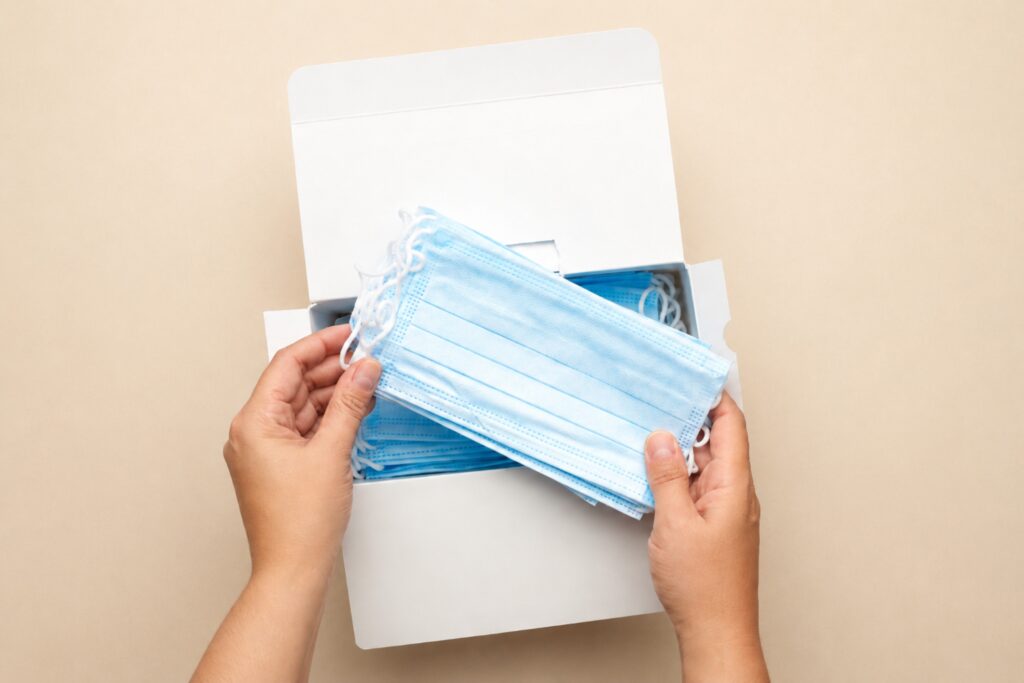
Medical face mask OEM (original equipment manufacturing) means a certified factory produces masks to your specification and under your brand — you own the label, the factory owns the production line, the cleanroom, and the test reports. It is how most distributors, pharmacy chains, and medical brands source their masks without building a factory. This guide walks through what a medical-grade mask OEM project actually involves: the certifications and test reports behind it, what can be customized, how MOQ and lead times are set, and the step-by-step path from first inquiry to shipped cartons.
What Does OEM Mean for Medical Face Masks?
In mask manufacturing, OEM and private label are often used interchangeably, but the scope differs slightly:
- Private label: you put your brand on the factory’s existing, already-certified mask — fastest route, minimal engineering.
- OEM: the factory produces to your requirements — your colors, sizes, packaging, and printing — on its certified production lines.
- Custom development: beyond OEM, structural changes (new shapes, new materials) that require new tooling and re-testing.
Most projects start as private label and add customization over time. Either way, the critical difference from ordinary consumer goods is that a medical face mask is, in most markets, a regulated protective device: every variation still has to meet the same filtration standard as the factory’s own line, which is why supplier choice matters more than in fashion or promotional masks. Graminton runs its medical face mask production in Taiwan and supports both private label and OEM projects through its product customization service.
What Certifications and Tests Support a Medical Mask OEM Project?
The same document set applies to every candidate factory. Documents that typically support a medical mask OEM project in Taiwan include:
1. CNS 14774 test reports — Taiwan’s national medical mask standard, requiring bacterial filtration efficiency (BFE) of 95% or higher. This is the baseline every production batch is measured against.
2. International test data — ASTM F2100 (US) and EN 14683 (EU) reports from recognized labs, if you sell into those markets. The thresholds map closely to CNS 14774 at entry level (BFE ≥95%).
3. A documented quality system — ISO-based quality management and batch-level testing records; how a factory controls quality day to day matters more than any single certificate. Graminton’s medical device manufacturing runs under an ISO 13485-certified quality management system — the full framework is on our quality standards page.
4. Material traceability — the filtration layer is melt-blown nonwoven, and its quality decides BFE performance. Graminton checks incoming spunbond and melt-blown fabric before converting, and fabric lots are recorded against finished-mask lots for traceability. (New to these materials? See our guide to what nonwoven fabric is.)
5. Third-party verification — SGS or equivalent independent test reports, renewed regularly rather than issued once.
One distinction: low-MOQ “custom mask” listings online are often printed fashion masks, a different product category. Medical face mask OEM is identified by BFE testing to a medical mask standard.
How Does the Mask OEM Production Process Work?
A typical medical mask OEM project moves through six stages:
1. Requirements briefing — target market, standard (CNS / ASTM / EN), sizes, colors, packaging format, and volumes. This determines which production line and which test protocol apply.
2. Specification and quotation — the factory confirms feasibility, quotes per-carton pricing, and states MOQ and lead time.
3. Sampling — you receive physical samples: standard products for private label, or pre-production samples for customized colors, embossing, and packaging.
4. Pre-production confirmation — artwork, packaging dieline, and product spec are signed off. For medical masks this includes the labeled standard claims that must match the test reports.
5. Mass production and batch testing — masks are converted on automated lines (ultrasonic welding of ear loops and nose wire), with BFE and differential-pressure testing per production batch.
6. QC, documentation, and shipment — final inspection, test documentation for your import registration, and export packing.
From confirmed order to shipment, several weeks is typical; exact lead time depends on customization depth and seasonal capacity, so confirm it in the quotation stage.
What Can Be Customized on a Medical Face Mask?
More than most buyers expect — without touching the tested three-layer structure:
| Item | Typical options | Notes |
|---|---|---|
| Color | Classic solids, seasonal colors | Outer-layer spunbond is dyed; filtration layer unchanged |
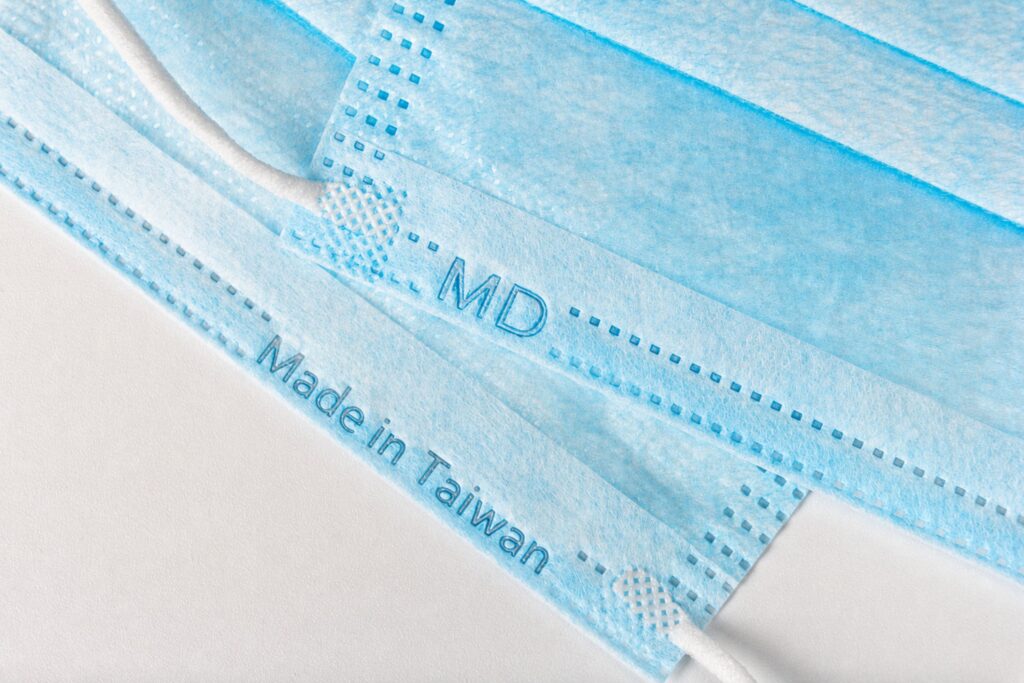
| Surface finish | Flat or embossed patterns | e.g., Graminton’s coral-embossed adult line |
| Size | Adult 17.5 × 9.5 cm, kids 14.5 × 9.5 cm | ±0.5 cm tolerance, ear-loop style |
| Packaging | Pieces per pack, printed retail boxes, cartons | Standard: 50 pcs/pack × 40 packs/carton (adult); 30 pcs/pack (kids) |
| Branding | Private label boxes, inner-bag printing | Your artwork, factory’s compliance text |
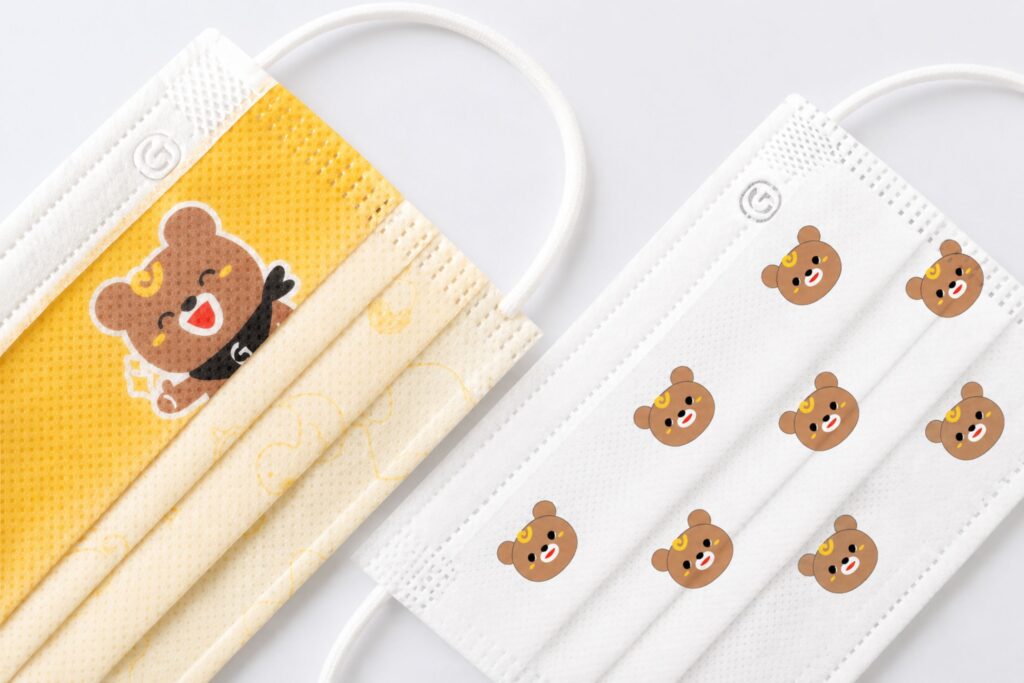
Structural changes — different pleating, tie-on surgical style, or new raw materials — fall under custom development and add tooling and re-testing time, so scope them early. You can see the range this produces across GhealthCare, Graminton’s own protective-products brand: the adult face mask in classic colors and the kids face mask are both CNS 14774-tested (BFE ≥95%) and made in Taiwan — the same lines and specs available to OEM buyers.
How Do MOQ and Lead Time Work for Mask OEM?
MOQ for medical masks follows production logic, not marketing:
- Machine-run economics: a converting line runs one spec at a time; each changeover (color, size, print) costs setup and testing time, so each variant carries its own minimum.
- Packaging is often the real MOQ driver: printed retail boxes are ordered from box plants in thousands — small mask volumes with custom boxes are usually the bottleneck.
- Carton math: quantities are quoted in cartons (e.g., 2,000 pcs per adult carton), so MOQs land on carton multiples.
- Mixed orders help: combining adult and kids sizes, or several colors of an existing line, in one shipment is generally easier than a single small custom run.
As a rule of thumb: private label on existing products needs the least volume, custom colors and packaging need more, and structural custom development needs the most. Ask for the MOQ per tier in your first inquiry — a transparent factory will break it down rather than quote one big number. For a broader look at how protection grades affect which product you should brief, see Graminton’s eight protection levels framework.
How Should You Evaluate a Medical Mask OEM Partner?
Beyond documents, three practical points show how a factory really works:
1. Where the melt-blown comes from. A manufacturer’s answer covers supplier qualification and incoming-QC procedure.
2. Batch test records, not just a certificate. A certificate shows the quality system passed its audits; batch records show whether testing actually happens per run.
3. The domestic track record. Taiwan’s mask market is standard-driven — factories serving it are audited by that testing culture every day. For the buyer-side view of qualifying Taiwan suppliers, see our B2B sourcing guide to Taiwan-made medical masks. Buying end-user masks first is a cheap audit: our guide on how to choose a medical mask shows what to inspect on a finished piece.
FAQ
Is “facial mask OEM” the same as medical face mask OEM?
No. In cosmetics, a facial mask (sheet mask) is a skincare product, and its OEM process involves formulas, essences, and ISO 22716 cosmetics GMP — a different industry from protective medical masks. If you are looking for beauty sheet mask manufacturing, see Graminton’s cosmetics OEM services instead.
Who handles FDA, CE, or local registration for OEM masks?
The importer or brand owner registers the device in the destination market. The factory’s role is to supply the test reports, technical documentation, and material files that support your application. Taiwan’s own TFDA registration covers the Taiwanese domestic market only.
Why do MOQs differ so much between mask suppliers?
Because “custom masks” covers two different industries. Print-on-demand services offering tiny MOQs typically supply printed fashion masks, not medical masks. Medical-grade OEM runs on cleanroom converting lines with batch testing, and custom packaging is printed in volume — both push minimums up. Compare suppliers within the same category; BFE test data is what identifies the medical-grade ones.
Can I start with a small trial order?
Usually yes, in stages: samples first, then a private label trial on an existing certified product, then customization once sales volume justifies it. This lets you validate quality and your market before committing to custom tooling and packaging minimums.
Planning a mask line under your own brand? Tell us your target market, standard (CNS / ASTM / EN), and estimated volume — we’ll reply with a spec sheet, MOQ breakdown, and sample arrangements.