
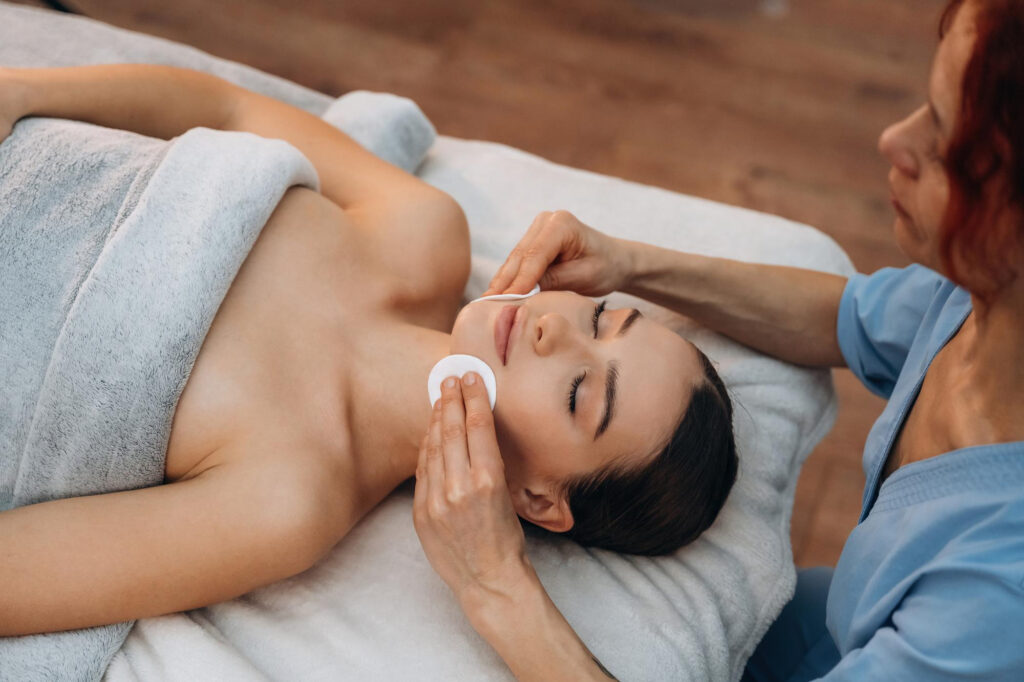
Salon cotton pads are the single-use pads an esthetician reaches for dozens of times a day — removing makeup, applying toner, pressing a wet compress, cleaning up after a mask. Unlike retail cotton rounds sold by the bag, salon pads are bought in bulk packs, judged on how they perform mid-treatment, and costed per client. This guide covers shapes, pad construction for each treatment step, consumption planning, and bulk pack formats. (Buying for store shelves or your own brand instead? Start with our cotton pads guide for retail and private-label buyers.)
What Makes a Cotton Pad Salon-Grade?
A pad that is fine for a bathroom counter can fail on a treatment bed. Professional use is harsher: pads are used soaked, dragged across skin repeatedly, and seen up close by a paying client. Four things separate salon-grade pads from commodity ones:
- Wet integrity. A pad must stay in one piece when saturated with cleanser or toner. Blends that pair absorbent fibers (cotton, rayon, viscose) with a support fiber (polyester) or long-staple structure hold together through a full pass of the face.
- Low lint on skin. Fibers left behind on a client's face — or caught in lash extensions — are visible quality failures. Edge-sealed or thermally bonded constructions shed less than cheap loose-fill pads.
- Skin-safety test evidence. Because pads sit on broken-out or freshly exfoliated skin, third-party test reports matter. Graminton's cotton pad lines carry SGS reports covering formaldehyde, heavy metals, E. coli, and migrating fluorescent agents; selected models additionally pass an SGS skin irritation test.
- Consistent supply. A treatment menu is built around specific pads. Graminton manufactures its NIKITA professional line and Gbuuty beauty line in Taiwan, so repeat orders arrive with the same spec sheet.
For how cotton pads fit into the wider consumables list — towels, bed covers, headbands — see the salon and spa disposables buyer’s guide; this article goes deep on the pad category alone.
Squares or Rounds: Which Shape Do Estheticians Prefer?
Round pads dominate retail shelves, but treatment rooms lean toward squares and rectangles. The reasons are practical:
- Coverage per piece. A rectangular pad covers more of the cheek or forehead in one pass, so a step takes fewer pads.
- Edge control. Straight edges let an esthetician work precisely along the hairline, jaw, and eye area without folding the pad first.
- Less waste. Squares and rectangles cut from the web with minimal offcut, which is part of why bulk pricing on them tends to be tighter than on die-cut rounds.
In US professional-supply catalogs you will see these listed as cotton squares or esthetic squares (in the UK, “cotton wool pads” is the umbrella term). Graminton’s professional pads follow this logic: the Gbuuty makeup pads run 50 × 60 mm, NIKITA remover pads 50 × 70 mm, and the stretchable compress pad is a 10 × 10 cm square. Rounds still make sense where clients see and self-serve the pads — a retail-style vanity station, for example — which is a stocking decision, not a treatment one.
How Do You Match Pad Construction to Each Treatment Step?
The biggest upgrade a salon can make is to stop using one generic pad for everything. Construction — layers, embossing, stretch — determines which step a pad serves best:
- Makeup and cleanser removal favors texture. The rhombus embossed makeup pad (BU8104) uses its embossing to lift dirt gently from pores, and the wood pulp–viscose cleansing makeup remover pad (NK8102) is built for high-volume cleansing work.
- Toner application and wet compress favor thin, conforming pads that absorb liquid and release it evenly. The ultra-thin makeup pad (BU8105) has micro-stretch that lets it follow skin curvature, and the three-layer premium cotton pad (BU8110) pairs a plain side that absorbs and releases liquid with a reticulated side for exfoliation — one pad, two steps.
- Extended masking with toner is the job of the stretchable makeup pads (NK8108): soak, stretch the 10 × 10 cm rayon-lyocell pad to size, and leave it on for 3–5 minutes as a targeted compress, per its product instructions.
- Daily cleansing and skincare application is covered by the soft makeup remover pad (NK9103), a viscose-polyester pad for applying product after cleansing.
- Larger-area work — full-face cleansing, mask removal, back-bar wipe-downs — is where a pad stops being the right tool; the 20 × 20 cm BU8109 cotton-soft tissue belongs to the facial-towel category, covered in our disposable face towels guide.
A simple way to audit your current setup: list your treatment menu step by step and note which pad each step actually uses. Most salons find two or three steps sharing a pad that suits only one of them.
How Do You Estimate Pad Consumption and Cost per Client?
Do not price pads by the pack — price them by the client. The math takes three inputs you already have:
1. Pads per protocol. Walk one treatment start to finish and count actual pads used per step (removal, toner, compress, cleanup). This is your number, from your own menu — supplier averages will mislead you.
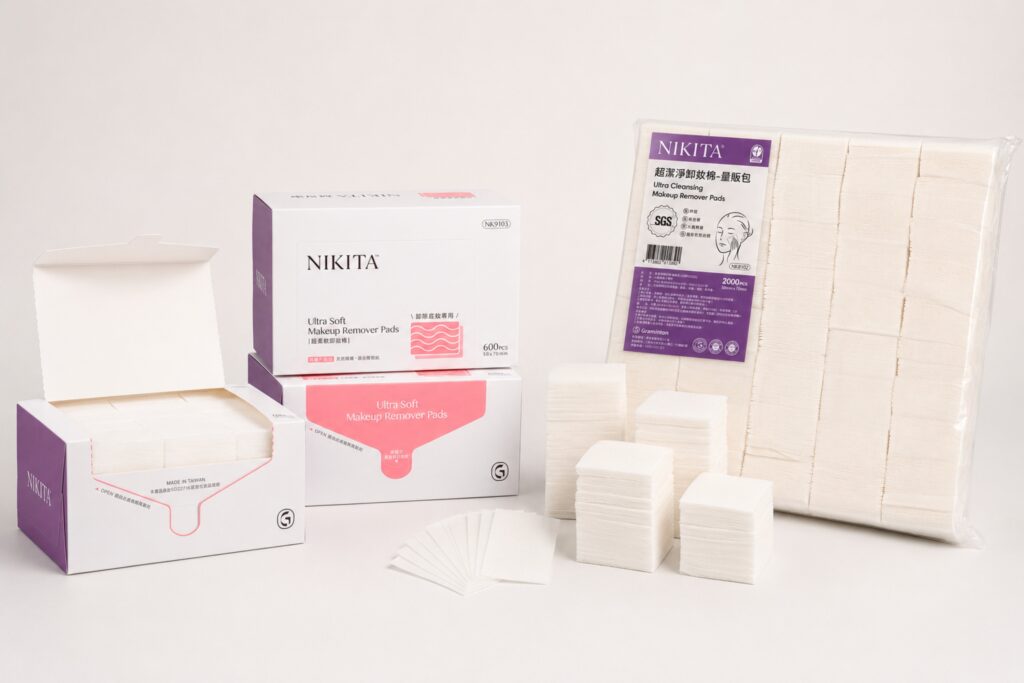
2. Per-piece cost. Divide pack price by piece count. Pack counts vary widely — Gbuuty pads come 120–200 pieces per pack, NIKITA remover pads 600 or 2,000 per pack — so per-piece cost is the only comparable figure across formats.
3. Reorder cadence. Pads per protocol × clients per week tells you weekly draw; divide pack (or carton) count by weekly draw to get weeks of stock per order.
As a worked illustration only: a salon whose combined draw is 60 pads a day would run through a 2,000-piece pack of NK8102 in roughly a month — which is exactly the kind of back-bar volume that pack size exists for. Run the same arithmetic with your own counts before committing to a format.
Two purchasing consequences: high-turnover cleansing steps belong on high-count value packs, while client-facing steps (a toner compress the client watches you prepare) can justify a premium pad, because its per-client cost difference is small even when the per-pack difference looks large.
What Should You Check in Bulk Packs and Packaging?
Beyond the pad itself, the pack format decides how pads survive a busy back bar:
| Check | Why it matters in a salon |
|---|---|
| Pieces per pack | High-count packs (600–2,000 pcs) cut per-piece cost and restock frequency for workhorse steps |
| Pieces per carton | Carton quantities set your storage footprint and how far one order stretches |
| Resealable / covered dispensing | Open trays collect product mist and dust; pads should stay covered between clients |
| Dry, clean storage | Pads absorb ambient moisture and odors; store sealed packs off the treatment-room floor |
| Spec sheet per batch | Size, materials, and piece count on paper — so a reorder is checkable on arrival |
For salon chains and the distributors that supply them, Graminton’s cotton pad lines can be customized — dimensions, embossing pattern, pack count, and packaging or branding are all discussable per SKU. Practical minimums depend on the specific pad and spec, so bring your target format to the conversation. Ordering pads together with towels, bed covers, and other consumables through the spa and salon solutions program consolidates freight into one shipment.
Which Graminton Cotton Pads Fit Professional Use?
All six pads below are made in Taiwan and SGS-tested for formaldehyde, heavy metals, E. coli, and migrating fluorescent agents; the skin irritation column marks models with the additional SGS skin irritation test on file.
| Model | Size | Pack | Material | Skin irritation test | Best for |
|---|---|---|---|---|---|
| BU8110 Premium Cotton Pad | 50 × 60 mm | 200 pcs/pack, 36 packs/ctn | Cotton fiber, rayon | ✓ SGS passed | Two-sided: wet compress + gentle exfoliation |
| BU8104 Rhombus Embossed Makeup Pad | 50 × 60 mm | 120 pcs/pack, 96 packs/ctn | Rayon, cotton fiber | ✓ SGS passed | Makeup removal, pore cleansing |
| BU8105 Ultra-Thin Makeup Pad | 50 × 60 mm | 200 pcs/pack, 180 packs/ctn | Rayon, polyester | ✓ SGS passed | Toner application, conforming wet compress |
| NK8102 Cleansing Makeup Remover Pad | 50 × 70 mm | 2,000 pcs/pack, 10 packs/ctn | Wood pulp fiber, viscose/rayon | ✓ SGS passed | High-volume back-bar cleansing |
| NK9103 Soft Makeup Remover Pad | 50 × 70 mm | 600 pcs/pack, 30 packs/ctn | Viscose/rayon, polyester | ✓ SGS passed | Daily cleansing, skincare application |
| NK8108 Stretchable Makeup Pads | 10 × 10 cm | 400 pcs/pack | Rayon, lyocell | ✓ SGS passed | Stretch-to-fit toner masking, 3–5 min compress |
The BU series belongs to Graminton’s Gbuuty beauty line and the NK series to the NIKITA professional line; both ship from the same Taiwan operation, so mixed orders are routine.
FAQ
Are esthetic wipes the same as salon cotton pads?
Not quite. In US professional-supply catalogs, “esthetic wipes” usually means larger nonwoven squares (commonly 4″ × 4″) used for general treatment-room wiping, while cotton pads are the smaller, denser pads used directly on facial skin for removal, toner, and compress work. The categories overlap at the edges — some suppliers use the terms loosely — so buy by size, material, and construction rather than by label.
Should a salon use disposable or reusable cotton pads?
For client-facing work, single-use is the professional default: each pad touches one client once, which removes laundering variables and cross-contamination risk, and clients can see the pad is fresh. Reusable bamboo or microfiber rounds make sense for a personal vanity routine, but in a commercial treatment setting the hygiene assurance and time cost of laundering argue for disposables.
We buy for a store or our own beauty brand — is this the right guide?
This article is written for salons, spas, and the distributors that supply them — people who use pads in services. If you are stocking shelves or developing a private-label product, the format, documentation, and packaging questions differ; start with our retail-focused cotton pads guide instead.
Can cotton pads be customized for a salon chain or distributor brand?
Yes — dimensions, embossing, pack counts, and packaging or branding can be tailored on Graminton’s cotton pad lines, with feasibility and minimums depending on the specific SKU and spec. Share your target size, texture, and pack format and we will confirm what is practical for that model.
Stocking a treatment room, a spa chain, or a distribution line? Tell us your treatment menu and volumes — we’ll recommend pad formats, send physical samples so your estheticians can test them mid-treatment, and quote bulk pack and carton options.