
To set up a tattoo station, clean and disinfect every work surface, wrap the tray and lay a dental bib on it plastic side down, bag or film everything the artist will touch, cover the bed, armrest and face rest, and lay out the single-use items before putting on gloves. Each layer is a disposable that gets changed for every client: dental bibs work as tray covers and lap cloths, bed sheets and face rest covers dress the bed, and paper towels handle drips and wipe-downs.
This guide is for owners of multi-station studios and the distributors who supply them. It extends the approach in our guide to salon and spa disposables to the tattoo station: zone by zone, with the disposable, its spec, the count per session and the carton math, plus how piercing and PMU (permanent makeup) stations differ.
How Do You Set Up a Tattoo Station, Step by Step?
Set up the station in the same order before every client:
- Clean and disinfect the tray, the cart, the bed, the armrest and the lamp handle with the studio’s surface disinfectant, used as its label directs, then wipe the surfaces dry.
- Wrap the tray in plastic wrap so the film folds down over every edge, then lay a dental bib on top of the wrap, plastic side down and paper side up.
- Put the tattoo machine in a machine bag, slide a cord sleeve over the clip cord, cover the power supply screen and the lamp handle with barrier film, and put each squeeze bottle into a bottle bag.
- Tear one bed sheet off the perforated roll and spread the sheet over the bed from the head end to the foot end. For a face-down session, line up the crosscut in the sheet with the face hole of the bed, and fit a face rest cover over the face cradle.
- Wrap the armrest in plastic wrap, then lay a dental bib over the wrap, paper side up, where the client’s arm or leg will rest.
- Before putting on fresh gloves for the session, tear a stack of paper towels off the roll and place the stack on the tray bib, so gloved hands never go back to the roll. Then set out ink caps, sealed cartridges and the other single-use items on the bib.
- Lay a dental bib across the client’s lap, paper side up, and another across your own lap if the client’s limb rests on your knee.
- After the session, with needles and cartridges already in the sharps container, fold the tray bib in from its edges so the used caps and paper stay inside, lift the bib off in one piece and drop it into the lined bin. Remove the bottle bags, machine bag, barrier film, armrest wrap, face rest cover and bed sheet into the same bin, then clean and disinfect the surfaces again before the next setup.
Studio hygiene rules for tattooing, piercing and PMU vary by market and jurisdiction, so check the rules that apply to your studio.
Which Disposables Does Each Zone of a Tattoo Station Use?
Each zone of the station takes one disposable, changed for every client. The table lists what covers each zone, the Graminton option, and a planning count per session.
| Zone | What covers it | Graminton option | Per session |
|---|---|---|---|
| Work tray or cart | Plastic wrap, then a dental bib | HC8401 dental bib; wide carts: HC7302 table paper sheets | 1 bib (2 on a wide cart) |
| Client’s lap, artist’s lap | Lap cloth | HC8401 dental bib | 1 to 2 |
| Armrest or leg rest | Plastic wrap, then a bib | HC8401 dental bib | 1 |
| Tattoo bed | Bed sheet; waterproof sheet under the work area when needed | NK7302 crosscut bed sheet; NK8306 soft waterproof bed sheet | 1 sheet, plus 1 waterproof sheet when used |
| Face cradle (face-down sessions) | Face rest cover | NK8301 face rest cover | 1 |
| Headrest (PMU, lying-down piercings) | Headrest sheet | NK7304 headrest sheet roll | 1 |
| Client’s neck and chest (PMU) | Client bib | HC8310 U-shaped bib | 1 |
| Drips, spills and wipe-down | Paper towels; low-lint wipes | L7282 or L7280 paper towel roll; L8151 low-lint dry wipes | A pre-torn stack; wipes as needed |
| Machine, cords, bottles, lamp, power supply | Machine bag, cord sleeve, bottle bags, barrier film | From your tattoo supply line | 1 set |
| Artist | Gloves; face mask | Gloves from your supply line; GhealthCare adult face masks | Per studio procedure |
Graminton’s part of the station is the paper and nonwoven layers: bibs, table paper, bed sheets, covers, headrest sheets, paper towels and low-lint wipes. Barrier film, machine bags, cord sleeves, ink caps, needles and gloves come from the tattoo supply line. Because each zone uses one fixed item, restocking comes down to multiplying the count per session by the number of sessions, as the stocking section below shows.
Why Do Tattoo Studios Use Dental Bibs as Tray Covers and Lap Cloths?
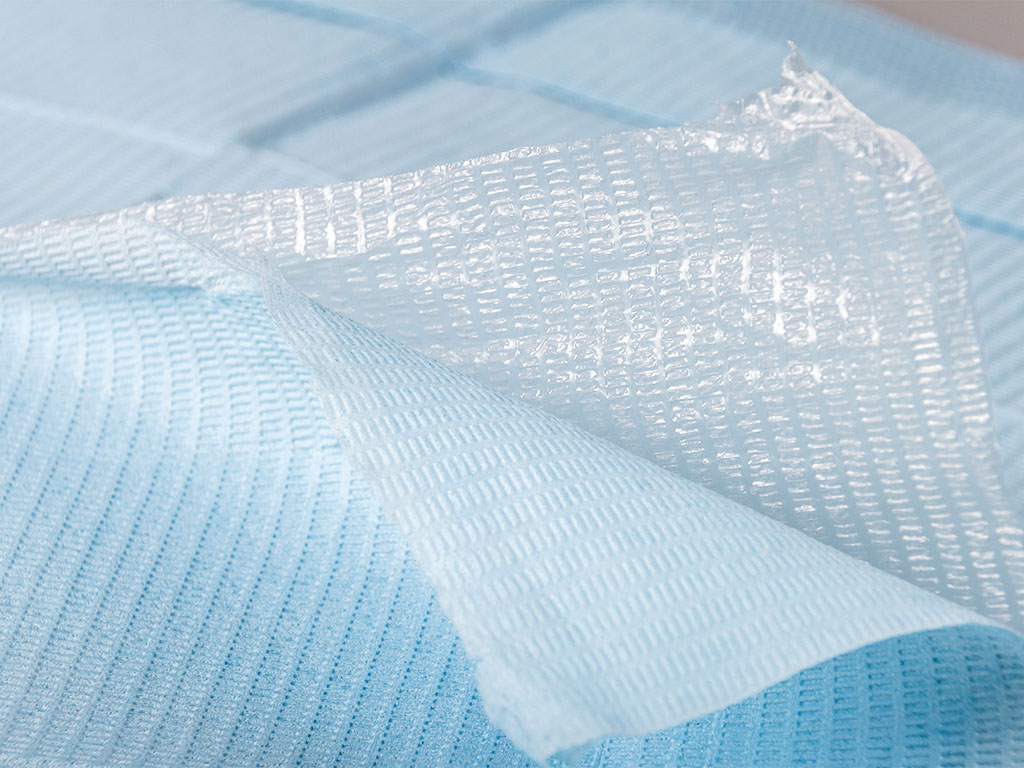
A dental bib has two layers: an absorbent paper face on top and a PE film underneath. The paper catches ink drips and rinse water, and the film stops them from soaking through to the tray or to clothing. At the end of a session the whole bib folds inward, taking the used caps and paper with it, so one lift clears the tray (step 8 above).
HC8401 dental bibs from GhealthCare measure 33 × 45 cm (13 × 18 in), come 50 per pack and 10 packs per carton, or 500 bibs per carton, and are available in pink and blue. They carry SGS results for formaldehyde, heavy metals, E. coli and migrating fluorescent agents, and they are made in Taiwan.
Many studios wrap the tray in plastic wrap first and lay the bib on top. The wrap covers the edges, but it does not absorb anything; the paper face is what catches drips. The same bib goes across the client’s lap or the artist’s lap, or over the wrapped armrest, always paper side up.
For wider carts and counters, GhealthCare table paper uses the same paper-and-PE build. HC7302 comes as 45 × 40 cm perforated sheets, 200 per roll, and HC7303 as a continuous 55 cm × 100 m roll torn to length; HC8305 single sheets come in S (35 × 50 cm) and L (55 × 50 cm), 200 per pack. All three are white; see the PE-backed table paper range for sizes.
How Should You Cover a Tattoo Bed, Armrest and Face Rest?
For the bed, the NK7302 crosscut bed sheet measures 80 × 180 cm, comes 50 sheets per perforated roll and 6 rolls per carton, and is polyester spunbond in 25, 30 or 40 gsm, in pink, white or brown. Tear off one sheet per client. For a face-down back piece, line up the crosscut with the face hole of the bed.
Where ink and rinse water run off the work area, add a soft waterproof bed sheet. NIKITA NK8306 measures 80 × 150 cm, comes 10 per pack and 20 packs per carton, and has a viscose and polyester spunlace top with a PE film back. Lay it absorbent side up and film side down, under the part of the body being tattooed.
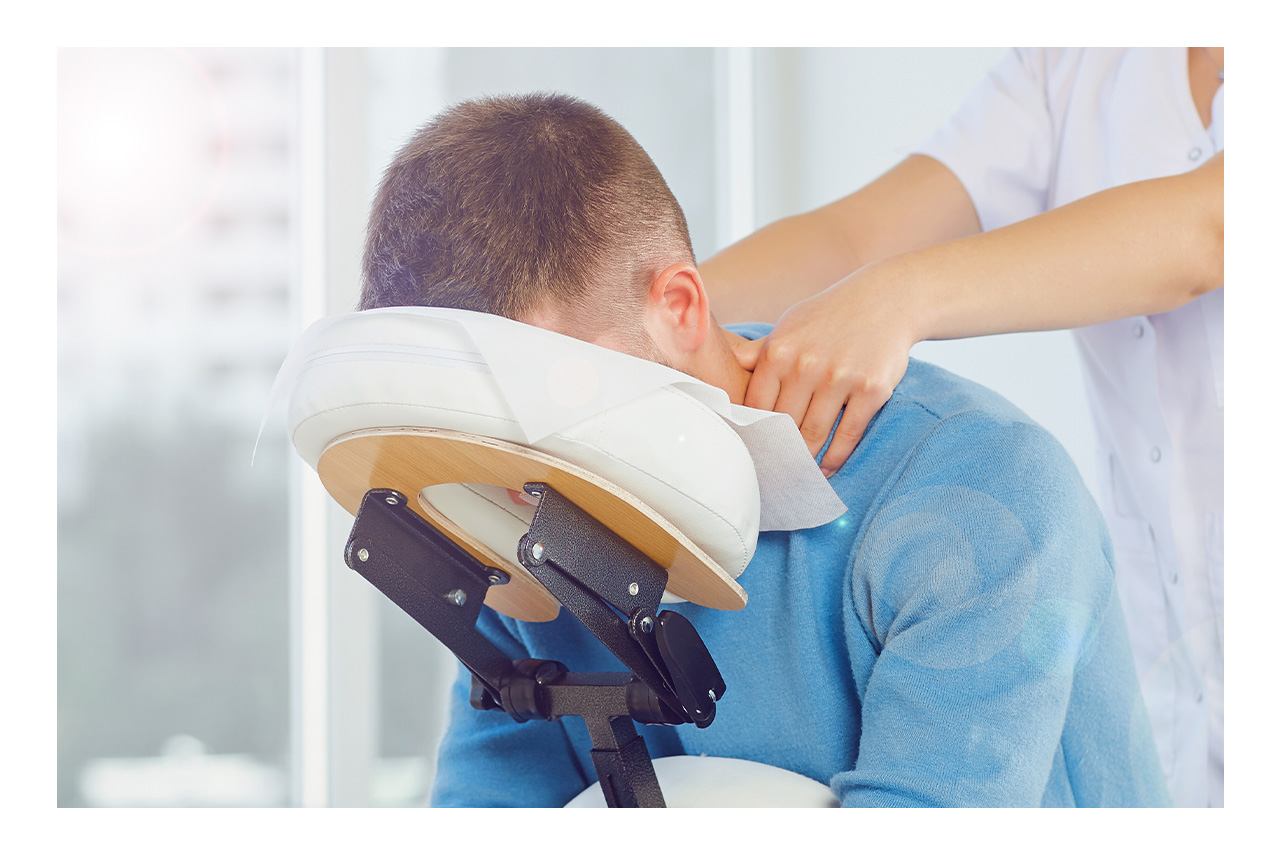
For face-down sessions on a bed or a massage-style tattoo chair, fit a face rest cover over the face cradle, with the crosscut over the opening. NIKITA NK8301 face rest covers are 40 × 40 cm polyester, pink, 100 per pack and 20 packs per carton. The armrest takes plastic wrap from the supply line and one HC8401 bib, paper side up.
For roll versus single-sheet formats, waterproof versus breathable sheets, and how to pick a weight, see disposable bed sheets and pillow covers.
How Do Piercing and PMU Stations Differ?
Piercing sessions are shorter and use a smaller tray. The tray is still disinfected and covered with an HC8401 bib, and the chair or bed takes a bed sheet or a length of HC7303 table paper. For piercings done lying down, one NK7304 headrest sheet goes over the headrest.
For PMU brows, lips and eyeliner, the client lies face up. Lay one sheet from a headrest sheet roll over the headrest or pillow: NIKITA NK7304 sheets are 80 × 40 cm, 225 per perforated roll and 6 rolls per carton (1,350 sheets), and the product’s application guide notes that a headrest sheet alone is enough for short services such as brow and lash work. Cover the full bed with an NK7302 sheet when the session calls for it.
Place the GhealthCare HC8310 U-shaped bib, 40 × 50 cm, white, 100 per pack and 10 packs per carton, with its semi-circular opening at the client’s neck and its adhesive backing holding it in place. The tray gets plastic wrap and then a dental bib, whose paper face keeps small tools from sliding. For the mask at the station, GhealthCare adult face masks are verified to CNS 14774, Taiwan’s national standard for medical face masks, with a bacterial filtration efficiency (BFE) of at least 95%, and the classic range includes black. PMU often runs inside aesthetic clinics or salons; for the wider supply list, see aesthetic clinic disposables.
How Many Disposables Does a Studio Go Through, and How Should It Stock Them?
Monthly use per item = stations × sessions per station per day × working days × items per session. The counts per session in the zone table are planning figures; replace them with your studio’s own.
For example, a studio with four stations, two sessions per station a day and 25 working days a month runs 200 sessions. At three bibs per session (tray, lap and armrest), that is 600 bibs, or 1.2 cartons of HC8401 at 500 per carton. The same 200 sessions use 200 bed sheets, or 4 rolls of NK7302, about two-thirds of a 6-roll carton.
| Item | Per pack or roll | Per carton |
|---|---|---|
| HC8401 dental bibs | 50 | 500 |
| HC8310 U-shaped bibs | 100 | 1,000 |
| NK7302 crosscut bed sheets | 50 per roll | 6 rolls (300) |
| NK8306 soft waterproof bed sheets | 10 | 20 packs (200) |
| NK8301 face rest covers | 100 | 20 packs (2,000) |
| NK7304 headrest sheet rolls | 225 per roll | 6 rolls (1,350) |
| HC7302 table paper sheets | 200 per roll | 9 rolls (1,800) |
| L7282 paper towel roll, 2-ply | 637 m per roll | 2 rolls |
| L8151 low-lint dry wipes | 100 | 16 packs (1,600) |
The stack of paper towels on each tray can come from a large roll: the LICK 2-ply paper towel roll L7282 (23 cm × 637 m) or the 1-ply L7280 (25.5 cm × 794 m), two rolls per carton, for surfaces, tables and countertops. The LE-0002 floor stand holds a roll up to 33 cm in diameter, 33 cm wide and 6 kg, and both roll widths are within that limit. For wet wipe-downs of the bed, tray and counter, L8151 low-lint dry wipes (30 × 33 cm) can be used dry or with alcohol.
For distributors, the station is the unit to sell: one item per zone, in bibs (pink or blue), bed sheet rolls, face rest covers, headrest rolls and paper towel rolls, restocked against each studio’s monthly session count. The bibs, bed sheets, covers, paper towel rolls and L8151 wipes named here carry SGS results for formaldehyde, heavy metals, E. coli and migrating fluorescent agents; the report for a specific SKU is available on request. All are made in Taiwan.
FAQ
What side of a dental bib goes down on a tattoo tray?
The plastic side goes down and the paper side faces up. The paper absorbs drips and rinse water, and the PE film underneath keeps them from soaking through to the tray. Many studios lay plastic wrap under the bib as well, so the tray edges are covered.
What is a lap cloth in tattooing?
A lap cloth is a sheet with an absorbent paper face and a PE film back, the same build as a dental bib, laid over the client’s lap, the artist’s lap or the armrest to catch ink and water. Tattoo suppliers sell the same 13 × 18 in size as both a lap cloth and a dental bib, and HC8401, at 33 × 45 cm, is that size. Dental practices use the same bib as a patient bib and a tray cover; see our checklist of dental chair disposables.
Do dental bibs for tattoo stations have to be black?
No. Black is popular because it hides ink stains, and blue is common too, but color does not change how a bib works: the paper face absorbs and the film blocks liquid. HC8401 comes in pink and blue.
How many dental bibs does a tattoo session use?
Usually about three: one on the tray, one as a lap cloth and one on the armrest, plus one or two more for a wide cart or a second lap cloth. At 500 bibs per carton, 200 sessions at three bibs each use about 1.2 cartons.
Are dental bibs and disposable bed sheets sterile?
No. They are single-use barriers, not sterile products. Items that need to be sterile are specified separately and handled under the studio’s own procedures.
Equipping a multi-station studio, or stocking a distribution business that serves tattoo, piercing and PMU studios? Tell us how many stations you supply, the sessions they run each month, and which zones you need to cover. We’ll reply with samples of the bibs, bed sheets and covers that fit, the SGS reports for the SKUs you shortlist, and carton pricing.