
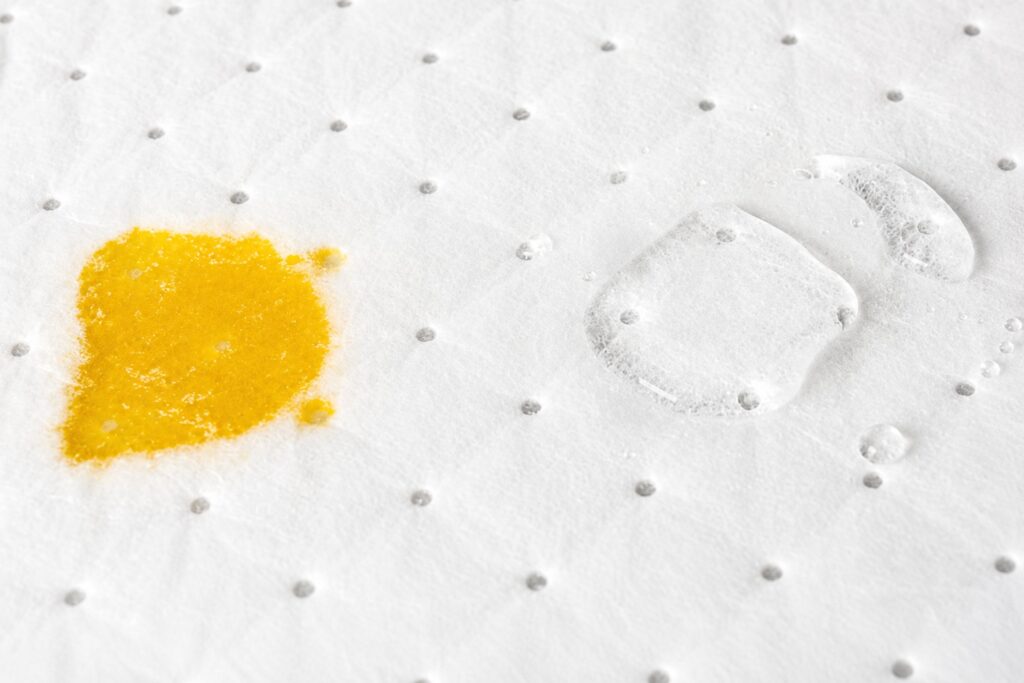
Oil absorbent pads (also called sorbent pads or spill pads) are polypropylene sheets engineered to soak up oil while repelling water, making them the standard first response for leaks and spills in workshops, food plants, and machine rooms. The format matters as much as the material: pads and rolls handle surface spills, tube-shaped socks and booms contain them. This guide explains how oil-only absorbents work, when to use each format, and what to check before ordering in bulk.
What Are Oil Absorbent Pads Made Of, and How Do They Work?
Industrial oil absorbents — including Graminton’s LICK LD series — are made from polypropylene (PP), a polymer that is naturally hydrophobic and oleophilic: it repels water and attracts oils and hydrocarbons such as lubricants, diesel, and hydraulic fluid. LICK absorbents hold more than 12 times their own weight in oil; actual take-up varies with oil viscosity and temperature.
Most oil-only pads, rolls, socks, and booms are built the same way: polypropylene fibers formed into a nonwoven sheet, or packed into a mesh tube for socks and booms. Other absorbent materials exist, such as cellulose and cotton fibers or clay, peat, and corn cob granules, but they take up water as well as oil, which is why polypropylene is the standard for oil-only products. On LICK pads, the surface is also perforated and heat-pressed: the holes speed up absorption, and the heat-pressing adds strength and toughness.
That combination gives oil-only absorbents two working advantages:
- They keep absorbing oil even in wet conditions — rain, condensation, or coolant-splashed floors.
- They float, so they recover oil from the surface of water instead of sinking saturated.
Beyond capacity, two properties separate industrial-grade absorbents from ordinary rags: retention (absorbed oil should not weep back out when the pad is moved or lightly pressed) and wet strength (the pad must not shred and leave debris). Fine fiber structure determines all three. If the material science interests you, our primer on what nonwoven fabric is covers how these fibers are formed.
Pads, Rolls, Socks, or Booms — Which Format Fits the Job?
| Format | Shape | Best for | Typical use |
|---|---|---|---|
| Pads | Cut sheets (e.g., 50 × 41 cm) | Small spills, drips, wipe-downs | Under fittings, machine bases, spill response |
| Rolls | Continuous roll (e.g., 100 cm × 42 m) | Covering walkways and work zones | Cut to length; leak-prone lines |
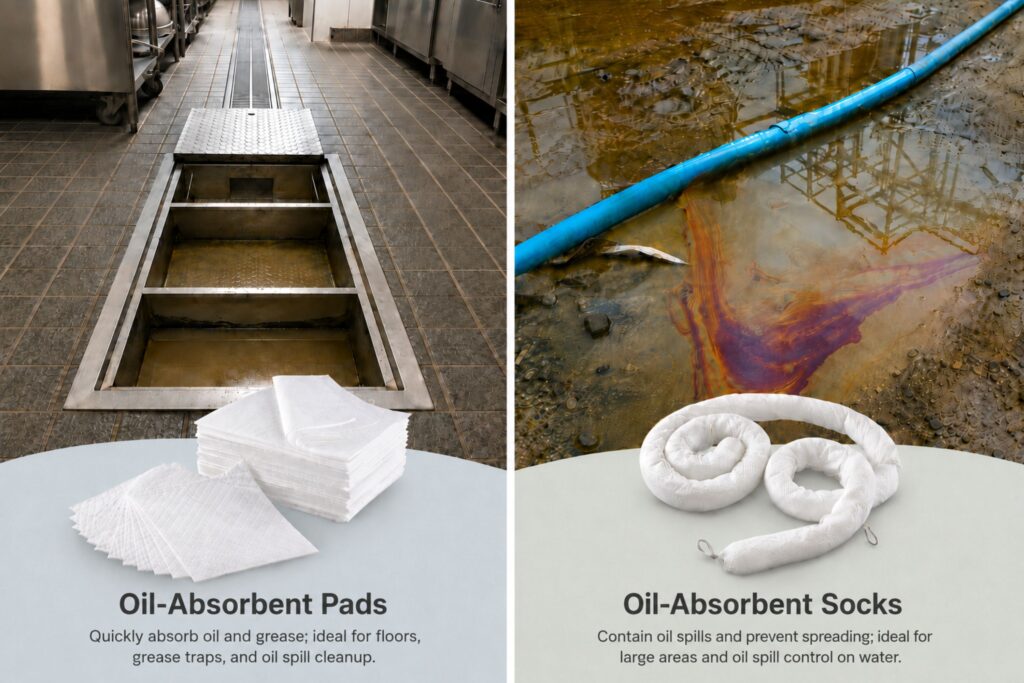
| Socks | Flexible tubes | Perimeter containment on floors | Around machine bases, in front of drains |
| Booms | Larger floating tubes | Containment on water | Oil-water separation tanks, ponds, harbors |
Not sure whether you need pads, rolls or booms? Describe the spill you deal with most often and we’ll match it to the right format, absorbency and pack size.
A practical rule: contain first, then absorb. For anything bigger than a drip, place socks or oil absorbent booms around the spill to stop it spreading, then lay absorbent pads over the contained area. Our guide to cleaning up an oil spill at work covers the full sequence, from containment to restocking.
Graminton’s LICK LD-series absorbents follow this system: LD360/LD4843 pads and rolls for surface work, and LD3/5/8 tube absorbents (Ø3″/5″/8″ × 10 ft) for containment — from snake-around-the-machine perimeters up to on-water booming.
Oil-Only vs Universal Absorbents: What's the Difference?
This is the most common purchasing mistake, so it deserves its own section.
- Oil-only absorbents (usually white) repel water and absorb oils and fuels only. Choose them outdoors, near drains, or anywhere water is present — they will not waste capacity soaking up rain or wash water. LICK LD-series pads and booms are oil-only, with acid and alkali resistance for harsh environments.
- Universal absorbents (usually grey) absorb a broad range of fluids — oils, coolants, solvents, and water-based fluids. Choose them indoors for mixed-fluid maintenance work.
If your spill risk is “oil near water,” oil-only is the answer. If it is “mixed fluids on a dry workshop floor,” universal earns its keep. Many plants stock both and color-code the response.
What Should You Check Before Ordering in Bulk?
1. Liquid compatibility — oils only, or coolants and chemicals too? This decides oil-only vs universal.
2. Absorbency capacity — compare oil absorbed per unit weight, not pad count per carton. LICK’s series absorbs 12+ times its own weight; actual performance varies with oil viscosity and temperature.
3. Chemical resistance — acid- and alkali-resistant polypropylene lasts longer around cutting fluids and cleaning agents.
4. Format mix — a workable starter ratio is pads for response, rolls for coverage, socks/booms for containment.
5. Packaging quantities — e.g., pads at 100 pcs/carton and rolls at 1 roll/bag; match carton sizes to your storage.
6. Supplier documentation — material specs and absorbency test data on request; consistency matters more than unit price when absorbents are part of your EHS compliance.
Where Are Oil Absorbents Used?
- Machinery and metalworking: under CNC machines, presses, and hydraulic units — see our machine industry solutions. For wiping parts and tools rather than absorbing spills, see our industrial cleaning wipes guide. For filtering solid particles out of cutting fluids, dedicated oil filter paper (temperature-resistant to about 80 °C) complements absorbents.
- Food processing: fryer areas, grease-prone floors, and drain protection — covered in our food industry solutions.
- Commercial and aviation facilities: fuel-transfer points and apron spill response.
- Cleanrooms and labs have their own wiping requirements — see our separate cleanroom wipers guide.
FAQ
What is the difference between an absorbent sock and an absorbent boom?
Shape and setting. Socks are smaller-diameter tubes for land use — snaked around machines or across doorways. Booms are larger tubes designed to float and contain oil on water. Product naming varies by supplier, so check the diameter and intended setting rather than the name alone.
How much oil can an absorbent pad hold?
LICK oil absorbents hold more than 12 times their own weight in oil — heavy-duty grade; actual figures vary with oil viscosity and temperature. Whatever the supplier, the tested absorbency figure is what lets you calculate cost per liter absorbed, which is a fairer comparison than price per carton.
Do oil absorbent pads absorb water?
Oil-only polypropylene pads do not. Polypropylene is hydrophobic, so the fibers reject water and take up oils — petroleum and cooking oils alike — rather than water. That is why LICK LD-series pads and booms keep working on wet floors and float on water instead of sinking saturated. If you also need to pick up coolant, wash water, or water-based chemicals, choose a universal (grey) absorbent, which takes up water-based fluids as well. Kitchens with grease-and-water mixtures are a typical oil-only case; see our guide to grease trap oil absorbents.
Can oil absorbent pads absorb diesel, gasoline, and hydraulic fluid?
Yes. Polypropylene is oleophilic toward petroleum products in general: diesel, gasoline, kerosene, hydraulic oil, and lubricating and gear oils; cooking oils in kitchen settings are covered in the grease trap guide linked above. Two practical notes. Capacity depends on the liquid: thin fuels drain back faster and heavy oils absorb more slowly, so the 12-times figure for LICK absorbents is a heavy-duty rating, not a guarantee for every liquid. And gasoline or other volatile fuels stay flammable inside a saturated pad: keep used pads away from ignition sources and hold them in closed, labeled containers until disposal. For aggressive solvents or oxidizers, confirm compatibility with the supplier first.
Can oil absorbent pads be reused?
Generally no. Wringing out a saturated pad releases oil and degrades the fiber structure. For recurring drips, place a fresh pad and replace it on schedule.
How do I dispose of used oil absorbents?
Treat saturated absorbents as oil-contaminated industrial waste. How the waste is classified and handled depends on where you operate, so check the rules that apply to you. In every case: do not wring pads out, keep them separate from general waste, store them in closed containers, and use a licensed disposal contractor.
Synthetic polypropylene pads vs natural granular absorbents (clay, peat, corn cob): when should you use which?
Use granular absorbents on rough, uneven, or gravel surfaces where a sheet cannot make contact, and for small drips that will simply be swept up. Use polypropylene pads, rolls, and booms when the surface is defined (floors, walkways, tank tops, water), when oil must be recovered from water, or when waste volume matters. Clay holds far less oil per kilogram than polypropylene, so the same spill produces more contaminated material to ship and pay for; it also creates dust and cannot float. Peat and corn cob are lighter and float for a time, but they are loose, hard to retrieve, and inconsistent in capacity. Many plants keep a granular product for outdoor yards and polypropylene absorbents everywhere else. Sourcing options are compared in our guide to buying oil absorbent pads in bulk.
Tell us your spill scenario — fluid type, area, and volume — and we’ll recommend a pad/sock/boom combination with specs and carton pricing from the LICK industrial line.