
A medical disposable face mask made in Taiwan must meet CNS 14774, the national standard that requires a bacterial filtration efficiency (BFE) of 95% or higher and strict limits on breathing resistance. For international buyers, this makes “Made in Taiwan” more than a label — it is a verifiable quality baseline backed by a mask manufacturing ecosystem built around national-standard testing. This guide explains what CNS 14774 covers, how it compares with ASTM F2100 and EN 14683, and what to check before you place a bulk order.
What Counts as a Medical Disposable Face Mask?
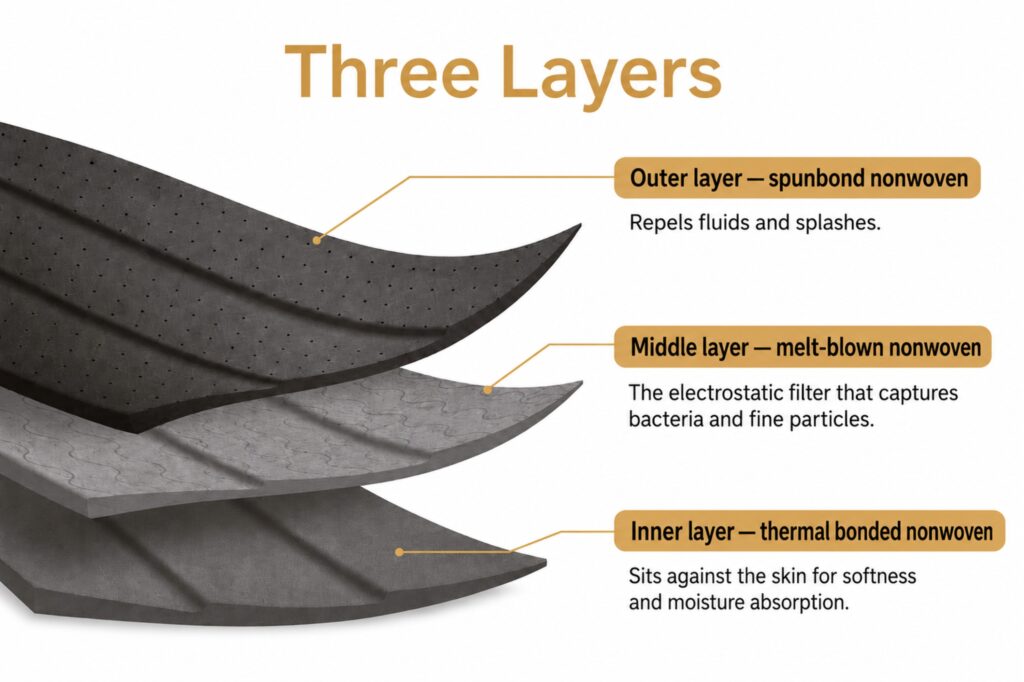
A medical disposable face mask (also called a surgical mask or procedure mask) is a single-use mask, typically three-layer, designed to block bacteria-carrying droplets. The three layers work together:
- Outer layer — spunbond nonwoven: repels fluids and splashes.
- Middle layer — melt-blown nonwoven: the electrostatic filter that captures bacteria and fine particles.
- Inner layer — thermal bonded nonwoven: sits against the skin for softness and moisture absorption.
The filtration performance comes almost entirely from the melt-blown middle layer, which is why material quality matters more than appearance. If you are new to these materials, our guide to what nonwoven fabric is explains how spunbond and melt-blown fabrics are made and why they behave differently.
Medical masks are regulated as medical devices in most markets — unlike general dust masks or beauty-use coverings. That regulatory line is what separates a certified product from a lookalike.
What Is CNS 14774, Taiwan's Medical Mask Standard?
CNS 14774 is the national standard of Taiwan for medical face masks, administered under the Chinese National Standards system. To comply, a mask must pass laboratory tests including:
- Bacterial filtration efficiency (BFE): ≥95%, tested under CNS 14775.
- Differential pressure (breathability): ≤5 mmH₂O/cm², tested under CNS 14777 — so protection does not come at the cost of breathing comfort.
Note that CNS 14774 and its related registration system apply to Taiwan’s domestic market. If you import masks for resale, medical-device registration in your own market (FDA, CE, or local equivalent) is handled by the importer or brand owner — the Taiwanese manufacturer’s role is to supply the test data and documentation that support your application.
For buyers, the practical takeaway: a CNS 14774 compliance claim stands on its test report. Certified product lines — including Graminton’s adult face masks — have BFE ≥95% results on paper, not just on the carton.
How Does CNS 14774 Compare with ASTM F2100 and EN 14683?
Most international buyers work with the US standard (ASTM F2100) or the European standard (EN 14683). The three systems measure similar things with different thresholds and groupings:
| Standard | Region | Grades | BFE requirement | Fluid resistance |
|---|---|---|---|---|
| CNS 14774 | Taiwan | Regular / surgical types | ≥95% | Required for surgical type |
| ASTM F2100 | United States | Level 1 / 2 / 3 | ≥95% (L1), ≥98% (L2/L3) | Increases with level |
| EN 14683 | Europe | Type I / II / IIR | ≥95% (I), ≥98% (II/IIR) | Type IIR only |
Comparing standards for a specific order? Send us your target market and volume and we’ll come back with the matching CNS 14774 or ASTM/EN test reports, carton quantities and MOQ.
Three points worth noting:
1. On BFE, a CNS 14774 general medical mask sits at the same ≥95% baseline as ASTM Level 1 and EN Type I — a tested everyday medical mask. Suppliers exporting to the US or EU often hold dual test reports.
2. Grades are about use case, not “better or worse.” Type IIR adds splash resistance and ASTM Level 3 carries the highest fluid-resistance rating, for fluid-heavy procedures; a clinic reception desk does not need them.
3. Terminology differs: in the narrow sense, a “surgical mask” ties behind the head, while a “procedure mask” uses ear loops — though usage varies by market and catalog. Most disposable medical masks sold today — including ours — are ear-loop procedure masks.
For a deeper look at how protection levels translate into daily use, see our overview of the eight protection levels used across Graminton’s product range.
Why Source Medical Masks from Taiwan?
Taiwan’s mask industry scaled dramatically during the pandemic and kept its quality infrastructure afterward. For a B2B buyer, the advantages are concrete:
- A national standard with teeth. CNS 14774 testing culture means laboratory verification is the norm across the supply chain — test reports are expected, not exceptional.
- Mature nonwoven supply. Graminton integrates spunbond and melt-blown layers into finished masks and checks incoming fabric before converting, so material quality is easy to trace. Its medical face mask lines are built on qualified medical-grade nonwovens with batch-level incoming QC.
- Export-ready documentation. Established manufacturers routinely provide SGS test reports, material traceability, and support for CE or FDA pathways.
- Reasonable MOQs for mixed orders. Adult and kids face masks can often be combined in one shipment — useful for distributors serving clinics and schools.
What Should B2B Buyers Check Before Ordering?
Qualifying a Taiwanese mask supplier typically comes down to seven points:
1. CNS 14774 test report — current, from a recognized lab, showing BFE ≥95%.
2. Registration documentation support — the supplier’s test data and technical files feed the medical-device registration in your own market (TFDA registration covers Taiwan only; OEM buyers typically file their own).
3. Material specification — three-layer construction (spunbond / melt-blown / thermal bonded), backed by fabric source documentation and traceability.
4. Sizing options — standard adult (17.5 × 9.5 cm) and kids (14.5 × 9.5 cm) sizes cover most channel needs.
5. Packaging details — pieces per pack and packs per carton affect retail readiness (e.g., 50 pcs/pack × 40 packs/carton for adult masks).
6. Factory audit evidence — ISO quality systems, SGS test reports, or an on-site/virtual audit option.
7. Consistency guarantees — batch testing frequency and how BFE performance is maintained over production runs.
If you are outfitting a clinic rather than a retail channel, our clinic disposables procurement guide covers the full consumables list beyond masks.
FAQ
What is the difference between a surgical mask and a procedure mask?
Both are medical face masks. In the narrow sense, a surgical mask ties behind the head — the style traditionally worn in operating rooms — while a procedure mask uses ear loops for quick donning. Filtration requirements can be identical — the difference is fixation and typical setting. For the full comparison — ASTM levels, regional terms, and how to specify them in a purchase order — see our procedure mask vs surgical mask guide.
Is a “facial mask” the same as a medical face mask?
No. In cosmetics, “facial mask” (or sheet mask) means a skincare product soaked in essence. Medical face masks are protective devices tested for bacterial filtration. If you are looking for beauty sheet masks, see Graminton’s Gmask cosmetic line instead — and if in doubt, check whether the product cites CNS 14774 or a skincare formulation.
Is BFE ≥95% good enough?
For general medical and daily protective use, yes — 95% is the baseline shared by CNS 14774, ASTM Level 1, and EN Type I. For procedures with fluid exposure, look to the fluid-resistant grades (ASTM Level 2/3, EN Type IIR) — they also carry BFE ≥98%, but fluid resistance is rated separately from BFE.
How do masks made in Taiwan differ from generic imports?
The testing chain. A Taiwan-made medical mask is produced against CNS 14774 requirements, and reputable makers add SGS reports per batch. Masks without that documentation may look identical, but their filtration performance is unverified. Our guide on how to choose the right medical mask shows how to read these labels as an end user.
Can medical face masks be customized or ordered OEM?
Yes — colors, embossing, sizes, and packaging can be customized at volume. Graminton produces masks under its GhealthCare brand and supports OEM projects; see our guide to medical face mask OEM for certifications, MOQ, and process.
Sourcing certified medical masks for your channel or clinic? Tell us your target market and volume — we’ll reply with specs, test reports, and MOQ.