
Cleanroom wipes vs paper is not an either-or choice; it is decided station by station. Three questions settle it: what the sheet will touch, whether IPA or another solvent is involved, and whether the job needs low shedding or fast absorption. Yield-critical surfaces, solvent wiping and repeated wet passes call for a low-lint nonwoven wipe. Light dry wiping, small spills and everyday wiping of instruments and benches can use light-duty wiping paper, where the zone’s policy allows paper. Most facilities stock both.
This guide explains how cloth and paper differ, maps common stations to each, and sets out four questions for deciding. For materials and how cleanroom wipers differ from general-purpose wipers, see our cleanroom wipers guide.
What Is the Difference Between Cleanroom Wipes and Wiping Paper?
In this guide, a cleanroom wipe is a low-lint cloth made for clean work, usually a spunlace nonwoven of polyester or a polyester blend, or a knitted polyester. Wiping paper is a sheet formed from wood pulp fibers: tissue-style wipers and paper rolls that absorb quickly and are used once.
Cloth (spunlace nonwoven):
- Fibers are entangled by high-pressure water jets, with no binder.
- Grades with a high polyester content keep their strength when wet and when used with solvents.
- Works dry or wet.
- Suits stations with repeated wiping or solvent use.
Paper (wood pulp):
- Short pulp fibers formed into a soft, light sheet.
- Absorbs water quickly and is discarded after one use.
- Suits light dry wiping, small water-based spills, and everyday wiping of instruments and benches.
- Solvent use depends on the product; the LICK paper wiper pages do not list solvent use.
Construction decides much of how a wiper behaves. For a closer look, see how knitted, spunlace, meltblown and paper wipers compare.

Which Stations Need Cloth and Which Can Use Paper?
Within one cleanroom, the cloth that wipes a critical surface and the paper that wipes a bench can be completely different. The choice follows what the sheet touches and how it is used, not the room’s classification. How wipers map to room grades is covered in our guide to cleanroom wipe classes.
| Station or surface | Usually | Why | Graminton examples |
|---|---|---|---|
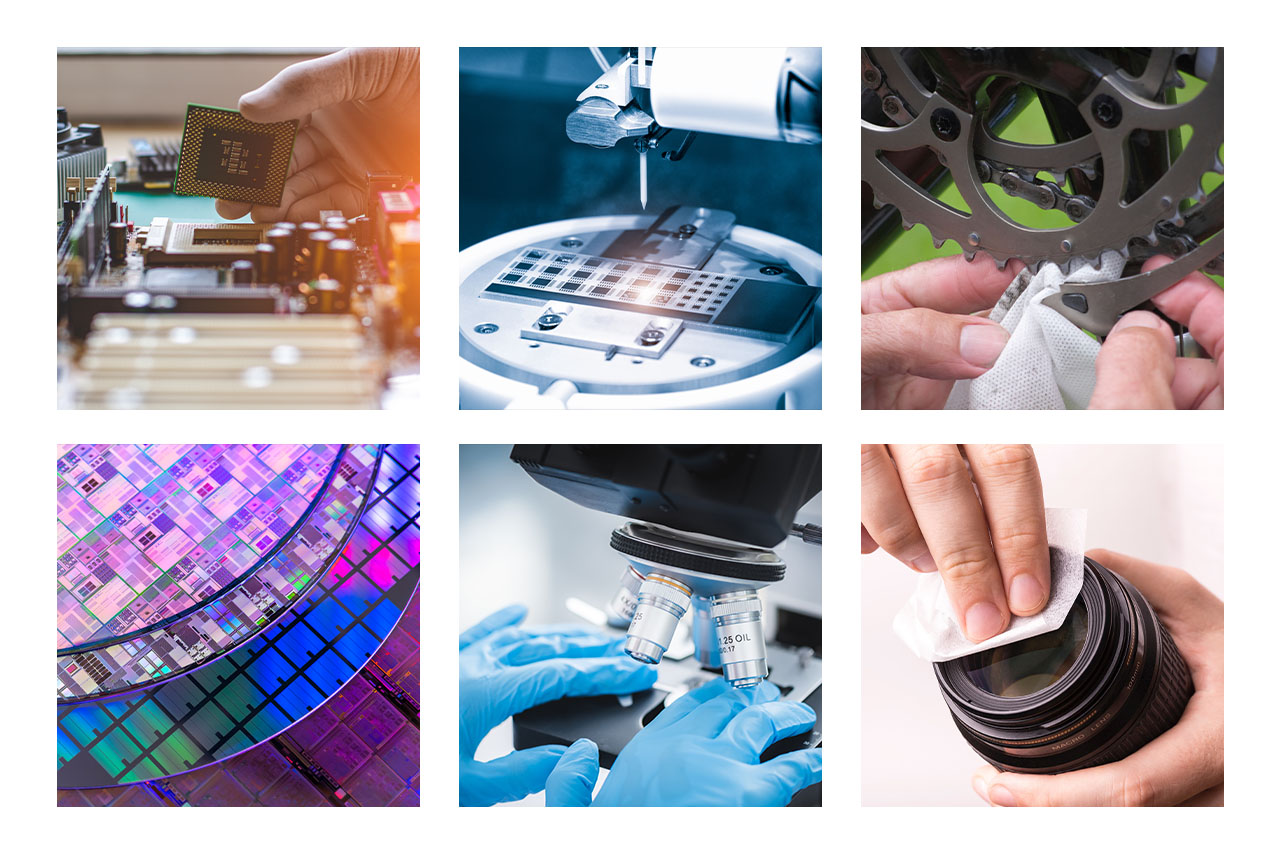
| Wafers, substrates, display panels and other yield-critical surfaces | Cloth | Direct contact; a fiber left behind becomes a defect; often wiped with IPA | LGK5 cleanroom wipes (semiconductor-related areas; won’t leave scratches), LGK3 (LCD-related areas) |
| Process tools, fixtures and equipment interiors | Cloth | Repeated wiping with solvent; the sheet has to hold together wet | LGK7 cleanroom wipes (dry or wet use; acid-, base- and solvent-resistant) |
| Solvent or disinfectant wipe-downs of benches and hoods | Cloth | Solvent use and repeated passes | LGK7, LGK3 |
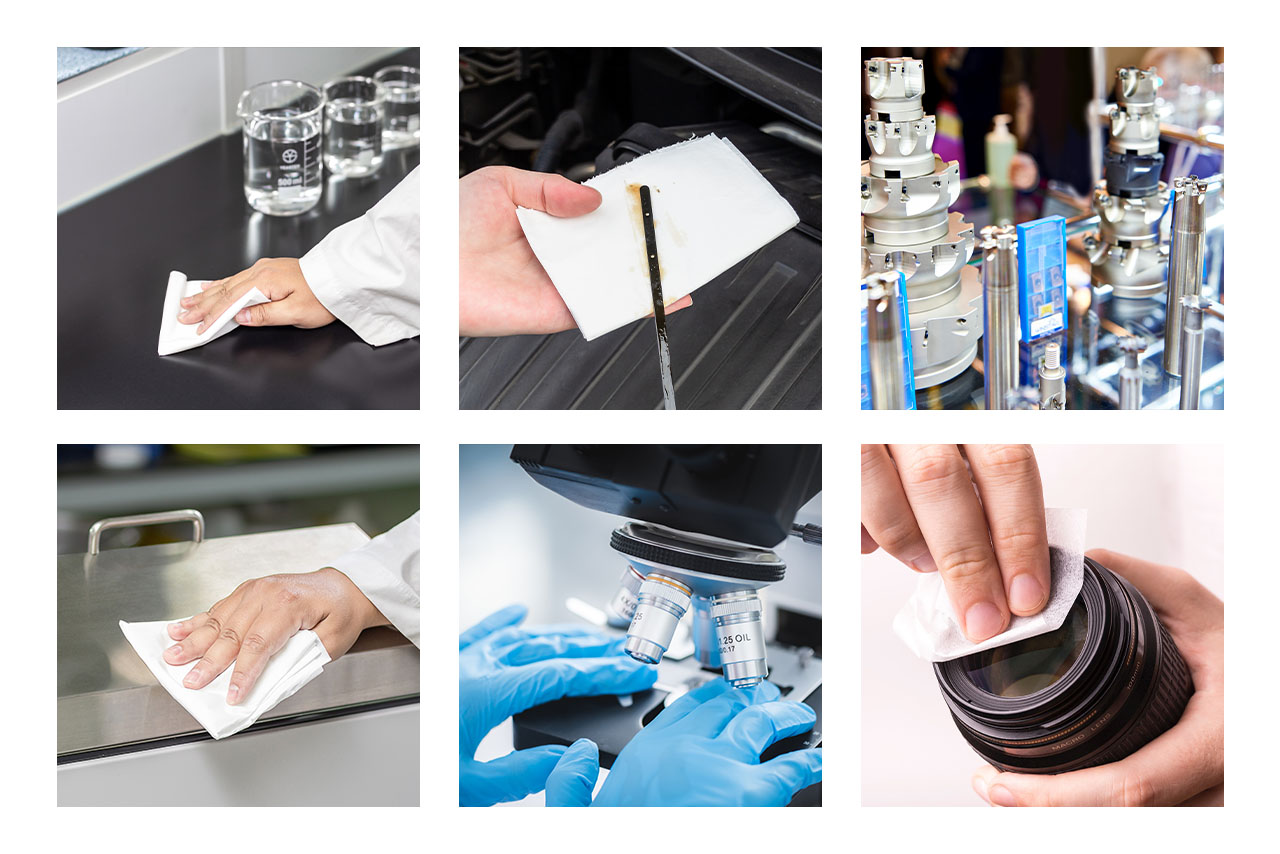
| Equipment exteriors and work benches, dry dusting | Either | Cloth with solvent or where no fibers may be left; paper for dry dusting where allowed | LGK3; L7282 (countertops, precision instruments, assembly parts) |
| Lab instruments, probes, slides and small parts | Paper, where allowed | Light-duty, single-use, soft sheet sized for small surfaces | L9133 light-duty wipes (surfaces, parts and instruments in labs; flip-top pack) |
| Small water-based spills in labs and support areas | Paper, where allowed | Fast absorption, use once and discard | L7282, L9133 |
| Optical lenses | Lens tissue | Its own technique and sheet | See the lens tissue guide below |
The “Either” row comes down to the task. If a solvent is used or the surface must be left free of fibers, use cloth. If the job is dry dusting or picking up a little water, paper can do it, provided the zone’s cleanroom policy allows paper there.
Four Questions That Decide Cloth or Paper
Run each station through the same four questions:
- What will the sheet touch? Surfaces that affect yield or the finished product, such as wafers, substrates, panels, optics and process tooling, point to cloth. Benches, equipment exteriors and instrument housings may only need paper.
- Is IPA or a solvent involved? Wiping with IPA, solvents or cleaning agents points to cloth; the LGK3 and LGK7 product pages list them as acid-, base- and solvent-resistant. Dry wiping or picking up small amounts of water-based liquid can use paper.
- Is the job about low shedding or fast absorption? If no fibers may be left and the surface is wiped repeatedly, choose cloth. If the goal is to soak up a little water-based liquid once and discard the sheet, paper fits.
- Does your cleanroom policy allow paper in that zone? Many facilities ban ordinary paper towels and tissues inside controlled areas and allow only approved wipers. Any paper wiper has to be on that zone’s approved list first.
Whatever the answers, trial the choice at your own stations, with your own solvents, before you standardize.
Why Do Many Cleanrooms Stock Both?
Each format covers stations the other does not. Cloth handles critical stations and solvent wiping; paper handles everyday wiping of lab instruments, benches and support areas. Using cloth everywhere spends more where it is not needed, while using paper everywhere leaves the solvent stations uncovered. For the cost side, see what drives cleanroom wipe costs. Mapping each station first keeps both formats where they belong.
Sourcing both from one supplier also means one set of requisitions and one receiving routine instead of two. Graminton’s LICK line includes both low-lint wipes and light-duty paper wipers for cleanrooms and labs:
- Cloth: LGK3 (25 × 20 cm, 100 per pack, polyester spunlace), LGK5 (23 × 23 cm, 300 per pack, plant fiber and polyester spunlace) and LGK7 (30 × 30 cm, 100 per pack, wood pulp and polyester spunlace). The LGK product pages list low lint among their SGS items.
- Paper: L9133 light-duty wipes (11 × 19 cm, 280 per pack, wood pulp, low lint) for surfaces, parts and instruments in labs, and the L7282 2-ply paper towel roll (23 cm × 637 m) for lab countertops, precision instruments and assembly parts.
Outside the cleanroom, the same thinking applies to paper towel rolls on the plant floor.
How Do You Set Up Cloth and Paper Stations?
A few habits keep each format at the station it was chosen for:
- Stock one format per station and label it, so cloth and paper stations stay separate and staff do not pick the wrong one.
- Match the sheet size to the wiping motion. Small sheets suit frequent changes (LGK3, 25 × 20 cm); larger sheets cover benches and tool surfaces (LGK7, 30 × 30 cm). For instruments, a small paper wiper such as L9133 (11 × 19 cm) fits.
- Keep packs closed between uses. The L9133 flip-top pack is designed to reduce dust.
- Keep only cloth at solvent stations, and apply the solvent to the wipe rather than pouring it onto the surface.
- Treat optics separately. Lenses need their own sheet and technique; see our guide to lens cleaning tissue.
FAQ
Can you use paper towels in a cleanroom?
Most facilities do not allow ordinary paper towels or tissues inside controlled areas and permit only approved wipers. Whether paper wipers can be used depends on each zone’s policy and approved list. Where allowed, paper suits labs, support areas and light dry wiping; for solvents or critical surfaces, use a low-lint cloth wipe.
Are cleanroom wipes better than paper wipers for IPA?
For repeated wiping with IPA, use cloth. The LGK3 and LGK7 product pages list them as acid-, base- and solvent-resistant, and LGK7 works dry or wet. The LICK paper wiper pages do not list solvent use. Trial with your own solvent before you standardize.
Are paper wipers lint-free?
No wiper is completely free of lint; lint-free is a common trade term. The LICK paper wipers are described as low lint, which is how we describe all our wipers.
Can one wiper cover every station?
Rarely. Critical and general stations need different things, so most facilities settle on one or two cloth wipes and one or two paper wipers, then assign each to its stations.
Setting up cloth and paper stations for a cleanroom or lab, or building a range for a distribution business? Tell us the stations, the surfaces, the solvents, and your monthly volume. We’ll reply with samples of the wipes and paper wipers that fit, the SGS reports for the SKUs you shortlist, and carton pricing. LICK paper wipers and industrial wipers can also carry your brand; the LGK cleanroom series is supplied in its stock specifications.