

A procedure mask (also called a procedural mask or isolation mask) is a disposable medical face mask with ear loops, worn to block bacteria-carrying droplets in everyday clinical settings. A surgical mask, in the narrow sense long used in ASTM F2100, ties behind the head — the style traditionally worn in operating rooms. In everyday language — and in much regulatory language — “surgical mask” is also used loosely for both. That double meaning causes real confusion in purchase orders. This guide separates the two terms, explains what ASTM Level 1, 2, and 3 actually measure, maps US terminology to UK and EU equivalents, and shows institutional buyers and distributors how to write all of this into a clean purchase specification. It is part of our broader medical face mask solutions resource for B2B buyers.
What Is a Procedure Mask?
A procedure mask is a single-use, flat-fold medical face mask secured with ear loops, intended for medical procedures and patient care outside sterile fields — examination rooms, dental chairs, isolation precautions, triage, and general clinic use. The name describes the use setting, not a separate technology: a procedure mask uses the same nonwoven construction as other disposable medical masks.
Three points define the category in practice:
- Fixation: ear loops, designed for fast donning and doffing between patients. This is the most visible difference from a tie-on surgical mask.
- Sterile status: procedure masks are typically supplied non-sterile; where a sterile mask is needed, that is specified separately.
- Performance rating: like any medical face mask, a procedure mask is rated against a performance standard — ASTM F2100 in North America, EN 14683 in Europe — rather than by its name.
The terminology varies by channel. Distributor catalogs may list the same product as an “earloop mask,” dental suppliers often say “dental mask,” and infection-control documents may say “isolation mask.” In the US regulatory context, the FDA groups masks marketed as medical procedure masks, isolation masks, and dental masks under its broader surgical mask / face mask umbrella — which is one reason the naming feels inconsistent from one document to the next.
Procedure Mask vs Surgical Mask: What's the Difference?
The short answer: fixation and typical setting — not necessarily filtration. A surgical mask in the narrow sense ties behind the head, which allows fit adjustment and is the style traditionally worn in operating rooms; a procedure mask uses ear loops for quick changes in general clinical care. A Level 3 procedure mask can out-filter a Level 1 surgical tie mask — the grade, not the name, tells you the protection.
| Attribute | Procedure mask | Surgical mask (narrow sense, tie-on) |
|---|---|---|
| Fixation | Ear loops | Ties behind the head (tie-on / surgical tie mask) |
| Sterile status | Typically non-sterile | Sterile or non-sterile, per product specification |
| Typical setting | Exam rooms, dental care, isolation precautions, general patient care | Operating rooms, sterile procedure areas |
| Donning speed | Fast on/off between patients | Slower; ties allow head-position adjustment under surgical hoods |
| Performance rating | ASTM F2100 Level 1/2/3 or EN 14683 Type I/II/IIR | Same standards — rating is independent of mask name |
| Common aliases | Procedural mask, isolation mask, dental mask, earloop mask | Tie-on mask, OR mask |
Note the second layer of meaning: in daily usage, and in FDA consumer-facing material, “surgical mask” often serves as the umbrella term for all disposable medical flat masks, ear-loop styles included. When a hospital tender says “surgical masks, ear-loop,” it almost always means procedure masks. When a document distinguishes the two terms, fixation and the traditional operating-room setting are what it is distinguishing. If you are reading this as an end user deciding what to wear day to day, our guide on how to choose a comfortable and protective medical mask covers fit and comfort; the rest of this article stays on the procurement side.
What Do ASTM Level 1, 2, and 3 Mean?
ASTM F2100 is the North American performance standard for medical face masks. It defines three levels based on five laboratory tests: bacterial filtration efficiency (BFE), sub-micron particulate filtration efficiency (PFE), synthetic blood penetration resistance (fluid resistance), differential pressure (Delta P, a breathability measure), and flame spread. The level system works the same way whether the mask is an ear-loop procedure mask or a tie-on surgical mask.
| Requirement | Level 1 | Level 2 | Level 3 |
|---|---|---|---|
| BFE | ≥95% | ≥98% | ≥98% |
| PFE (0.1 micron) | Required — threshold depends on the edition and test method cited in the report | ||
| Fluid resistance (synthetic blood) | 80 mmHg | 120 mmHg | 160 mmHg |
| Differential pressure (breathability) | Lower limit (easier breathing) | Slightly higher limit allowed | Slightly higher limit allowed |
| Flame spread | Class 1 | Class 1 | Class 1 |
How to read the levels as a buyer:
1. Level 1 — baseline barrier for general patient care and settings with no expected fluid exposure.
2. Level 2 — moderate fluid resistance; commonly referenced for procedures with low-to-moderate spray or splash potential.
3. Level 3 — highest fluid resistance in the standard; referenced where heavy fluid exposure is expected.
Levels are about matching exposure risk, not “better or worse” — a reception desk rarely needs Level 3, and the higher fluid barrier can come with slightly higher breathing resistance. The performance differences between levels come from the mask’s filtration materials and how they are tested, which we cover in what medical masks are made of. For how mask grades sit within a wider protection framework across product categories, see our eight protection levels overview.
In Europe, the parallel standard is EN 14683, with Type I (BFE ≥95%), Type II (BFE ≥98%), and Type IIR (BFE ≥98% plus splash resistance tested to ISO 22609). Taiwan’s national standard CNS 14774 requires BFE ≥95% for general medical masks, with a surgical grade that adds sub-micron particle filtration, synthetic blood penetration, and flammability testing — for how Taiwanese makers test and document against it, see our guide to medical disposable face masks made in Taiwan.
One rule matters more than any single number: ASTM levels and EN types are separate classifications under separate test protocols. They are not interchangeable, and a mask must be tested against each standard to claim its rating. A mask tested only to EN Type IIR cannot be labeled ASTM Level 2, even though the performance bands look similar on paper. For buyers sourcing for multiple markets, the question is which standards a supplier holds test reports against — one does not imply the other.
Do the Terms Differ Between the US, UK, and EU?
Yes — and this is where international tenders most often go wrong. “Procedure mask” is primarily a North American term. UK and EU documents rarely use it; they specify masks by EN 14683 type instead.
- United States / Canada: "procedure mask" and "surgical mask" distinguish setting and fixation; performance is specified by ASTM level (e.g., "Level 2 procedure mask, ear-loop").
- United Kingdom: clinical guidance uses FRSM — fluid-resistant surgical mask — which in practice means an EN 14683 Type IIR mask. An FRSM is functionally the UK's name for what a North American tender would call a fluid-resistant medical mask; the term appears throughout NHS infection prevention and control documentation.
- European Union: specifications go by EN 14683 type — Type I, Type II, or Type IIR — regardless of whether the mask has ear loops or ties. "Medical face mask" is the standard's own product name.
- Taiwan: CNS 14774 splits masks into general medical and surgical grades; export-oriented manufacturers typically also test against ASTM or EN so their documentation travels.
The practical consequence for buyers: the same physical product — a non-sterile, ear-loop, flat-fold medical mask — may be called a procedure mask in a US catalog, a Type IIR medical face mask in an EU tender, and an FRSM in an NHS document. Write specifications in the standard-plus-level format and the terminology differences stop mattering.
How Should Buyers Specify Masks in a Purchase Order?
Because mask names are ambiguous, a purchase specification should never rely on the product name alone. A complete mask line item answers five questions:
1. Standard and level — the load-bearing part of the spec. “ASTM F2100 Level 2” or “EN 14683 Type IIR”, matched to your market and use setting. Never write “surgical grade” without naming the standard.
2. Sterile or non-sterile — state it explicitly. Most clinic and institutional use calls for non-sterile masks; sterile-field use is a separate requirement with separate supply implications.
3. Fixation — ear-loop or tie-on. If your end users work under surgical hoods or need all-day adjustment, ties matter; for high-turnover patient care, ear loops win.
4. Size and construction — adult vs. child sizing, nose-wire, pleated flat-fold. As reference points from our own GhealthCare line: adult ear-loop masks measure 17.5 × 9.5 cm, and the kids face mask is 14.5 × 9.5 cm — a dimension worth specifying whenever pediatric or small-face coverage is in scope.
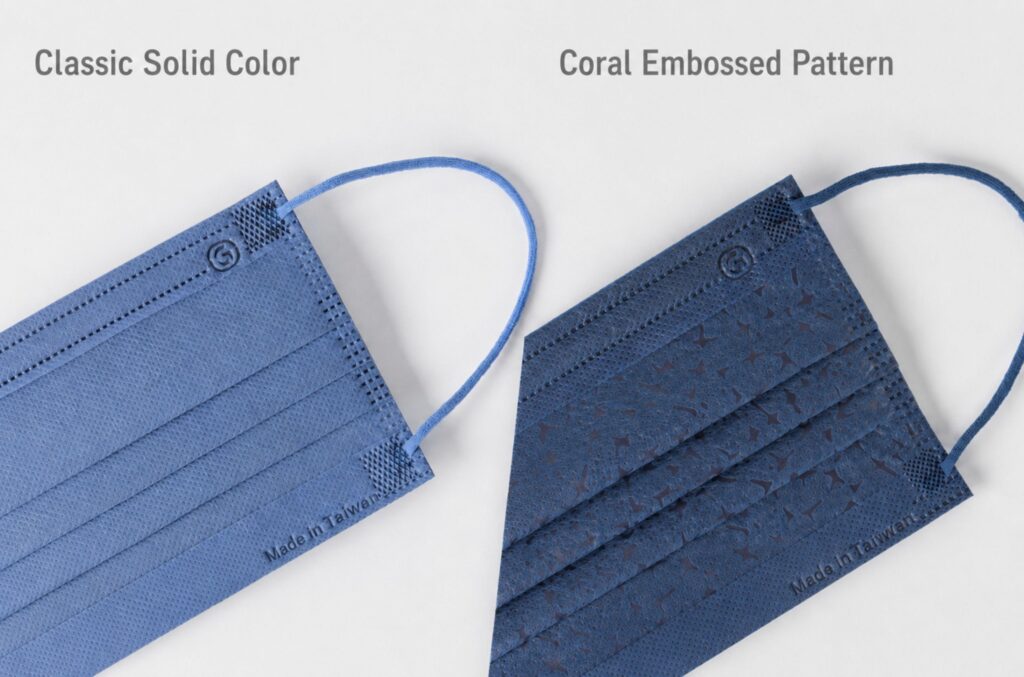
5. Packaging and documentation — pieces per pack, packs per carton, and the test reports you require. Our adult masks pack at 50 pcs/pack × 40 packs/carton (kids: 30 pcs/pack × 40 packs/carton); carton math like this drives freight and shelf planning for distributors. On documentation, the test report should be for the standard and level you specified, from the product line you are buying — our Made in Taiwan embossed adult masks, for example, come with CNS 14774 test data showing BFE ≥95%.
A worked example of a clean line item:
Non-sterile ear-loop procedure mask, 3-ply flat-fold, adult 17.5 × 9.5 cm with nose wire; tested to CNS 14774, BFE ≥95%, with current test report; 50 pcs/pack, 40 packs/carton; country of origin: Taiwan.
Every term in that line is verifiable, and none of it depends on whether the catalog calls the product a procedure mask, an earloop mask, or a surgical mask.
FAQ
Is an isolation mask the same as a procedure mask?
In most catalogs, yes. “Isolation mask” is an alias for the ear-loop procedure mask, named for its use in isolation precautions. The FDA groups isolation, dental, and medical procedure masks together in its surgical-mask umbrella category. When comparing products across the two names, ignore the label and compare the ASTM level or EN type.
Are procedure masks sterile?
Usually not — most procedure masks are supplied non-sterile, and that is appropriate for their typical settings: examination rooms, dental care, isolation precautions, and general patient contact. Sterile-field use calls for masks specified and supplied for that purpose. If sterility matters for your application, it must appear as its own line in the purchase specification.
Is ASTM Level 2 the same as EN Type IIR?
No. The performance bands look similar — both require BFE ≥98% with a fluid-resistance test — but they are separate standards with different test protocols, and ratings are not transferable. A mask must be tested against ASTM F2100 to claim a Level, and against EN 14683 to claim a Type. For multi-market sourcing, what counts is which reports the supplier actually holds.
Can a procedure mask be worn in surgery?
The name does not decide it — the facility’s operating-room protocol does, by specifying the level, fixation, and sterility it accepts; many call for tie-on masks. Outside the operating room — pre-op areas, recovery, general wards — procedure masks are standard. Follow your facility’s infection-control policy for setting-by-setting requirements.
What ASTM level does a dental clinic need?
It depends on the procedure’s spray and spatter exposure, so most dental guidance points to higher fluid-resistance grades (ASTM Level 2 or 3) for procedures that generate spray or spatter and lower grades for exams. Mask levels rate fluid and filtration barriers, not respiratory protection, so confirm against the infection-control guidance that applies in your jurisdiction.
Graminton manufactures non-sterile, ear-loop medical face masks in Taiwan under the GhealthCare brand, with BFE ≥95% test data and carton-ready packaging for institutional and retail channels. If you have a specification in hand — or want help turning your market’s requirements into one — contact us for a consultation or samples.
Building your own brand instead? See our medical face mask OEM service.